










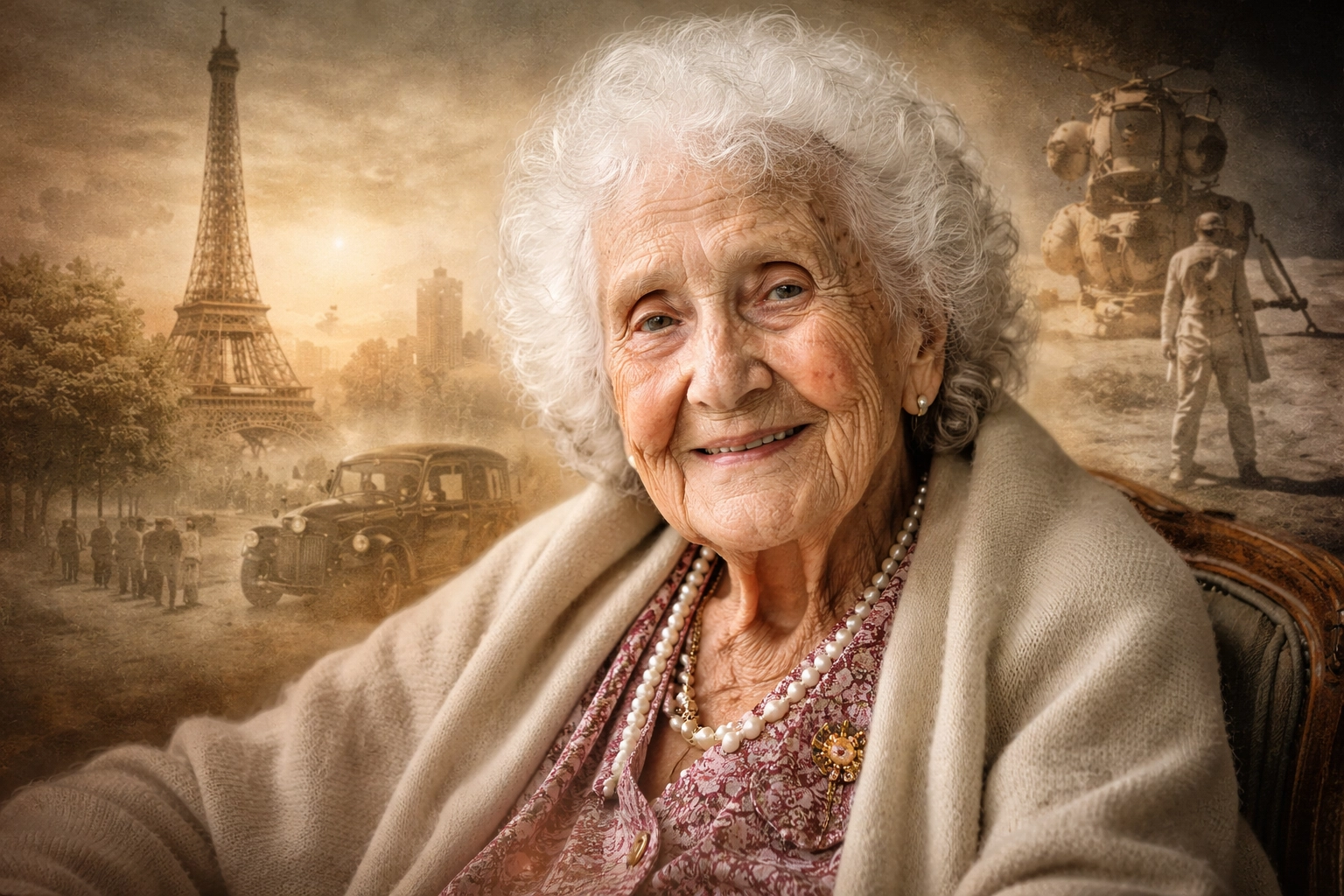
Longevity has always fascinated humankind. In every culture, there are stories of elders who seemed to defy time people said to have lived through generations, wars, and revolutions. Yet when it comes to scientifically verified human lifespan, only one name stands clearly above all others: Jeanne Calment of France, who lived to the remarkable age of 122 years and 164 days.
Born in 1875 in the southern French town of Arles, Jeanne Calment entered the world when telephones were rare curiosities and the Eiffel Tower had not yet been built. By the time she passed away in 1997, humanity had walked on the Moon and entered the digital age. Her life spanned three centuries the 19th, 20th and a glimpse of the 21st in spirit making her not only the longest-lived verified human but also a living bridge across extraordinary eras of change.
What makes Calment’s age stand apart is not just its magnitude, but its meticulous verification. Demographers and gerontologists scrutinised birth records, census data, marriage documents and historical registries. Her case has been studied extensively because claims of extreme age are common around the world, yet rarely backed by reliable documentation. In Calment’s case, the paper trail was clear and consistent, leaving little room for doubt.
Her longevity has often been attributed to a combination of genetics, lifestyle and environment. She remained physically active for much of her life, reportedly riding a bicycle into her 90s. She enjoyed simple pleasures of olive oil in her diet, moderate wine consumption, and daily routines that included social interaction and humour. Though such details are sometimes romanticised, they highlight a broader point: longevity is not the result of a single miracle habit, but rather a web of biological and social factors.
Scientists caution against treating her life as a formula for replication. Not everyone who follows a Mediterranean diet or stays socially engaged will reach 120. Exceptional longevity appears to depend heavily on rare genetic advantages, combined with favourable environmental and lifestyle conditions. Even among those who live past 100, reaching beyond 110 is extraordinarily uncommon.
What Jeanne Calment’s life truly represents is the outer known boundary of human lifespan. It offers a glimpse into how resilient the human body can be under optimal conditions, but it also reminds us that such longevity remains an exception, not a norm. Despite advances in medicine and living standards, very few people even approach 110, and fewer still surpass it.
Her story also invites reflection beyond biology. To live 122 years is to witness profound transformation, technological revolutions, social shifts, and the reshaping of nations. Longevity at that scale is not merely about survival, but about continuity, memory and perspective.
Jeanne Calment’s record still stands today, untouched. In a world where scientific frontiers are constantly expanding, her lifespan remains a quiet benchmark, a reminder of both the remarkable potential and the natural limits of human life.
Subscribe Deshwale on YouTube


