










The Games That Almost Never Happened
There is a 16-year-old boy from Raipur named Tikeshwar Dhruv. He comes from a family of modest means. He has no access to a professional gym and no scholarship letter in his father’s hands. What he has is a body he has disciplined through years of self-directed training, and today, he walks into the 60 kg weightlifting arena at the inaugural Khelo India Tribal Games, representing Chhattisgarh on a national stage for the very first time.
Tikeshwar’s story is not exceptional. It is the story. And as India’s first-ever Khelo India Tribal Games 2026 officially open in Chhattisgarh on 25 March and run until 6 April, there are thousands of stories just like his, stories that have waited far too long to be told.
India has been running the Khelo India Games in various formats since 2018. It began as a youth sports festival, expanded to include university games, and then slowly began addressing the gaping hole at its centre: the near-total absence of organised competitive sport for communities that make up roughly 8.6 per cent of India’s population but represent a disproportionately large share of its raw sporting talent.
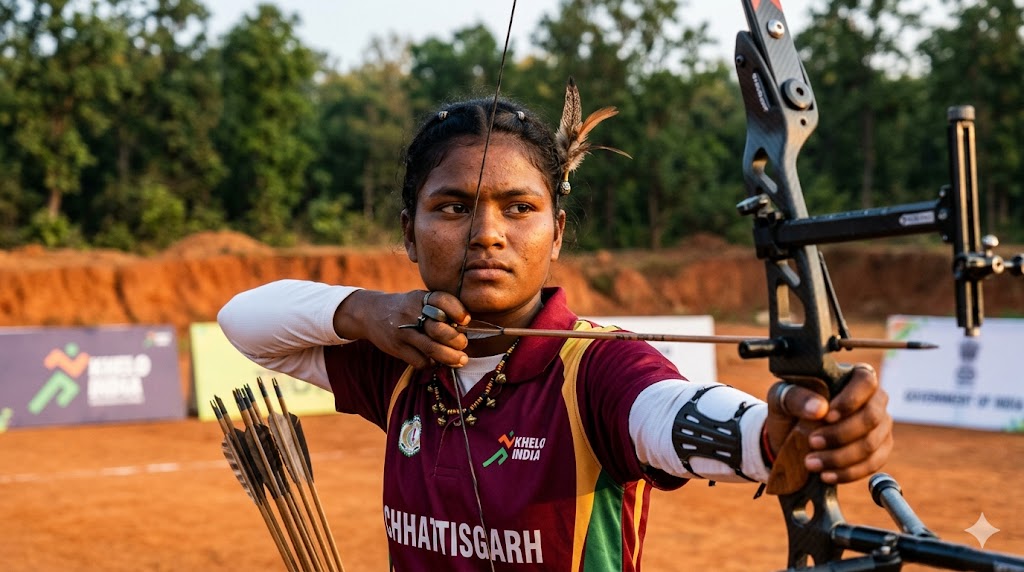
The inaugural Khelo India Tribal Games 2026 is the formal acknowledgement of that gap. Over 2,300 athletes drawn from these communities across the country are competing across three host cities – Raipur, Jagdalpur and Surguja – in seven sports: athletics, archery, football, hockey, swimming, weightlifting and wrestling. Mallakhamb and kabaddi have been included as demonstration sports, a nod to indigenous physical traditions that have never quite found their place in the mainstream competitive calendar.
The event is jointly organised by the Ministry of Youth Affairs and Sports, the Sports Authority of India, the Indian Olympic Association, and the Chhattisgarh state organising committee. The mascot, named Morveer – combining the Chhattisgarhi words for “ours” and “brave” – is a small but deliberate signal. This Games belongs to those it serves. Whether it delivers on that promise over the next twelve days and, more importantly, in the years that follow, is an entirely different question.
The Numbers Behind the Silence
Start with geography. Chhattisgarh alone has a population exceeding 32 per cent classified under Scheduled Tribes. Jharkhand, which gave India Deepika Kumari and Nikki Pradhan, has a corresponding figure of 26 per cent. In the north-eastern states like Meghalaya, Mizoram and Nagaland, the numbers exceed 80 per cent. These regions have consistently produced athletes who go on to represent India at the highest levels. The connection is not incidental. It is structural.
These communities have historically engaged in high-intensity physical activity as part of daily life: farming, hunting, river navigation, and traditional martial disciplines. The physical baseline tends to be high. What has been systematically absent is the institutional bridge: coaching access, nutritional support, competitive exposure, and a clear pathway into the federation ecosystem. For every Dipa Karmakar who reached Rio, there are hundreds who never found the door. Some of them never even knew there was a door to find.
The KITG is, at its most fundamental level, an attempt to build that door. The scale of the event – over 6,000 participants across three cities in a single state – suggests genuine ambition rather than tokenism. The selection of Chhattisgarh as host carries its own logic. Bastar has produced archers who compete credibly at national level. The Surguja belt has developed a wrestling culture that most sports desks in India have never bothered to cover. The football programmes in Jagdalpur have been building grassroots infrastructure quietly for nearly a decade, with very little external attention or funding.
The Word “Tribal” and the Damage It Has Done
Here is where the sociologist must sit with some honest discomfort, because this story begins with a word that was never ours to begin with.
The term “tribal” was introduced into the Indian subcontinent by European colonisers, primarily through the administrative machinery of the British Raj. It was a classificatory instrument, designed not to describe communities on their own terms but to sort them within a colonial hierarchy that placed settled, revenue-generating, English-educated populations at the top and forest-dwelling, non-Christian, non-literate communities at the bottom. The word carried the explicit assumption of primitiveness. It was not neutral. It was never neutral.
What is more troubling is what happened after 1947. The Anglicised brown élite that inherited the apparatus of the Indian state retained the term almost without debate. The constitutional categories of Scheduled Tribes were administratively necessary for protective legislation, and that protective intent was genuine. But the word “tribal” came bundled with its colonial baggage and was absorbed wholesale into the vocabulary of the new republic, by policymakers, academics, journalists and civil society alike. India’s intellectual class, educated in English and instinctively deferential to colonial frameworks of knowledge, did not interrogate the terminology with the seriousness it deserved.
The consequences have been real. Communities with sophisticated governance systems, deep astronomical knowledge, established trade networks, and extraordinarily rich artistic traditions have spent seventy-five years being described through a word that implies the absence of civilisation. The Gond, the Santali, the Bhil, the Munda, the Khasi – these are not “tribal” peoples in the dismissive colonial sense. They are communities with long and complex histories that predate the colonial encounter by centuries. The official retention of the word has, in many ways, done more harm to their standing in the national imagination than any single policy failure.
The Khelo India Tribal Games carries this contradiction in its very title. It uses the official government classification, which is administratively unavoidable, while the communities it serves have always been something richer and more specific than the label permits.
Matriarchy, Agency and the Women Competing Here
Among the most significant aspects of the KITG 2026 is what its women’s categories actually represent in practice.
It is important to say this clearly: many of the communities participating in these Games are deeply matriarchal or strongly matrilineal in their social organisation. The Khasi and Jaintia communities of Meghalaya trace descent through the mother, with property and family name passing through the female line. The Garo follow a matrilineal system in which the youngest daughter inherits family land. Several communities in Chhattisgarh and Jharkhand have long traditions of women occupying central economic and decision-making roles within the household and the community. To frame the women competing at the KITG as having overcome their own communities in order to reach this stage is to misread the social reality entirely.
The obstacles that have faced women athletes from these communities have less to do with internal community attitudes and far more to do with the absence of external sporting infrastructure: coaching programmes that reach their geography, scholarships that arrive on time, competition circuits that are accessible without prohibitive travel costs. A 17-year-old female wrestler from Korba district who competes in Raipur this week has, in most cases, already cleared multiple hurdles of access and logistics. Her community, more often than not, has been behind her rather than against her.
India’s sports system has pockets of genuine excellence when it comes to women from these communities. Boxing from Manipur. Weightlifting from Mizoram. Archery from Jharkhand. These are not accidents. They reflect communities where women’s physical capability and competitive ambition have long been socially validated. The KITG has the structural opportunity to map and build on these existing strengths rather than approaching women’s participation as a problem to be solved.
Policy, Promises and the Problem of Follow-Through
The Government of India has framed the KITG within the broader Viksit Bharat agenda, tying sports development to community empowerment at a policy level. Union Sports Minister Dr Mansukh Mandaviya has spoken of identifying talented athletes early, integrating them into SAI training centres, and building continuity beyond this inaugural event.
These are the right words. The question, as always, is the mechanism.
Consider one number. SAI currently operates 12 regional centres across India. Their locations tell their own story: Chandigarh, Zirakpur, Sonipat, Lucknow, Guwahati, Imphal, Kolkata, Bhopal, Bengaluru, Mumbai, Gandhinagar. Not one of these regional centres sits in Chhattisgarh or Jharkhand, which together account for two of the three highest Scheduled Tribe population concentrations in the country. Odisha, the third, is similarly absent from this list. The infrastructure map and the talent map do not overlap. That gap is not new information. It has simply never been addressed with the urgency it deserves.
India’s sports bureaucracy has a complicated relationship with institutional follow-through more broadly. The Khelo India Youth Games, now in their eighth year, have produced genuine success stories – athletes who moved from KIYG podiums to national squads and international competition. They have also produced a larger number of athletes who peaked at sixteen, received one year of centralised support, and then found themselves without a pathway when they aged out of the youth category or when funding cycles shifted.
The athlete from a forest-edge community faces additional complications worth naming specifically. Scholarship disbursements have a documented history of administrative delay. Travel reimbursements have been caught in paperwork for months. An athlete from Bastar who qualifies for a national training camp but cannot independently cover the cost of a train ticket to Patiala has not failed. The administration has failed that athlete. Getting this right requires infrastructure reform and genuine administrative accountability, not just rhetoric at inauguration ceremonies.
The KITG 2026 will not, in the end, be judged by its opening ceremony or the number of medals distributed. It will be judged by whether the athletes competing in Raipur and Jagdalpur and Surguja this week are still inside the sports system in 2028. That is the only number that actually matters.
Bhaichung and the Longer Memory
Former India football captain Bhaichung Bhutia, himself from a community in Sikkim that falls under the Scheduled Tribes classification, has spoken consistently over the years about the depth of natural athleticism in these populations and the importance of structured programmes to channel it meaningfully. His career, from a school in Gangtok to professional football in England, is the template that most talented athletes of his generation from similar backgrounds were never offered. The ladder existed for him in a way it did not for hundreds of peers who were equally gifted and considerably less fortunate.
Pullela Gopichand has made similar observations about the north-east, where physical conditioning and hand-eye coordination are notably high but coaching infrastructure remains thin and underfunded. The observation is consistent across disciplines and decades: India does not lack talent. It lacks a reliable system for that talent to move through at every stage, not just the first one.
A Short Note on Media
Most major sports desks in India do not have a journalist in Raipur this week. That is honestly a problem and worth saying plainly.
The KITG has six thousand participants from communities with long and distinct sporting traditions, competing with genuine intensity across three cities. It has teenage girls wrestling in Chhattisgarh who have never appeared on any screen. It has archers from the forests of Bastar whose technical skill would embarrass some state-level coaches. It has a story that is simultaneously about sport, identity, language, state capacity and social justice. The coverage it is receiving reflects, with uncomfortable clarity, whose stories the Indian sports media has decided are commercially viable and whose are not.
The Khelo India Tribal Games 2026 is a beginning. It is imperfect, carries the usual bureaucratic weight of a government initiative, and has rough edges that experience will smooth. But it is also, unmistakably, a door that has opened for communities that were handed a diminishing colonial label and managed to build extraordinary lives and cultures in spite of it. Whether Indian sport – its institutions, its media, its federations and its funding structures – chooses to walk through that door alongside the athletes will define what this Games actually turns out to mean.
Tikeshwar Dhruv competes today. The country should be watching.


