










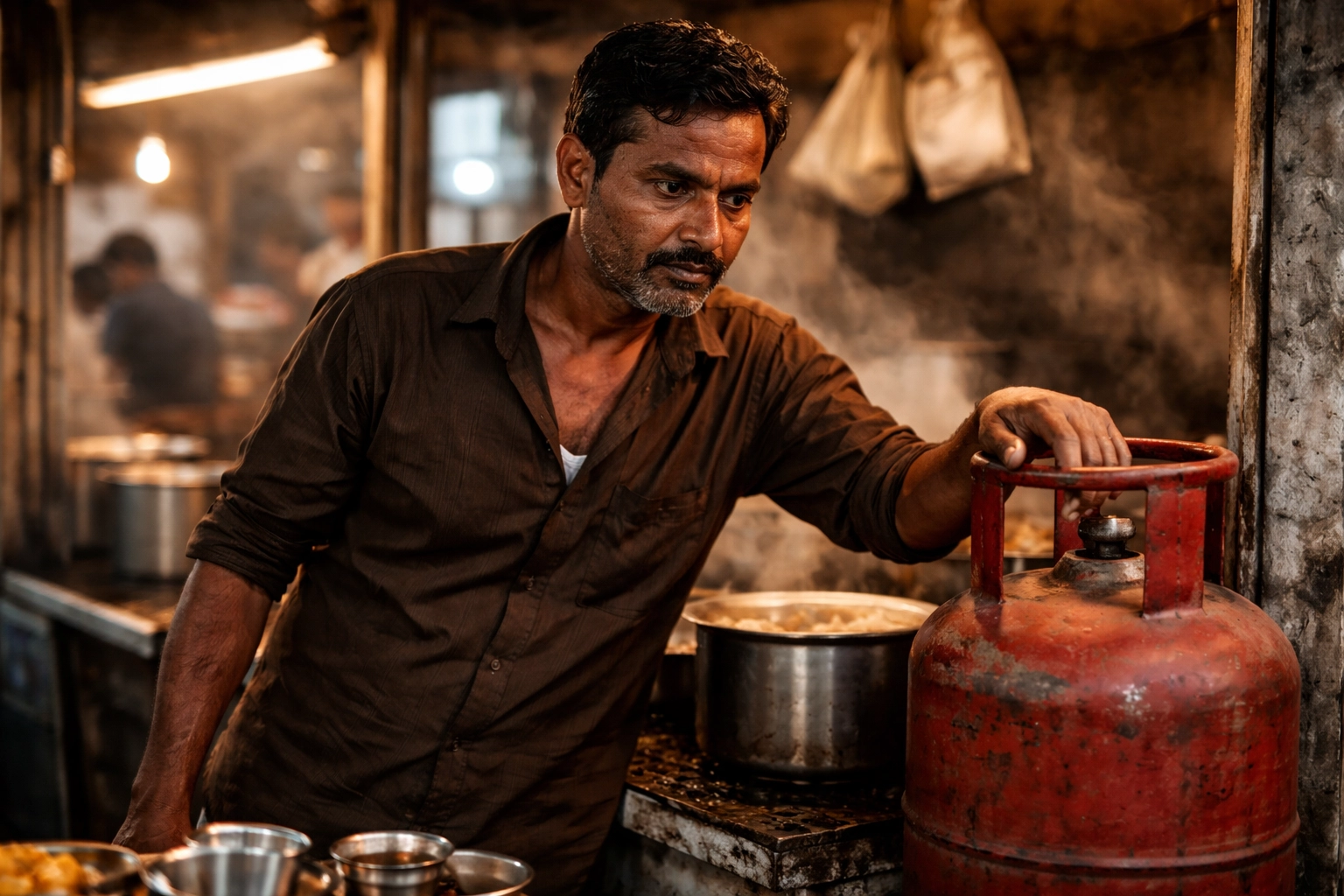
There is an ingredient in every Indian meal that nobody talks about. It is not turmeric. It is not oil. It is not the secret masala that every cook claims is unique to their kitchen.
It is the gas that fires the flame beneath the pan.
For decades, LPG liquefied petroleum gas has been the silent foundation of Indian cooking. It sits in a cylinder behind the kitchen door, taken for granted until it runs out. But right now, across India, that cylinder is becoming expensive enough to change what we eat, where we eat, and how our food is cooked. And most of us have not noticed yet.
The numbers behind the flame
To understand what is happening to Indian food, you first need to understand what has happened to LPG prices.
India imports roughly 60 percent of its LPG requirement. That single fact makes every geopolitical tremor thousands of kilometres away somebody’s problem here at home. When US and Israeli military strikes on Iran triggered the closure of the Strait of Hormuz, a narrow waterway through which nearly 20 percent of the world’s oil supply moves, the shockwave reached Indian kitchens within weeks.
The Saudi Arabia Contract Price, which serves as the international benchmark for LPG, rose by approximately 44 percent between March and April 2026 alone, jumping from US $542 to US $780 per metric tonne. That is not a gradual drift. That is a surge.
The result: on March 7, 2026, domestic LPG cylinders were hiked by ₹60, the first significant increase for household consumers since April 2025. Then, on April 8, came another ₹50 hike. A 14.2 kg domestic cylinder in Delhi, which was ₹803 in late 2024, now costs ₹913. Commercial LPG, the larger 19 kg cylinder used by restaurants, dhabas, tea stalls, and street vendors was hiked by ₹195.50, taking its Delhi price to ₹2,078.50. In Kolkata, the same cylinder now costs ₹2,208.50.
These are not abstract statistics. They are the reason your favourite neighbourhood dhaba quietly raised the price of a plate of dal chawal. They are why the cup of tea that cost ₹10 last month now costs ₹15.
The first thing to go: The menu
When fuel becomes expensive, food businesses do not immediately raise prices. That is the last resort. The first thing they do is shrink.
Menus get quietly trimmed. Dishes that require long cooking times, slow-cooked curries, dum-style preparations, anything that needs a flame burning for an hour or more start disappearing. They are replaced by faster items, simpler preparations, things that can be made with less gas. The restaurant looks the same. The menu board is the same size. But the food it describes is a shorter, cheaper version of what it once was.
This is already happening. In Dehradun and Haridwar, dhabas and roadside eateries confirmed they had cut menu items because of the LPG shortage and price rise. In Punjab, approximately 20 to 25 percent of dhaba operators have increased food prices, while others have reduced what they offer to survive. A survey by LocalCircles, covering responses from 309 districts across India, found that 57 percent of urban consumers noticed food price hikes between 10 and 50 percent at restaurants. At street vendors, 54 percent of respondents noticed hikes of up to 25 percent.
A full meal at a working-class dhaba that cost ₹60 to ₹70 now costs ₹85 to ₹90 in several cities. For a daily wage worker who eats out for every meal, that is not a minor inconvenience. That extra ₹20 or ₹25 a day, every day, across a month, becomes a hole in the budget that does not close.
When the gas runs out, the wood comes back
Here is the part of this story that is rarely told because it sounds almost too dramatic to be real.
Across Dehradun, Haridwar, and parts of Punjab, dhabas and small eateries that could not afford the commercial cylinder prices or could not get supplies at all did something that India had largely moved away from over the past two decades. They went back to wood-fired stoves. Some switched to coal. Some began using induction cooktops. One Maggi point vendor in Dehradun told reporters that he was cooking on a wood-fired stove but still could not keep up with orders. Customers were leaving without food.
In Hyderabad, hotel and restaurant owners were reportedly paying ₹3,000 to ₹5,000 per cylinder on the black market just to keep their kitchens running three to five times the official commercial rate.
This is what a fuel crisis looks like when it enters a kitchen. It does not announce itself. It shows up as a longer wait for your food, a simpler dish than you expected, a slightly different taste you cannot quite place.
Because here is what nobody tells you about wood fire versus LPG: the food tastes different. Temperature control changes. Cooking time changes. The texture of a roti made on a tawa heated by wood is not the same as one made on an LPG flame. The quality of a gravy slow-simmered on coal is not identical to one made on a gas burner. The invisible ingredient changes. And so does the dish.
The Swiggy and Zomato effect
The LPG crisis has not stayed inside the walls of physical restaurants. It has entered your phone screen too.
Ghost kitchens delivery-only food businesses that power a significant share of Swiggy and Zomato orders run almost entirely on commercial LPG. They have no dine-in revenue to offset rising costs. Every rupee increase in the commercial cylinder price hits them directly. Restaurant owners have confirmed they will pass these costs on to customers. In some cities, food delivery platforms have already seen temporary closures of listed restaurants not because the business has shut down permanently, but because the owner cannot source LPG at a price that makes cooking viable.
Zomato has also recently increased its platform fee by nearly 19 percent per order. When that is combined with rising restaurant prices driven by LPG costs, the total bill for a home-delivered meal has climbed significantly without the customer necessarily knowing why.
The people who feel it most
Every price crisis has a hierarchy of pain. The people at the top, those who eat at air-conditioned restaurants, who order from premium delivery apps, who cook at home on subsidised domestic cylinders feel it least and last.
The people who feel it first and hardest are at the bottom. The daily wage worker who cannot cook at home and depends entirely on the ₹70 dhaba meal. The migrant labourer is eating in a tent near a construction site, where the tea vendor has quietly added ₹5 to every cup. The small street food vendor who has to choose between absorbing the higher cost and eating the loss or raising prices and watching customers walk away.
In Punjab, a daily wager named Chandan Kumar put it simply: an extra ₹20 to ₹25 per meal, every single day, is real money for someone earning daily wages. It is not an abstraction. It is fewer rupees to send home at the end of the month.
Meanwhile, the workers inside these struggling restaurants are feeling it too. As establishments cut back on operations, reduce cooking hours, and serve fewer items, the helpers, cooks, and assistants who work in them are seeing reduced hours and, in some cases, losing their jobs entirely.
The bigger picture India is not asking
India’s relationship with LPG is both a public health success story and a structural vulnerability that has never been properly addressed.
The Pradhan Mantri Ujjwala Yojana brought clean cooking fuel to over 10 crore households across rural India replacing wood and coal with LPG and reducing the health damage caused by indoor smoke. It was a genuine achievement. But it also meant that India built an enormous dependence on a fuel it does not produce enough of domestically. Importing 60 percent of your LPG needs means that every war, every sanctions regime, every Strait of Hormuz closure, every shift in Saudi Arabia’s pricing becomes a kitchen problem in Patna, Ludhiana, and Chennai.
The government has shielded domestic consumers to a significant degree absorbing enormous losses to keep household cylinder prices stable even as international prices surged. Oil Marketing Companies reportedly absorbed losses of ₹40,000 crore to protect domestic consumers from the full weight of global price increases. But commercial LPG, the fuel that feeds public eating, has not received the same protection. And it is commercial LPG that feeds the millions of Indians who cannot cook for themselves.
What your food is quietly telling you
The next time you sit down at a dhaba and notice the menu has fewer options. The next time your Zomato order costs a little more than it did last month. The next time a cup of tea tastes slightly different and you cannot explain why.
It is not your imagination. It is not a coincidence.
It is the invisible ingredient, the fuel that was always there, always assumed, always taken for granted quietly making its presence felt in the only way it knows how.
Not through headlines. Not through formal announcements. But through a plate that costs a little more. A dish that takes a little longer. A taste that is just slightly off from what you remembered.
LPG is not listed on any menu. You will not find it in the ingredients section. No cook will mention it when they describe what makes their food special.
But right now, in kitchens across India, it is the ingredient that matters most. And we are only just beginning to understand what happens when we cannot afford it.
Subscribe Deshwale on YouTube


