



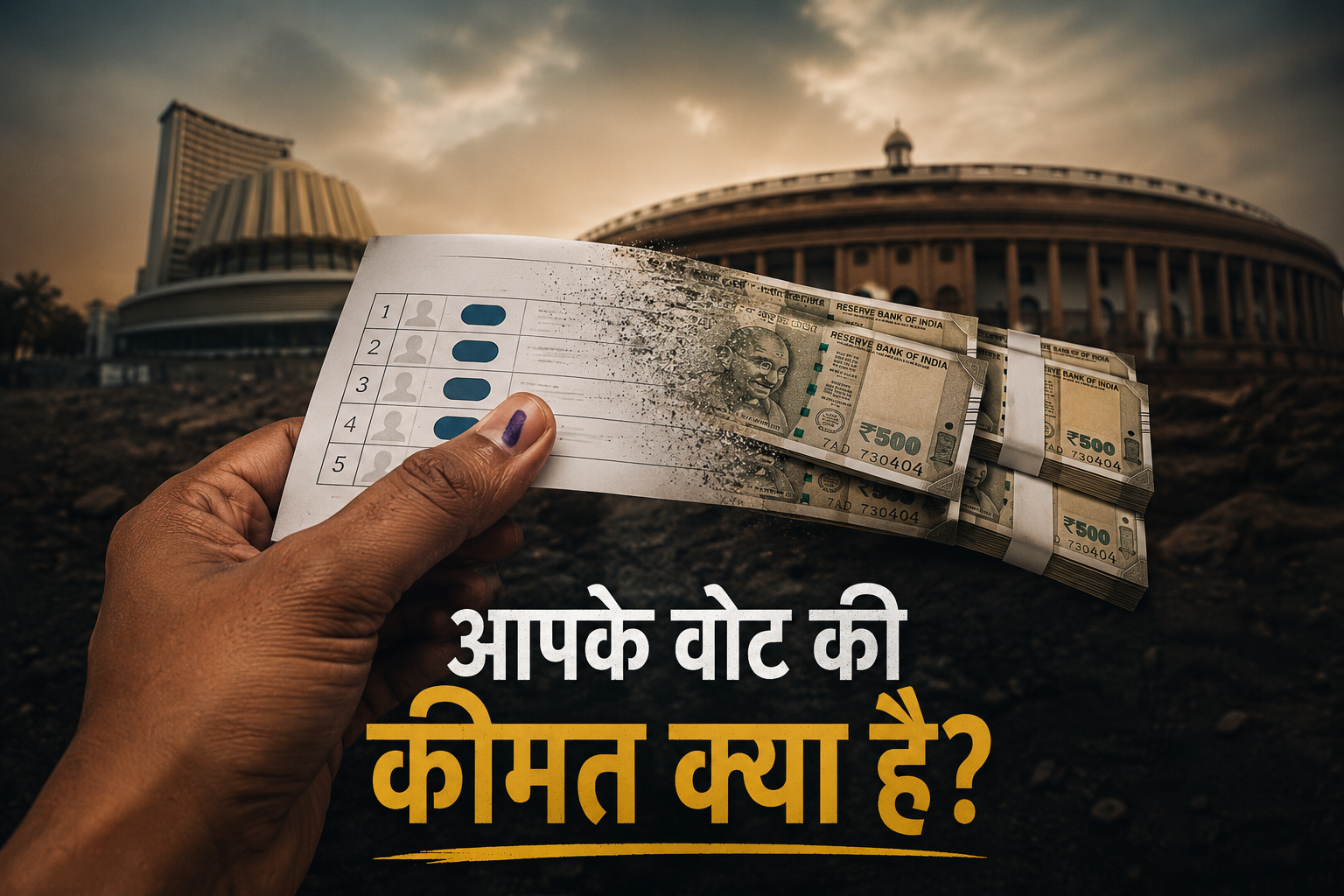
When a lawmaker you voted for allegedly switches sides for money, the real question is not about politics it is about what your ballot means.
In the early hours of Wednesday, June 17, something unusual was happening in Delhi. Six Lok Sabha MPs from Uddhav Thackeray’s Shiv Sena (UBT) , a party that fought hard to win those seats just two years ago had quietly boarded flights to the national capital. By morning, reports were circulating that they had met Maharashtra Deputy Chief Minister Eknath Shinde. By afternoon, the entire state of Maharashtra was asking the same question: what exactly were these MPs offered to walk away from the party that brought them to Parliament?
Sanjay Raut, the outspoken Rajya Sabha MP and the loudest voice in the UBT camp, did not hold back. He alleged on social media that each of the six MPs was being offered Rs 15 crore to switch sides. When Trinamool Congress MP Mahua Moitra responded sarcastically noting that the TMC’s own defecting MPs had reportedly received less, Raut fired back with a line that has since gone viral. He wrote that the ‘Minimum Support Price’ for an MP in Maharashtra has been fixed at Rs 50 crore, with Rs 15 crore being merely the advance payment.
It was intended as a sharp political jab, and Raut is known for those. But underneath the wit, there is a deeply uncomfortable question that every voter in Maharashtra should be sitting with right now.
The person you voted for did they ever plan to stay?
The six MPs reportedly at the centre of this episode Omraje Nimbalkar, Nagesh Patil Ashtikar, Sanjay Deshmukh, Sanjay Jadhav, Sanjay Dina Patil, and Bhausaheb Wakchaure were all elected to the Lok Sabha in 2024 on the Shiv Sena (UBT) symbol. Voters in their constituencies cast their ballots for them as part of the opposition Maha Vikas Aghadi alliance. They were sent to Parliament to represent a specific political ideology and a specific constituency of people.
If these MPs do formally switch sides and align with the ruling NDA, those voters get no say in that decision. There is no by-election. There is no referendum. The seat stays with the MP, not with the people who put them there. This is the quiet injustice at the heart of every defection story in Indian politics, and it rarely gets the attention it deserves.
This is not the first time and that is the problem
Shiv Sena was founded by Bal Thackeray on June 19, 1966 a party built on fierce loyalty and Marathi pride. For decades, the image of a Shiv Sainik was one of unshakeable devotion to the Thackeray name. That image was shattered in June 2022, when Eknath Shinde led a rebellion of more than 40 MLAs out of the party, toppling Uddhav Thackeray’s government. Shinde subsequently became Maharashtra’s Chief Minister, a post he held until December 2024, after which he was sworn in as Deputy Chief Minister under Chief Minister Devendra Fadnavis. In that transition, his faction also walked away with the party name and the ‘bow and arrow’ symbol.
That 2022 split was Maharashtra’s political earthquake. But what is now being called ‘Operation Tiger’ the alleged attempt to peel away UBT’s Lok Sabha MPs suggests that the aftershocks have not stopped. What is striking is the timing: this is unfolding just days before June 19, the 60th foundation day of the original Shiv Sena. The symbolism, intentional or not, is brutal.
The UBT camp has pushed back strongly. Arvind Sawant, the party’s parliamentary leader, wrote to Lok Sabha Speaker Om Birla on Wednesday, urging him not to recognise any rebel faction. He invoked the Tenth Schedule of the Constitution commonly known as the anti-defection law, warning that any MP who switched sides without a formal party merger could face disqualification proceedings.
The allegations what has been claimed, and what has not been proved
It is important to be clear here. The allegations of money changing hands come from Sanjay Raut, a political opponent with his own motivations to frame this story in the most damaging way possible. No independent evidence of financial transactions has been presented publicly. Shiv Sena, the Shinde faction, has denied engineering any defection. As of Wednesday, no MP has formally announced switching sides.
Raut also alleged that one MP, Omraje Nimbalkar, had been offered legal assistance in connection with a personal criminal case, a charge that is particularly serious if true, and equally serious to make without evidence. These claims are in the public domain, but they remain allegations.
What is not in dispute is that six UBT MPs travelled to Delhi, that Shinde was in the same city that night, and that the UBT leadership responded with enough alarm to immediately write to the Speaker.
When defection becomes routine, democracy pays the price
The exchange between Raut and Moitra, two opposition MPs casually comparing the going rate for a defecting legislator would be funny if it were not so disturbing. When senior politicians from different parties can publicly joke about the ‘minimum support price’ of an elected representative, it tells you something about how normalised this has become.
India’s anti-defection law, introduced in 1985 through the Tenth Schedule, was designed specifically to stop this. However, there is a loophole: if two-thirds of a party’s legislators merge with another party, it is considered a legal merger rather than defection. In 2022, Shinde’s camp used legislative majority strength to successfully claim the original party name and symbol before the Election Commission, a move that remains contested in the Supreme Court. The UBT now fears a similar playbook is being used again, this time in Parliament.
But laws, however well-written, cannot fix a political culture. A voter in Parbhani or Dharashiv who elected an MP on the strength of their party’s promises cannot go to court to demand that their representative stay loyal. The system relies on conscience and conscience, as Raut’s sardonic remark suggests, appears to have a market rate.
As of Wednesday evening, the situation remained fluid. The UBT leadership held a press conference projecting unity. Some MPs reportedly in Delhi denied any plan to switch sides. The Speaker’s office had not responded publicly to Sawant’s letter.
Whether ‘Operation Tiger’ results in an actual split or collapses under legal and public scrutiny remains to be seen. What is already real, however, is the damage to public trust, the feeling that elected representatives are players in a game whose rules have nothing to do with the people who voted for them.
Sanjay Raut meant his ‘₹50 crore MSP’ line as a punchline. But for the ordinary voter in Maharashtra, there is nothing funny about it. Their vote, cast in good faith, apparently has a price and they are the last to know what it is.
Subscribe Deshwale on YouTube
