










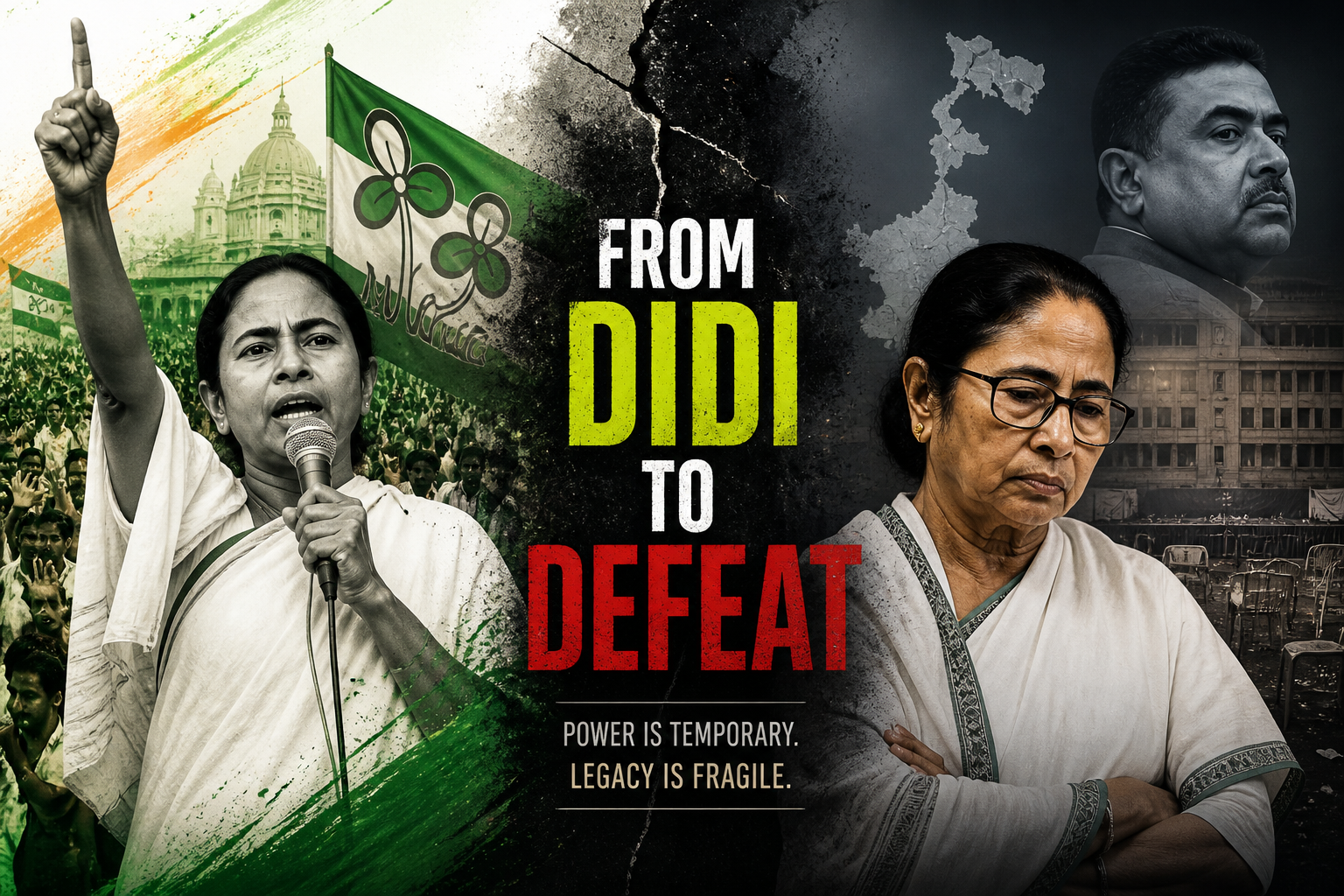
She toppled a dynasty, built an empire, and then lost everything — including her own seat — to the man she once called her loyalist.
1984: The rebel rises
1998: TMC is born
2011: Left ousted
2016–21: Empire expands
2024: Cracks appear
2026: The fall
From Kalighat to the corridors of power
Mamata Banerjee was born on January 5, 1955, in a modest lower-middle-class home in Kalighat, south Kolkata. Her father, Promileswar Banerjee, was a freedom fighter. Her mother, Gayatri, was the backbone of the family. She was not born into privilege, she was born into anger, and she never stopped being angry.
She joined the Indian National Congress in the 1970s and rose quickly. By 1976, she was General Secretary of the Mahila Congress, the Women’s Wing of the party for West Bengal, a position she held until 1980. In 1984, she delivered her first great shock to the political establishment: she stood from Jadavpur, a CPI(M) stronghold, and defeated the party’s heavyweight barrister Somnath Chatterjee. She was 29. No famous surname, no inherited base, no political godfather. She won anyway.
The Left retaliated; she was physically beaten by Left Front workers in 1990. She did not retreat. After more than 26 years in the Congress, she broke away in 1998 and founded the All India Trinamool Congress. The name meant “grassroots.” The intent was revolution.
The hunger strike that broke the Left
The moment that truly made Mamata unstoppable came in 2006. The Left Front government had struck a deal with Tata Motors: nearly 1,000 acres of farmland in Singur would be acquired to build the Tata Nano plant. For displaced farmers, it was a catastrophe. For Mamata, it was a cause.
On December 3, 2006, she went on an indefinite hunger strike. She sat in protest for 26 days through the Kolkata winter, until President APJ Abdul Kalam and Prime Minister Manmohan Singh personally appealed to her to stop. On October 3, 2008, Ratan Tata announced the plant was leaving Bengal for Sanand, Gujarat. The Left had blinked. Mamata had not.
Simultaneously, violence in Nandigram where the government was trying to acquire 10,000 acres for a special economic zone had turned public opinion decisively against the CPI(M). A key organiser of that resistance was Suvendu Adhikari, a trusted TMC leader. He and Mamata were building their future together.
“She sat for 26 days through the Kolkata winter. The President called. The Prime Minister called. She still did not move.”
2011: The earthquake
In May 2011, Bengal delivered its verdict. The Left Front which had governed West Bengal for 34 unbroken years since 1977 was swept out. TMC won 184 seats; the full alliance took 227 of 294. On May 20, 2011, Mamata Banerjee was sworn in as Chief Minister, the first woman ever to hold that office in West Bengal.
The early years were genuine. Welfare schemes like Kanyashree for girls’ education and Sabuj Sathi free bicycles for students reached millions. She wore cotton saris and rubber slippers. She wrote poetry. She answered calls from ordinary citizens. For a state tired of Left machinery, Didi felt like sunlight.
She won again in 2016 with 211 seats, and again in 2021 with 215. The numbers were extraordinary. So was the rot quietly spreading beneath them.
The man she trusted and lost
Suvendu Adhikari had been with Mamata since TMC’s founding year of 1998. He became Transport Minister in 2016. On November 27, 2020, he resigned from that post. On December 17, 2020, he resigned from the TMC itself and joined the BJP at a rally addressed by Amit Shah.
In the 2021 elections, Mamata chose to contest from Nandigram Adhikari’s own stronghold to confront him directly. It was meant to be a humiliation. Instead, she lost by 1,956 votes. TMC won the state overall, and she was sworn in as Chief Minister after winning the Bhabanipur by-election. But the wound from Nandigram never healed.
2024: The year the mask slipped
On August 9, 2024, a trainee doctor was found raped and murdered at RG Kar Medical College and Hospital in Kolkata a government institution under Mamata’s own Health Ministry. The protests that followed were unlike anything Bengal had seen in years. The victim’s mother publicly accused Mamata of lying. When the Chief Minister urged protesters to “return to festivities” ahead of Durga Puja, the backlash was savage. The image of a leader who had built her identity on fighting for the vulnerable now asking women to stop demanding justice was politically lethal.
2026: The reckoning
Bengal voted on April 23 and 29, 2026, with a historic turnout of 92.93% the highest ever in the state. The results on May 4 were seismic. BJP won 206 seats. TMC was reduced to roughly 78. Mamata Banerjee lost Bhabanipur to Suvendu Adhikari by over 15,000 votes. The man she had trusted, lost, confronted, and been wounded by beat her again, this time in her own home.
Fifteen years of unbroken rule ended not with a whisper but with a roar. She was 71. She had fought for over four decades. And in the end, she was brought down not by a faceless wave, but by the accumulation of her own choices, corruption allowed to fester, dissent silenced, loyalty confused with entitlement, and a state’s patience finally exhausted.
That is the shape of a Greek tragedy. The hero does not fall because they were weak. They fall because of who they were taken one step too far.
Subscribe Deshwale on YouTube


