




Power, however immense, must be matched by an equally immense humility. There is an old Gujarati folk line worth invoking here: “Veera mora gajthi hetha utaro”, “Step down from the elephant-ish ego, my brother”, a gentle but firm call to a person of stature to come down off their high perch. That line has rarely felt as apt for Modi as it does at this moment.
Sanjay V. Shah
Je poshtu te martu, or, “That which nourishes can also destroy.” It is an old Gujarati proverb, and it could not be more fitting here.
Narendra Damodardas Modi first became Chief Minister of Gujarat on 7 October 2001. He first became Prime Minister of India on 26 May 2014.
Between those two dates lie 9,058 days. Or, put another way: 24 years, 9 months and 18 days.
For a man who has occupied two of the country’s highest offices, one of them the very highest, bowing to the agitation of a digitally-born outfit like the Cockroach Janata Party, is nothing short of unprecedented. It is one of history’s finer ironies that Modi, who proved better than almost anyone that digital media could be wielded as an unfailing political weapon, should now find himself bending the knee for the first time, and doing so, of all things, because of digital media’s own power.
Buried within this episode is a foundational truth about this government, one important enough to note yet almost certain to be forgotten: this administration does not permit its ministers the relief of resigning to accept moral responsibility. Instead, it compels them or, more charitably, encourages them to stay on, correct course, and carry on working.
Across this long stretch in power, Modi, together with Amit Shah, has consistently done precisely what he judged fit. The public has accepted his decisions, sometimes with genuine enthusiasm, sometimes simply for want of an alternative.
Through all this, an opposition that has proved rudderless and feeble, consistently outmanoeuvred by Modi on strategy, has rarely managed to sound a battle-horn of any consequence. A robust and effective opposition is as vital to a democracy as a strong government. Under present circumstances, that is simply not on offer. The BJP does not even command a majority in the Lok Sabha today and still, the opposition has failed to extract any advantage from that opening.
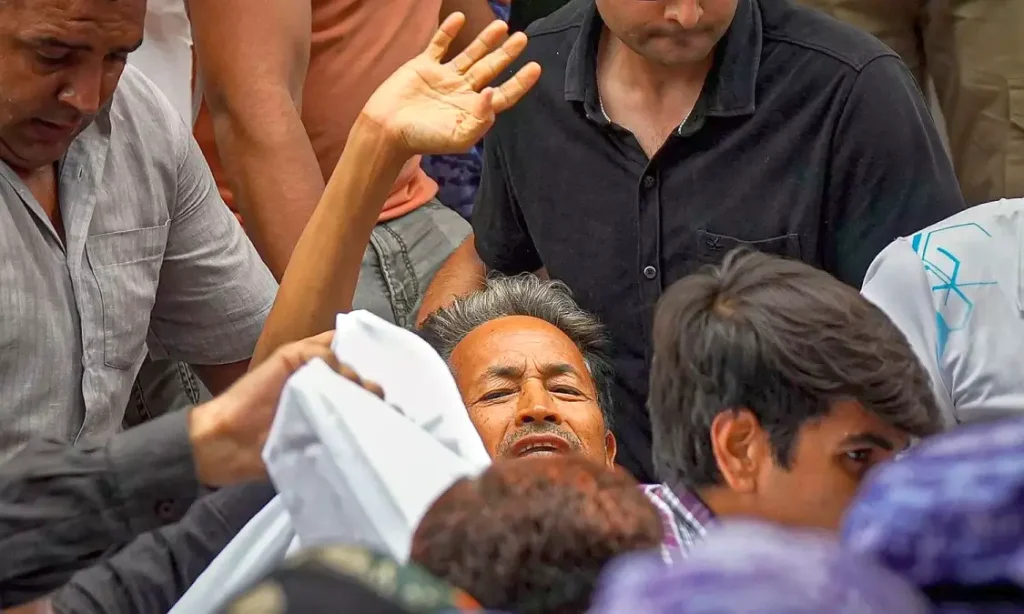
Recall the farmers’ agitation of 2021. For nearly a year, farmers fought against the farm laws. Even then, the government’s response was delayed, and Modi was undoubtedly forced into a policy retreat, but matters never reached the point of a minister’s resignation. That retreat, one suspects, owed something to the assembly elections due in Uttar Pradesh and Punjab in 2022. Whether Punjab would ever have fallen into the Aam Aadmi Party’s lap had the Modi government responded to the farmers’ agitation earlier and more sympathetically remains a question for analysis.
Before that, there was the public fury over CAA-NRC in 2019-20, the outrage over Agnipath in 2022-23, and the explosive situation in Manipur. Never once before did Modi bow.
The BJP, too, has always stood steadfastly behind Modi through it all.
In 2002, after the communal riots in Gujarat, opposition parties’ clamour over Modi’s continuance as the state’s Chief Minister came to nothing. Chandrababu Naidu, today seated comfortably beside Modi, had once glared furiously, demanding Modi’s removal from office. It yielded nothing.
In 2015, during Modi’s first term as Prime Minister, Hardik Patel’s star rose much as Abhijeet Dipke’s has now, confined largely to Gujarat. The euphoric predictions that the Patidar agitation would alter the course of Gujarat’s politics ultimately came to nothing. By 2022, Hardik had simply joined the BJP. That was that.
Before becoming Prime Minister, Modi opposed the GST. He then implemented it with considerable fanfare.
Few have risen from being an ordinary party worker to the nation’s highest office as Modi has. Among the Prime Ministers before him who could claim as clean an image, one might name three: Lal Bahadur Shastri, Morarji Desai and Manmohan Singh. Against Nehru, by contrast, stood the shadows of nepotism, favouritism, the encouragement of the License Raj, and the Haridas Mundhra scandal linked to LIC funds, in which the then Finance Minister, T. T. Krishnamachari, was compelled to resign.
For Modi, even after this long spell in power, a large section of the public (not all are Modi Bhaktas, please note) still says, and still believes, “Modi is simply not corrupt.” For a man who commands that reputation, does this first-ever climbdown offer some hint of what lies ahead?
- Modi may not be corrupt but what of the corrupts around him?
- Modi holds no press conferences, offers no timely, open clarification on public grievances or agitations, and never candidly owns up to his government’s mistakes, what does one make of that? And yet he continues, unfailingly, to broadcast Mann Ki Baat. What are people to make of it?
- No industrialist under Modi’s rule has managed progress on the scale Adani has. Why only Adani has made it and no other industrialist?
- Narendrabhai, tireless, and superbly able to communicate with people of every age, possesses what amounts to a doctorate in digital understanding. Why, then, did he so badly misjudge the potential force of the Cockroach Janata Party’s agitation? Why could he not foresee where a movement that began in June would end up, or how it would shape the thinking of the younger generation and the public mood at large? Or did he see it clearly enough, and choose to ignore it regardless?
- The country needs Modi, certainly for as long as neither the opposition nor the BJP itself produces a leader capable of standing anywhere near him. Given such love and trust from the public, why did Modi go on ignoring people’s movements for so long, almost as though that very trust were itself something to fear?
Assembly elections are due next year in seven states. One of them is Gujarat, where the BJP is so dominant that defeat is all but impossible. It is harder to say the Cockroach Janata Party’s agitation will leave the other states unaffected.
If Modi’s remaining and forthcoming tenure is written in golden letters, the country will only be glad of it. For that, he will need to reconsider his approach to public neglect and the dismissal of people’s movements.
Power, however immense, must be matched by an equally immense humility. There is an old Gujarati folk line worth invoking here: “Veera mora gajthi hetha utaro”, “Step down from the elephant-ish ego, my brother”, a gentle but firm call to a person of stature to come down off their high perch. That line has rarely felt as apt for Modi as it does at this moment.
MODI’S STAGGERING SOCIAL MEDIA FOLLOWING
X (Twitter): 10,96,00,000
Instagram: 10,30,00,000
Facebook: 6,00,00,000
YouTube: 3,11,00,000
LinkedIn: 55,18,108
WhatsApp Channel: 1,53,91,879
Total followers: 32,46,09,987
Note: Of Modi’s followers on X, 10,70,00,000 are on the @narendramodi handle and 26,00,000 on the @narendramodi_in handle. Of the 10,30,00,000 followers on Instagram, roughly 10 lakh were gained following his recent late-night message.
