



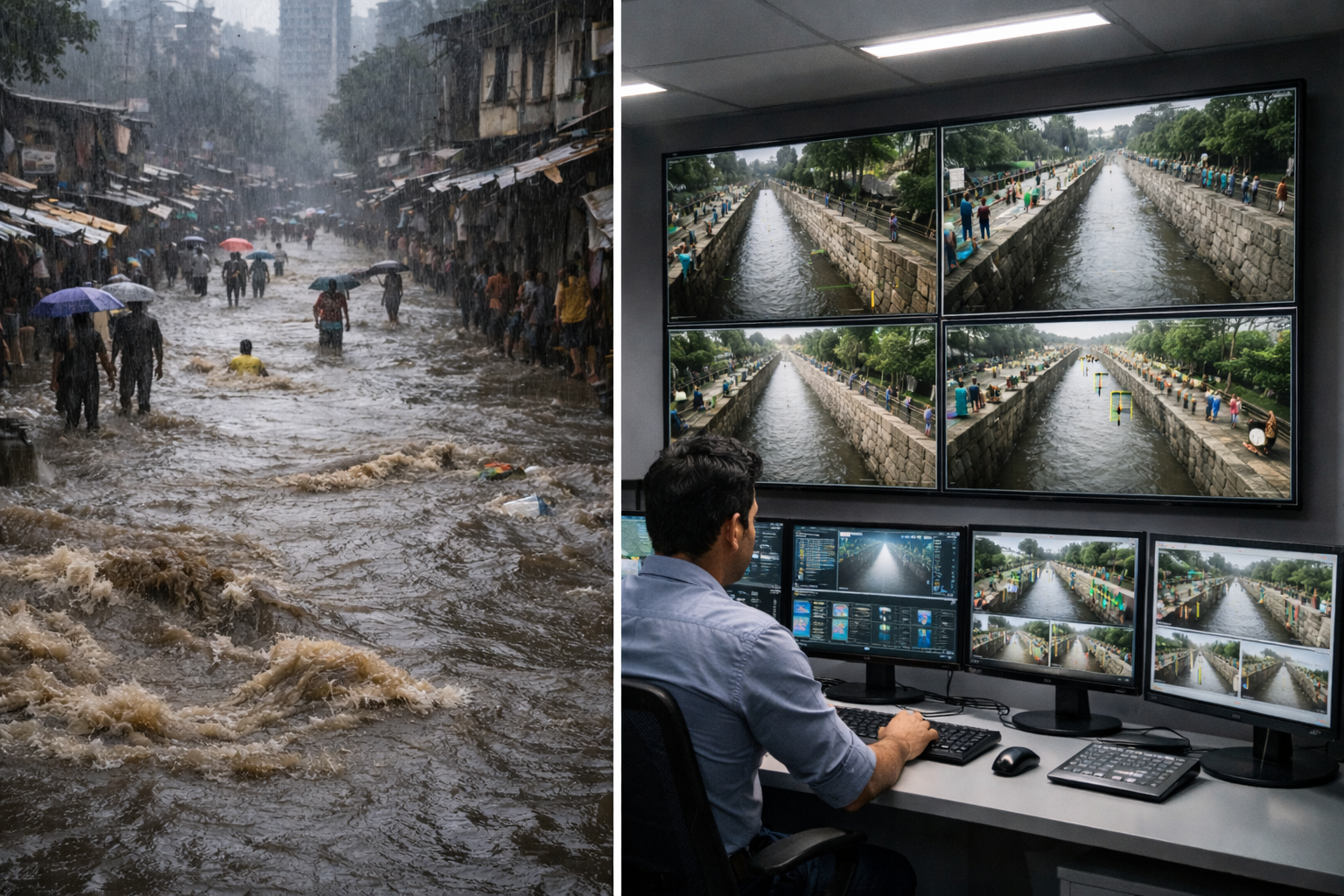
The Brihanmumbai Municipal Corporation does not lack ambition. In its 2026-27 budget, tabled by Commissioner Bhushan Gagrani in late February, India’s richest civic body proposed a record outlay of Rs. 80,952.56 crore. Inside that enormous number sits a smaller, pointed proposal that has drawn sharper attention than most big-ticket allocations: the deployment of AI-enabled video analytics across 1,150 CCTV cameras spread across the city, at an earmarked cost of Rs. 46.67 crore. The plan involves upgrading 500 existing cameras with artificial intelligence and machine learning software while adding 650 new units. The stated goals are to crack down on illegal dumping, open littering, footpath encroachments, waterlogging spots, and overflowing garbage. Live feeds, the BMC has said, will be shared in real time with Mumbai Police and the Maharashtra State Disaster Management Department.
It is, on paper, a compelling shift. In practice, the questions it raises are harder to answer than the technology it promises to deploy.
The Governance Gap This Is Meant to Fix
Mumbai’s civic enforcement problem is not a secret. Walk through Dharavi, Kurla, Malad or Bhandup on any morning and you will find encroachments on footpaths that have existed for years, garbage that has been dumped in the same corner for a decade, and open nullahs choked with solid waste. Ward-level staff have neither the numbers nor, in many cases, the incentive to act. Marshals deployed to check public littering have been a recurring line item in BMC budgets for years, yet the results are visible to anyone who uses the city.
The AI camera proposal frames itself as a corrective. The BMC has acknowledged that it currently lacks even a basic incident alert system, and that the manual monitoring of the city’s sprawling civic landscape has obvious limitations. By using video analytics to automatically detect civic violations and push alerts to ward offices and control rooms, the intent is to close the gap between an offence occurring and a civic response being triggered.
This is a reasonable diagnostic. The problem is that the diagnosis ignores the more stubborn question: why have manual systems failed for so long? Technology can flag a violation. It cannot, on its own, ensure that the ward official who receives the alert acts on it, that the encroachment belongs to a politically inconvenient operator, or that the contractor responsible for waste collection shows up the next morning. Surveillance generates data. It does not generate accountability.
How Does Mumbai Compare?
Other cities have tried this. The lessons are mixed, and worth reading carefully before Mumbai counts on cameras to change behaviour.
Surat is the most directly comparable case in India. The Surat Municipal Corporation has deployed over 3,500 AI-enabled cameras across the city, with an additional 800 operated by the police. Its Integrated Command and Control Centre runs round the clock with over 80 monitoring staff. The AI system detects potholes, waterlogging, and traffic congestion in real time, routes the footage directly to the relevant department, and tracks resolution. What made it work in Surat was not the cameras. It was the enforcement culture behind them. Ward-level officers were held to documented response timelines. The camera data was treated as an accountability record, not just an alert trigger. Without that institutional follow-through, the same system becomes an expensive archive of ignored problems.
Hyderabad built its surveillance infrastructure at an altogether different scale. Its Police Command Centre, which networks over 9 lakh cameras across Telangana and cost Rs. 600 crore to construct, is regularly cited as a benchmark for AI-driven urban governance in India. The city has used facial recognition, traffic rule enforcement, and emergency detection through this network. The infrastructure is genuinely impressive. Whether it has made the city more livable for the average resident in its informal settlements is a more contested question, with civil society groups raising concerns about coverage gaps and the absence of a legal framework governing how long footage is retained and who can access it.
Bengaluru offers perhaps the most instructive parallel for Mumbai, precisely because it illustrates where AI surveillance works and where it quietly stalls. The city’s traffic police deployed AI cameras across 50 key junctions and, by 2025, were detecting 87 per cent of all traffic violations through automated systems, collecting over Rs. 185 crore in fines in a single year. The technology worked because the application was narrow, the enforcement chain was direct, and the outcome was measurable.
But when the Greater Bengaluru Authority attempted to extend a similar AI camera network to detect civic violations such as potholes, garbage dumping, and encroachments, the project was halted over privacy concerns before it could be properly implemented. The lesson is not that civic AI surveillance cannot work. It is that extending cameras from traffic enforcement to broader civic monitoring involves a different set of institutional, legal, and political complications that Bengaluru has not yet resolved and that Mumbai has not yet acknowledged.
Internationally, Singapore’s reputation for urban cleanliness owes far less to its camera network than to a sustained, decades-long culture of enforcement backed by substantial fines and a political consensus that public space belongs to everyone. The cameras supplement a system that was already working. London, by contrast, has one of the densest urban camera networks in the world and is not a particularly clean city. Mumbai, with its density, its informal economy, and the sheer volume of street-level activity, is a more complex environment than any of these comparisons. The question of whether 1,150 cameras can make a city of over 20 million meaningfully cleaner depends entirely on what sits behind the screen.
Disaster Preparedness: The Stronger Case
Honestly, the more credible application for AI surveillance in Mumbai is not catching the man throwing a plastic bag into a drain. It is early warning for the kinds of disasters that kill people.
Mumbai sits at the intersection of multiple hazard categories. Flooding, building collapses in ageing structural stock, high-rise fires, and overloaded drainage infrastructure that gives way during heavy monsoon are all recurring, documented threats. The BMC has proposed using the upgraded camera network to automatically detect fires, building collapses, and water pipeline bursts and alert its Disaster Management Control Room without waiting for a human to notice and report.
This is where the technology makes genuine sense. Early automated detection, even a few minutes faster than a phone call to the ward office, can meaningfully change rescue outcomes. The BMC has also proposed setting up an on-premises data centre and a disaster recovery facility at the City Institute of Disaster Management to ensure the system remains operational when the city is under stress. These are not glamorous announcements, but they are the right ones.
The context makes the proposal more urgent. The BMC’s disaster management department currently depends heavily on MTNL landlines for communication, and nearly 90 per cent of those lines are reportedly non-functional. DMR radios lose coverage in parts of the city. During major emergencies, mobile networks become congested. The civic body is now exploring a satellite-based communication system to fill these gaps. What this means, in plain terms, is that Mumbai is spending Rs. 46.67 crore on AI camera analytics while its disaster communication backbone is largely broken. Both need fixing. Only one is getting done.
The Budget Question Nobody Is Asking Loudly
At Rs. 46.67 crore for 1,150 cameras, including software licensing, AI analytics deployment, installation, and data infrastructure, the per-unit cost works out to roughly Rs. 4 lakh per camera. That figure needs context to mean anything. Delhi’s city-wide CCTV rollout, which put up approximately 2.46 lakh basic cameras across the capital, cost around Rs. 600 crore in total, working out to between Rs. 2,000 and Rs. 2,500 per camera. Mumbai’s cost is exponentially higher, but the comparison is not quite fair. Delhi’s programme deployed standard surveillance cameras without AI analytics layers or associated control room infrastructure. Mumbai’s proposal bundles video analytics software, machine learning processing, a new data centre, and disaster recovery capabilities into a single budget line. That explains some of the cost differential.
What it does not explain is the absence of any publicly available breakdown of how that Rs. 46.67 crore is allocated across hardware, software licensing, installation, and operations. Government-grade AI surveillance contracts in India have a documented history of software licensing fees that escalate sharply after the first year and maintenance agreements that create long-term vendor dependency. Whether this project went through open competitive tendering, who the technology vendors are, and what the five-year total cost of ownership looks like are questions that have not been answered in any budget document released to date. Political opposition has already raised broader concerns about the BMC’s contractor-oriented budget orientation. This specific allocation deserves scrutiny of the same kind.
What Happens to the People Already Doing This Job
This part tends to get skipped in the excitement about technology, so here it is.
The BMC’s sanctioned strength of permanent sanitation workers stands at 28,028, a number that was last formally updated in 1995. Mumbai’s population has grown from roughly 12 million at that time to over 20 million today. The city now generates approximately 6,500 metric tonnes of solid waste every single day. The workforce tasked with managing it has not grown to match. On top of those permanent workers, the BMC employs several thousand contractual sanitation staff whose status has been contested through court battles for three decades.
The civic body has tried human-led enforcement before. It deployed clean-up marshals specifically to check littering in public spaces. That initiative was eventually scrapped after complaints from citizens and questions about its effectiveness. In May 2025, the BMC launched the “Pink Army,” a dedicated team of female sanitation workers assigned to a second round of street sweeping on the city’s busiest roads. The intent was good. But it is a workforce-based response to a problem the new budget now proposes to address with cameras instead.
Nobody at the BMC is formally saying this is an automation exercise. No retrenchments are planned. But when a technology system is deployed to detect exactly what a human workforce has been doing, the internal pressure to stop replacing attrition quietly builds. Telling underpaid sanitation supervisors that cameras now report what they once reported does not motivate better performance. It signals something else entirely.
Cameras Cannot Fix Cause
Here is the thing about Mumbai’s civic chaos that no camera can see: most of it is a downstream consequence of upstream policy failure.
Footpath encroachments exist in such volume because the city’s street vending policy has never been properly implemented. The Street Vendors Act, passed over a decade ago, has produced some town vending committees on paper and very little on the ground. The BMC’s own QR-code certification drive for authorised hawkers, announced in the same 2026-27 budget, is an acknowledgement that the city does not even have a clean database of who is legally allowed to be where. An AI camera that flags an unauthorised vendor is identifying a symptom of that failure, not the failure itself.
Illegal dumping along nullahs and on empty plots persists because waste collection infrastructure in informal settlements is inconsistent, because the city’s solid waste management concession model has chronic compliance gaps, and because residents who have no bin within 500 metres of their home make rational decisions about where their garbage goes. Waterlogging returns every monsoon not because nobody is watching but because the stormwater drainage network is structurally insufficient for the city’s current density and its changed rainfall patterns.
The BMC’s Development Plan, the master planning framework that is supposed to shape how Mumbai grows, has historically been revised, diluted and selectively implemented in ways that concentrate development pressure in corridors where drainage and sanitation infrastructure cannot support it. AI cameras will document the consequences of that planning failure very efficiently. They will not address it.
Mumbai is not a city that lacks documentation of its problems. It has inspectors, reports, ward registers, satellite imagery, and 25 years of newspaper articles about the same overflowing drain in the same neighbourhood. What it lacks is the institutional will and the political environment to act on what is already known.
Whether 1,150 new AI eyes make the city cleaner will depend on whether, this time, someone is actually looking at the screen and empowered to do something about what they see. That is not a technology question. It never was.
Subscribe Deshwale on YouTube
