



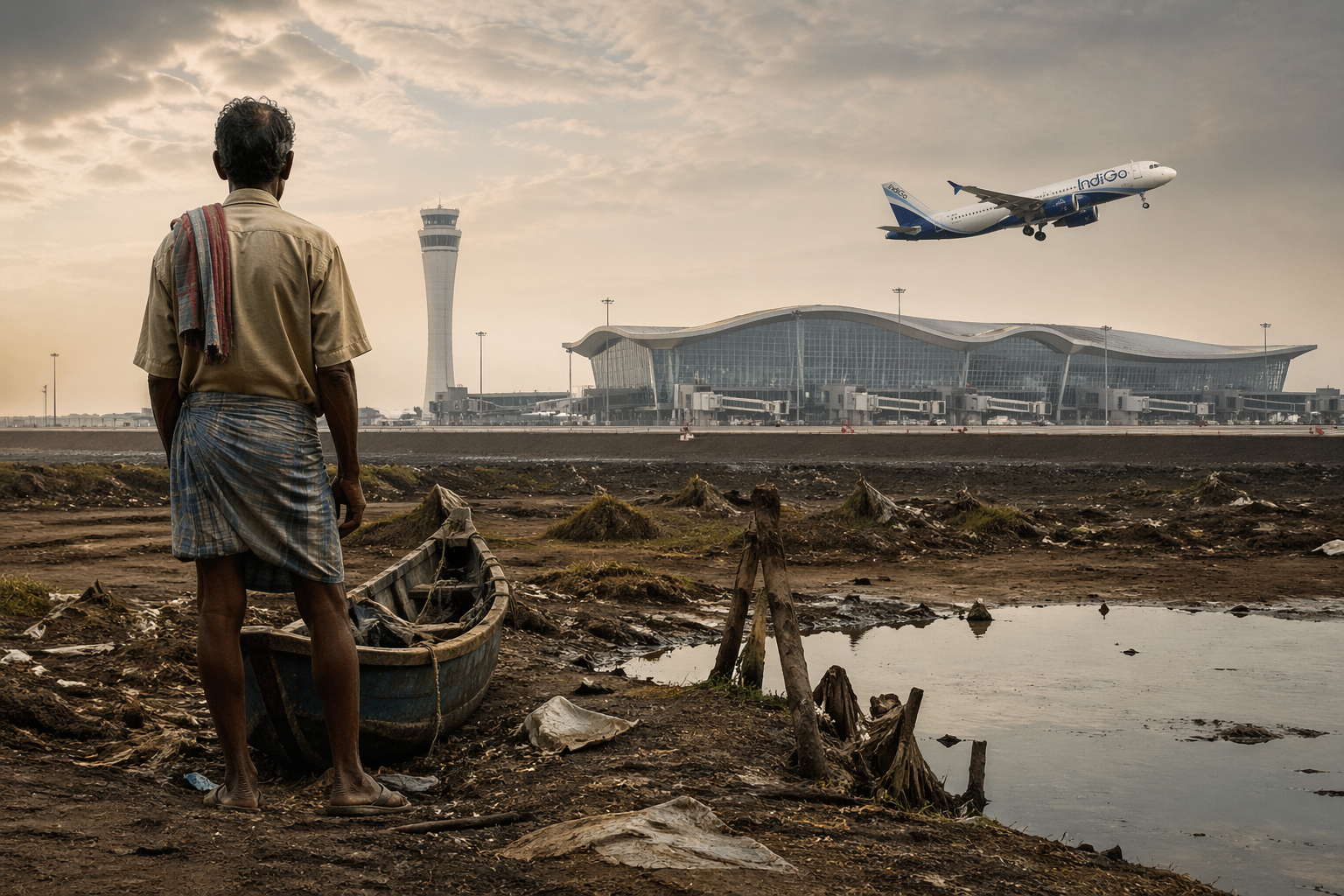
The fishermen and farmers of Ulwe, Targhar and eight other villages sacrificed everything for Navi Mumbai’s gleaming new airport. Four months after its inauguration, many are still waiting for what was promised to them.
On December 25, 2025, an IndiGo flight lifted off from the newly opened Navi Mumbai International Airport (NMIA) a ₹16,700 crore marvel of glass, steel, and Zaha Hadid-designed curves sitting on 1,160 hectares of reclaimed coastline. Somewhere within a few kilometres of that runway, families from the villages of Ulwe, Targhar, Pargaon, Kolhi, Kopar, Ganesh Puri, Chinchpada, Dungi, and Manghar watched the planes cut through the sky above land that, not long ago, was their own.
They had farmed it. Fished the creeks running through it. Buried their dead in it.
Now it belongs to progress.
The land that was taken
The Navi Mumbai International Airport project, first proposed in 1997 and finally approved by the Union government in 2007, required approximately 2,900 hectares of coastal land in the Kopar-Panvel area of Raigad district, around 35 kilometres from Mumbai. The City and Industrial Development Corporation of Maharashtra (CIDCO), the state agency tasked with executing the project, identified around 3,500 families across 10 villages who would need to be displaced to make way for runways, terminals, and airport infrastructure.
Most of these families belonged to the Agri, Koli, and Kradi communities communities whose livelihoods were rooted entirely in the land and the sea. Agriculture and fishing were not just occupations. They were identities. When the land went, so did the way of life built on top of it.
Years of protest, blasting, and broken promises
The road to displacement was neither clean nor quiet.
In November 2017, nearly 2,000 residents from across the affected villages marched in protest, demanding fair compensation and proper rehabilitation before work began. Their grievance was simple: CIDCO had not yet developed the resettlement sites, and they were being asked to leave their homes for land that did not yet exist.
Construction did not wait for them. As explosives were used three times a day to flatten the 90-metre Ulwe Hill which needed to be reduced to just 10 metres for the runway houses cracked from the tremors. In January 2018, a poorly controlled blast triggered a landslide that injured five engineers on-site and sent rocks crashing through the rooftops of nearby homes in Siddharth Nagar. Five women were injured. A seven-year-old boy playing outside his house needed stitches.
The villagers had asked for blasting to stop until they were safely resettled. Their request was overruled. Four platoons of the State Reserve Police were deployed to keep construction moving.
What compensation looked like
CIDCO’s rehabilitation package offered displaced families ₹1,500 per square foot for their land, 18 months of rent, and a developed plot in a newly built township called Pushpak Nagar located near the airport measuring three times the roof area of their old homes, at a Floor Space Index of 1.5. Residents were also entitled to 22.5 percent of developed plots in the Resettlement and Rehabilitation zone.
On paper, it was a package. On the ground, it was contested.
Many families refused to move, pointing out that Pushpak Nagar lacked basic infrastructure, no functioning schools, no streetlights, no crematorium, and no proper roads. In August 2019, villagers filed formal complaints stating that CIDCO had yet to fulfil promises around employment priority, community centres, and professional compensation for the loss of farming and fishing income.
In February 2020, senior state officials, including then Urban Development Minister Eknath Shinde, personally assured residents that compensation would follow a survey to be completed within 15 days. The survey happened. Residents are still counting the years.
By 2022, CIDCO had cleared all 3,070 remaining residents from the project site and handed it over to Navi Mumbai International Airport Limited (NMIAL), now managed by the Adani Group, which had taken over the project from GVK in 2021.
The irony sitting on the horizon
Research conducted on the displaced communities paints a sobering picture. More than 95 percent of respondents from the affected villages reported some form of economic disruption after resettlement. Nearly 30 percent of Agri community members reported joblessness following displacement. Landlessness was a condition virtually unknown to these communities before it became a new, defining reality.
The airport, meanwhile, is designed for a very different kind of person. It features a celebrity lounge with private rooms and white-glove service, an immersive NaviVerse art zone, and a curated food court celebrating Mumbai’s culinary heritage. By the time its final phase opens in the 2030s, NMIA is projected to handle 90 million passengers a year.
The Koli fishermen of Ulwe are not expected to be among them. The average domestic airfare in India today hovers between ₹4,000 and ₹8,000 for a one-way ticket, a sum that represents days or weeks of income for families rebuilding lives with daily wages and uncertain land titles.
A question worth asking
India’s infrastructure ambition is real and necessary. Mumbai genuinely needed a second airport. The old Chhatrapati Shivaji Maharaj International Airport is bursting at its seams, and the country’s aviation sector is among the fastest growing in the world.
But the communities that made this airport physically possible who surrendered their fields, their fishing grounds, their ancestral homes, and in some cases their safety deserve more than a resettlement plot and a promise. They deserve to be visible in the story of what was built on their land.
The runway at Navi Mumbai International Airport is 3,700 metres long. Pushpak Nagar is just a few kilometres away. The distance between them, however, is measured in something other than kilometres.
Subscribe Deshwale on YouTube
