










In Noida’s industrial corridors, the real wage thief isn’t the law it’s the system the law refuses to see
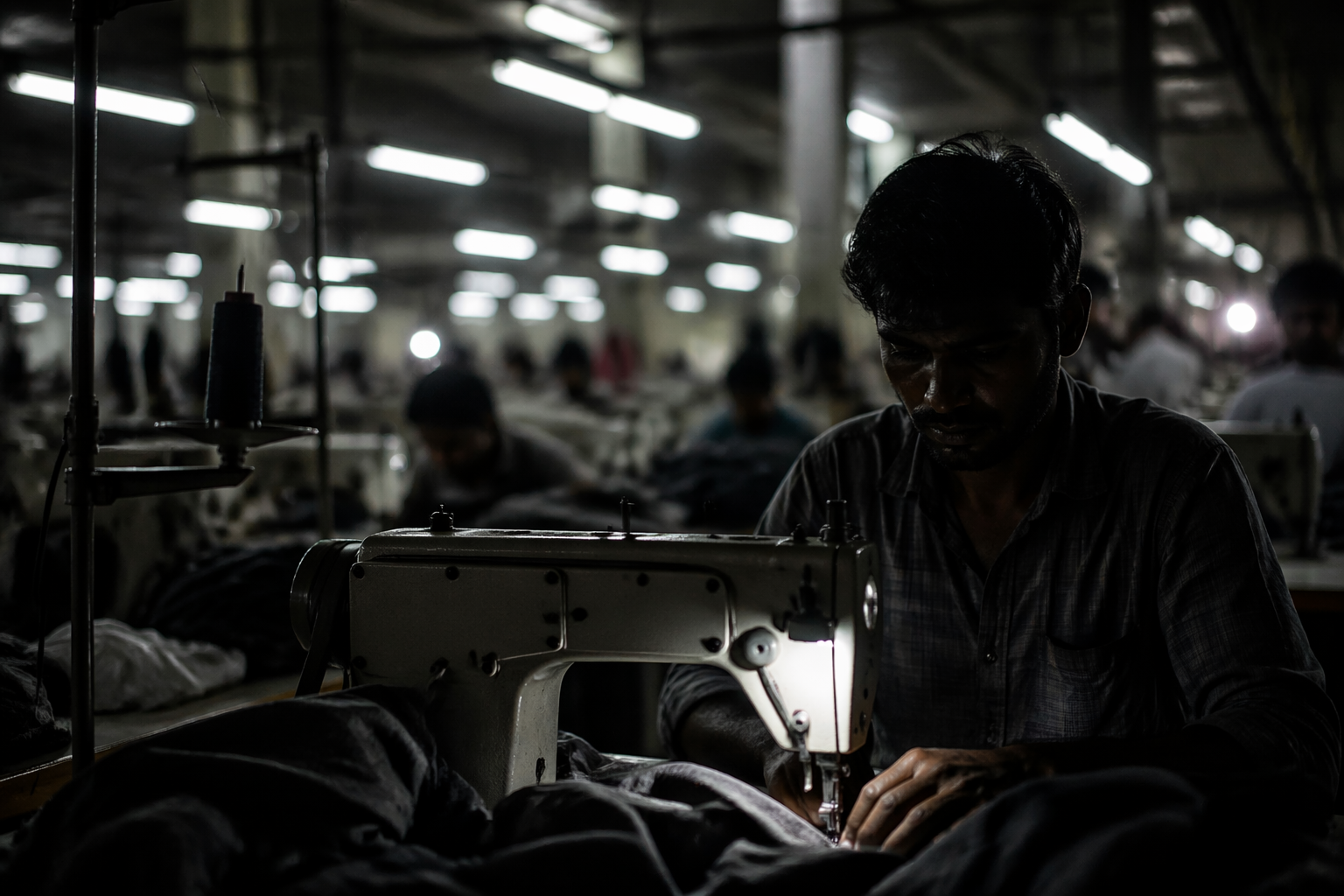
Kaleem has spent twenty years bent over a sewing machine. He knows the hum of a factory floor the way a farmer knows rain by its sound, its weight, its meaning. In those two decades, he has watched governments revise minimum wages no fewer than forty times. He has watched the numbers on the notification boards go up. And every single time, he has walked home with roughly the same amount he walked home with the year before.
This is not a coincidence. It is architecture.
When Uttar Pradesh’s government announced a 21 per cent wage hike for workers in Gautam Budh Nagar and Ghaziabad on April 13 pushing unskilled workers’ pay to ₹13,690 a month and skilled workers’ to ₹16,868 it was widely presented as a capitulation to the tens of thousands of factory workers who had spilled onto the streets of Noida since April 9. The optics were those of a responsive government. A protest. A revision. Resolution.
But for the workers still sharing ten-to-a-floor in narrow lanes off Sector 57, the revision answers the wrong question entirely.
The question everyone is asking is: Is the minimum wage high enough?The question nobody in power is asking is: Why does the minimum wage whatever its number never actually reach the worker’s hand?
Noida’s industrial ecosystem is built on a structure so elegant in its exploitation that it has survived every labour law reform for three decades. A large company, a phone manufacturer, a European fast-fashion brand, a domestic auto-parts giant does not employ factory workers directly. It engages a contractor. The contractor recruits, manages, and pays the workers. The principal employer, technically, never touches the wage slip. It outsources not just labour but accountability.
More than 10,000 industrial units operate in Noida, predominantly small-scale establishments producing mobile phones, auto components, and readymade garments much of it for export. The workers are predominantly migrants on temporary contracts. Nearly 25 percent of them are women.
When a contractor is paid ₹15,000 per worker per month by a principal employer, the worker does not see ₹15,000. The contractor takes their cut. What remains, after the margin is extracted, lands in the worker’s hand. Whether that remainder clears the minimum wage threshold is, in practice, a matter of paperwork rather than reality. “On paper they show one thing, in hand we get something else,” as one garment worker put it.
To understand what dignity costs in Noida today, consider the arithmetic. A rented room near the industrial belt costs approximately ₹3,500 a month. Food dal, rice, vegetables cooked on a small stove runs another ₹3,000 to ₹4,000. That is ₹5,000 to ₹6,000 per month simply to exist. What remains from ₹11,000 the legal floor for an unskilled worker before the recent hike is approximately ₹5,000 for everything else: transport, medicine, a phone recharge, and the remittance to a village in Bihar where a family waits.
There is no cushion. Any disruption, a fever, an accident pushes a worker into debt. After fifteen years of labour, many have nothing saved.
This is not the informal economy failing people. This is the formal economy producing destitution at scale.
The labour department’s recent action against 203 contractors directing them to pay ₹1.16 crore in dues is the most concrete enforcement move Noida has seen in recent memory. It is overdue. It is also, structurally, a Band-Aid.
The problem is not 203 bad contractors in a system of otherwise good ones. The problem is that the system requirescontractors to squeeze workers in order to remain profitable. The principal employer retains the production, the export revenue, the brand. What it does not retain is any liability for the people who made the product.
This is the wall that minimum wage revisions break against, every six months, like clockwork.
A permanent solution would require something no gazette notification can deliver: making principal employers jointly liable for every statutory entitlement of every worker in their supply chain. Not as corporate social responsibility. As law.
Until that happens, every wage revision is a revision to the number on a board that most workers will never actually collect.
Kaleem already knows this. He doesn’t use the language of supply chains or statutory compliance. He uses simpler language.
“The number goes up. We don’t.”
That sentence contains more economic analysis than most government committee reports will ever produce.
Subscribe Deshwale on YouTube


