



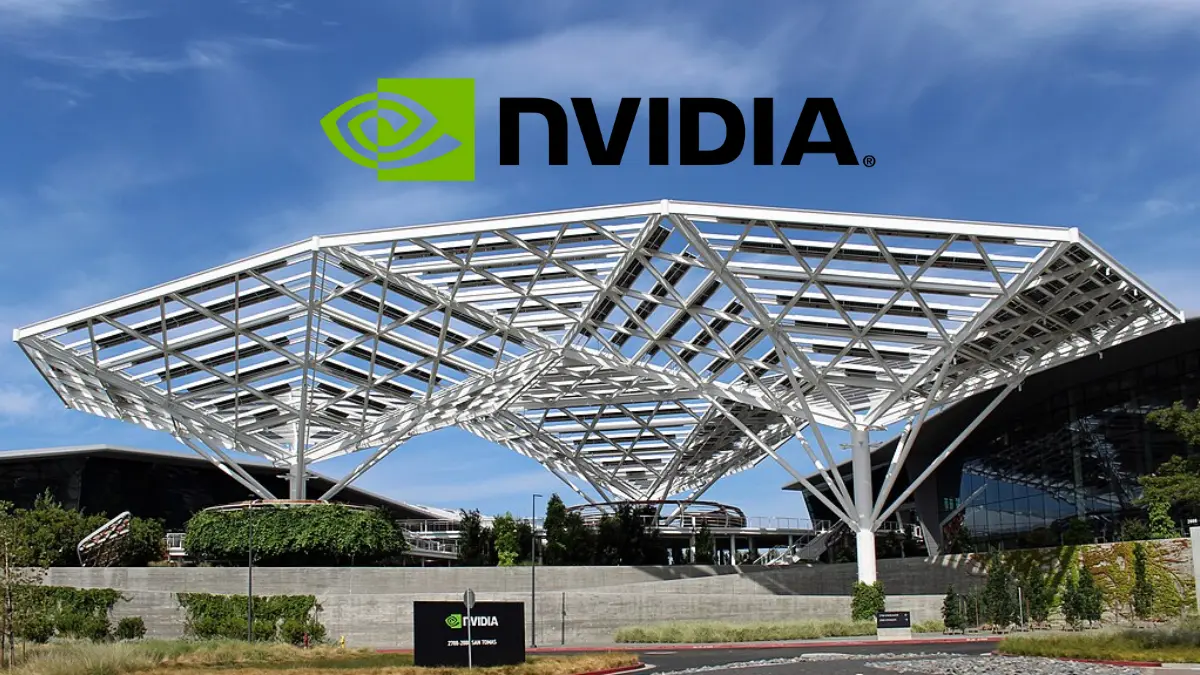
In July 2025, Nvidia etched its name in history by briefly touching a $4 trillion market capitalization, a feat no company had achieved before. This milestone crowns over three decades of relentless innovation, bold decisions, and an uncanny ability to anticipate technological shifts. From a small startup crafting graphics cards for gamers to a global titan powering artificial intelligence (AI), Nvidia’s journey is a masterclass in adaptability. For Indians, this story resonates deeply as Nvidia’s presence in cities like Bengaluru fuels local tech dreams. Yet its dominance sparks debates about market control, making its rise both inspiring and complex.
The story begins in 1993 when Jensen Huang, Chris Malachowsky, and Curtis Priem founded Nvidia in Santa Clara, California. Their vision was simple yet ambitious: to revolutionise computer graphics for the burgeoning gaming industry. With personal computers gaining popularity, the demand for vivid visuals was soaring. Nvidia’s first product, the NV1, launched in 1995 with a $10 million investment from Sequoia Capital. But it stumbled. Its quadratic texture mapping clashed with the industry’s DirectX standard, leaving Nvidia trailing competitors.
Undeterred, Nvidia pivoted swiftly. In 1997, the RIVA 128 hit the market, aligning with DirectX and delivering superior performance. It sold a million units in four months, cementing Nvidia’s place in the graphics race. The real game-changer came in 1999 with the GeForce 256, dubbed the world’s first GPU. Its hardware transform and lighting (T&L) capabilities offloaded complex calculations from CPUs, transforming gaming visuals. This innovation catapulted Nvidia to the forefront, capturing the hearts of gamers worldwide.
The 2000s saw Nvidia dominate the gaming market. Successive GeForce generations pushed visual boundaries, making Nvidia synonymous with high-performance graphics. By 2008, it held a significant share of the discrete GPU market, a position it maintains today with a 92 percent share in 2025. But challenges loomed. In 2008, Nvidia faced a $200 million write-down due to defective chipsets in laptops, sparking lawsuits from Apple, Dell, and HP. A 2011 settlement with Intel for $1.5 billion resolved further disputes, showcasing Nvidia’s resilience.
A pivotal moment arrived in 2006 with the launch of CUDA (Compute Unified Device Architecture). This platform allowed GPUs to handle general-purpose computing, opening doors beyond gaming. Suddenly, Nvidia’s chips powered scientific simulations, financial modelling, and early machine learning tasks. As Jensen Huang later reflected, “Software is eating the world, but AI is going to eat software” (BrainyQuote, 2025). CUDA laid the groundwork for Nvidia’s future, positioning it to ride the AI wave.
The 2010s marked AI’s renaissance, driven by deep learning. Nvidia’s GPUs, with their parallel processing prowess, became the gold standard for training neural networks. The Tesla GPU line, tailored for data centres, powered AI systems in autonomous vehicles, healthcare, and more. In India, Nvidia’s Bengaluru and Pune centres employed thousands, contributing to AI-driven startups in agriculture and diagnostics. By 2016, the Pascal architecture introduced mixed precision computing, slashing AI training times. The 2017 Volta architecture added tensor cores, while 2018’s Turing brought real-time ray tracing for gaming.
Nvidia’s software ecosystem amplified its hardware. Libraries like cuDNN simplified deep learning development, making Nvidia GPUs indispensable. The 2020 Ampere architecture further boosted AI and gaming performance, solidifying Nvidia’s dual dominance. The 2022 launch of ChatGPT ignited a generative AI boom, with Nvidia’s GPUs at its core. Companies like Meta and Tesla, likely among Nvidia’s top buyers, drove demand. From fiscal year 2023 to 2025, Nvidia’s revenue soared from $26.97 billion to $130.50 billion, a 380 percent leap, largely from data centre sales (MacroTrends, 2025).
Market milestones followed. In May 2023, Nvidia hit a $1 trillion market cap, joining Apple and Microsoft. By June 2024, it surpassed $3 trillion, and in July 2025, it briefly touched $4 trillion, making it the world’s most valuable company (Reuters, 2025). This ascent wasn’t without hurdles. The 2020 attempt to acquire Arm Holdings for $40 billion collapsed in 2022 amid regulatory concerns from the UK and EU. Competition from AMD and Intel persists, though Nvidia’s 92 percent GPU market share dwarfs rivals (Britannica, 2025).
Nvidia’s journey isn’t just about numbers. It’s about vision. Its failed Arm acquisition showed adaptability, redirecting focus to AI accelerators like the Blackwell chips, which drove a third of 2025’s data centre revenue. Yet its dominance raises questions. Critics argue Nvidia’s market control stifles innovation, and geopolitical tensions like US-China trade issues threaten supply chains. Still, Nvidia’s ability to navigate these challenges underscores its strength.
For Indians, Nvidia’s story is a beacon. Its R&D hubs in India foster local talent, powering innovations that touch lives globally. As Huang’s vision drives Nvidia forward, its journey from a graphics startup to an AI powerhouse inspires a generation. The $4 trillion milestone is not just a number. It’s a testament to how embracing change can reshape the world.
Nvidia’s Key Milestones:
| Year | Milestone | Impact |
|---|---|---|
| 1993 | Nvidia founded | Began focus on graphics processing units. |
| 1995 | NV1 released | Failed due to incompatible technology. |
| 1997 | RIVA 128 launched | Established Nvidia in graphics market. |
| 1999 | GeForce 256 introduced | First GPU with T&L, revolutionised gaming. |
| 2006 | CUDA launched | Enabled GPUs for AI and general computing. |
| 2016 | Pascal architecture | Boosted AI training with mixed precision. |
| 2023 | $1 trillion market cap | Joined elite tech giants. |
| 2025 | $4 trillion market cap | Became world’s most valuable company. |
Nvidia Revenue Growth
| Fiscal Year | Revenue ($B) | Growth (%) |
|---|---|---|
| 2023 (Jan 2023) | 26.97 | 0.22 |
| 2024 (Jan 2024) | 60.92 | 125.85 |
| 2025 (Jan 2025) | 130.50 | 114.20 |
