










If you’re driving through Purnia district in Bihar and someone points to a place called Pakistan Tola, you’d probably think they were joking. But this isn’t a punchline. It’s a real village named Pakistan Tola.
A forgotten corner of Bihar
Just 30 kilometres from Purnia town, in the north-east of Bihar, lies Pakistan Tola — a village that seems trapped in another time. While India celebrates high-speed internet, bullet trains, and a growing economy, here the basics are still missing. For the people who live here, ‘Digital India’ is something they have only ever seen on television.
The basics that never arrived
The list of what Pakistan Tola does not have is longer than what it does. There’s no school. No health centre. No proper toilets. During the rainy season, the narrow dirt roads dissolve into thick mud, making it almost impossible to get in or out. When the village floods — and it does every year — families have to abandon their homes and take shelter wherever they can find higher ground.
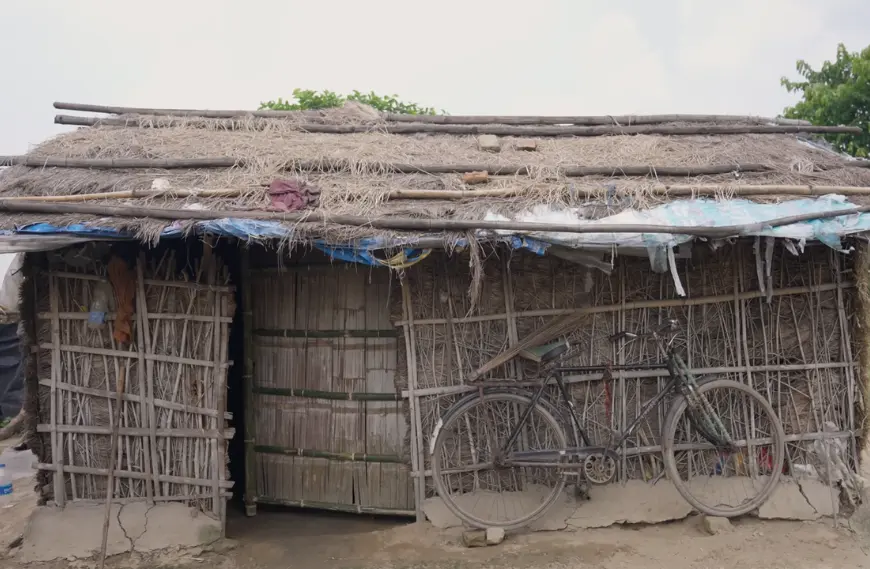
Electricity is patchy at best. Clean drinking water is never guaranteed. Most homes are made of mud and bamboo, with thatched roofs that struggle to survive heavy monsoon rains.
A daily struggle to survive
Work is scarce. The majority of residents are Santhal Adivasi families who rely on farm labour for income. It’s seasonal, unpredictable, and pays just enough to scrape by. When there’s no farm work, many men migrate temporarily to nearby towns for construction jobs or manual labour. Women often take on agricultural tasks or small-scale weaving and craft work, but it rarely brings in steady money.
In emergencies, the nearest hospital is miles away — and with no reliable transport, reaching it in time can be a challenge. Something as simple as a fever can become life-threatening when basic healthcare is out of reach.
Poverty with an extra burden
As if these challenges were not enough, Pakistan Tola carries a name that adds to its problems. The word ‘Pakistan’ appears on every official document — voter IDs, Aadhaar cards, and other docs. For some, it’s a curiosity; for others, it’s a reason to mistrust or discriminate.
There are residents who have been refused work or treated with suspicion simply because of where they are from. It’s a prejudice that has nothing to do with them, yet follows them everywhere. Poverty already limits opportunities here — but the stigma of the name closes even more doors.
The push for change
The villagers have long wanted to change the name to Birsa Nagar, after Birsa Munda, the legendary Adivasi leader who fought against British rule. It’s a name that, they say, would honour their heritage and remove the association with another country.
Earlier this year, local officials announced the change and even held an inauguration ceremony. For a brief moment, the community felt hopeful. But nothing changed in the systems that matter. In government records, election rolls, and ID databases, the name Pakistan Tola remains. On paper, the village never changed at all.
What’s in a name?
For many policymakers, rural development is a numbers game — roads built, schools opened, toilets installed. But for Pakistan Tola, dignity and development are tightly connected. The name change is not just symbolic, it’s a first step toward being recognised and treated equally.
When the name on your address makes people doubt your nationality, even the simplest interactions become battles. And when your village is already cut off from the benefits of infrastructure, those battles become harder to win.
The larger rural story
Pakistan Tola is far from the only place in India left behind by development. Across the country, thousands of villages face the same problems — poor roads, no schools, no reliable healthcare. The difference here is that the name draws attention, even if that attention does not always lead to action.
In many ways, the struggles of Pakistan Tola are a warning. Progress is not measured only in GDP figures or global rankings. It’s measured in whether families can send their children to school without walking miles, whether the sick can get treatment in time, whether people have a safe roof over their heads. By those measures, Pakistan Tola — and villages like it — show how far there is still to go.
A question that won’t go away
Will Pakistan Tola get the roads, schools, and clinics it needs? Will the name Birsa Nagar finally be recognised in every official document? The answers depend on more than local promises. They require state and national authorities to see villages like this not as footnotes to history, but as communities with the same rights and needs as anywhere else in the country.
Until then, Pakistan Tola remains a place where daily life is a test of resilience — where people endure both the harsh realities of poverty and the quiet injustice of being defined by a name they never chose.


