











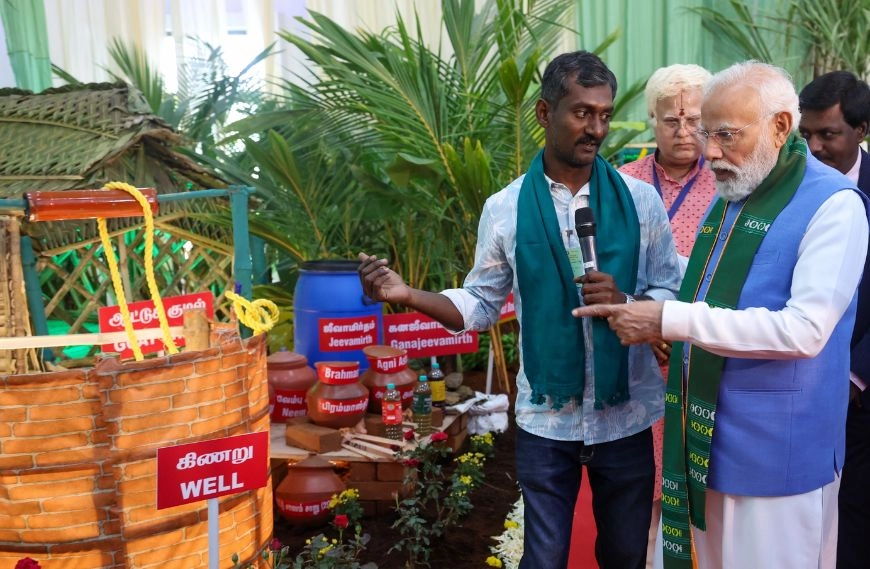
Prime Minister Narendra Modi met with farmers at the South India Natural Farming Summit 2025 in Coimbatore, Tamil Nadu. During the summit, he praised the farmers for their dedication to sustainable agriculture and innovation.
Addressing the farmers, PM Modi showed keen interest in the use of banana waste for value added products. He learned that many farmers were working in Farmer Producer Organisations and that their products made from banana waste were sold online, exported, and available in markets across India.
He also discussed the variety of tea grown using natural farming methods, including black, green, white, and oolong tea. One farmer explained that oolong tea was 40 percent fermented, and the PM noted the rising popularity of white tea in domestic markets.
PM Modi appreciated the farmers’ agricultural diversity, including GI tagged products such as Kumbakonam betel leaves and Madurai jasmine. He also learned about the farming and value addition of Moringa leaves, which are processed into powder and exported globally, especially to countries like the United States, parts of Africa, Japan, and Southeast Asia.
Highlighting youth involvement, the PM observed that many highly educated young farmers, including PhD holders, are embracing natural farming. At least seven thousand farmers and three thousand college students have been trained at the summit’s model farm.
Modi also praised Tamil Nadu’s work in preserving traditional paddy varieties. These include nearly one thousand heritage rice strains, many of which have nutritional profiles comparable to millets.
Reflecting on his earlier initiatives in Gujarat, PM Modi referred to the “cattle hostel” concept, a system designed to house all village cattle centrally with minimal resources. He noted that similar community led sustainability concepts are now being successfully adopted in natural farming initiatives.
The event was also attended by the Governor of Tamil Nadu R N Ravi and Union Minister L Murugan, highlighting the government’s continued support for sustainable agriculture and natural farming practices.
Subscribe Deshwale on YouTube


