



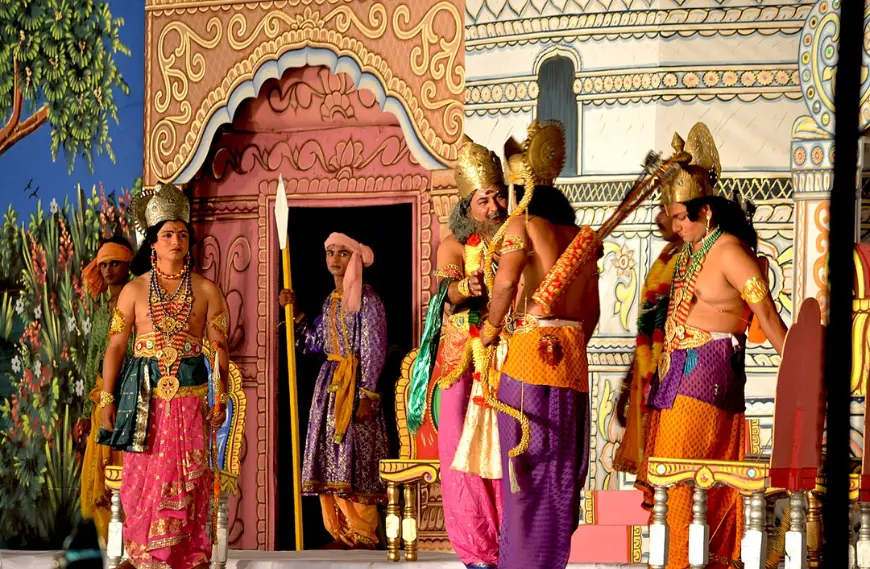
Why do we celebrate Ramlila?
Ramlila is a happy drama that tells the story of Lord Rama from the Ramayana, an old Indian book. We celebrate it because it shows that good always wins over bad. It happens during Navratri, a nine-night festival, and ends on Dussehra, the tenth day. Navratri is a time to worship Goddess Durga, but in places like Uttar Pradesh, it also celebrates Rama’s victory. Ramlila is like a big village party where people sing, dance, and learn good values like being honest and brave. It’s so special that the whole world knows about it – UNESCO called it a treasure in 2008!
The story behind Ramlila
Ramlila brings the Ramayana story to life with acting, songs, and dances. Here’s the story simply:
- Rama’s happy life: Rama is a kind prince from Ayodhya. He marries Sita after winning a bow contest. Everyone loves him.
- Living in the forest: His stepmother tricks the king, and Rama has to live in the forest for 14 years. Sita and his brother Lakshmana go with him. They help people and fight small demons.
- Sita gets taken: A demon king named Ravana, with ten heads, tricks Sita and takes her to his island, Lanka.
- The big battle: Rama teams up with Hanuman and the monkey army. They build a bridge to Lanka and fight Ravana’s army. Rama kills Ravana with a special arrow.
- A joyful return: Sita proves she is good, and they return to Ayodhya. People light lamps to welcome them, which is why we have Diwali later. Rama becomes king, and everyone is happy.
Every night, villagers act out these parts. On Dussehra, they burn big dolls of Ravana and his family with fireworks to show that evil is gone.
Why Ramlila is famous in UP villages
In Uttar Pradesh villages, especially near Banaras and Ghazipur, Ramlila is very exciting. UP is special because Ayodhya, Rama’s hometown, is there. Villages turn into open-air theaters for nine nights. The plays happen under the stars, and everyone can watch for free or a small price. Kids cheer, families sit on mats, and people sing along. Villagers act themselves, making simple stages with wood and cloth.
Ramlila teaches lessons like helping others and being brave. It also brings the village together, with everyone helping with money, food, or time. People even walk miles to watch it!
How It’s done: actors, rehearsals, and scripts
Only men and boys act in Ramlila, even for girls like Sita. Young boys, usually under 16, play Rama, Sita, and others. They put on makeup and flowers to look like gods and fast before acting.
Weeks before Navratri, actors get scripts from the Ramcharitmanas, a simple Hindi version of the Ramayana. Rehearsals start months before in fields or yards. Costumes are made at home with paper crowns, clay masks for demons, and cloth tails for monkeys. Oil lamps are used for lighting at night.
The big mela after the play
After each night, there’s a big fair called a mela. Stalls sell food like jalebi, samosas, pakoras, and sweets. Women buy bangles, clothes, toys, and other items. There are small rides, games, and crafts like pottery and rose water items. Everyone eats, dances, and talks until late. The mela also collects money for next year’s Ramlila.
Special way in my village
In my village in Ghazipur, everyone joins in – men act, kids watch, and everyone helps. Rehearsals are funny, and we love seeing them practice. The mela has tasty Banaras-style food and unique items. Sometimes we add dances or a boat ride on the Ganga River on the last day. It’s a proud tradition that makes our village happy!
Where are famous Ramlilas played?
- Ramnagar, Varanasi (UP): The most famous, lasts 31 days with a king leading it.
- Ayodhya, UP: Rama’s birthplace with big crowds and lights.
- Mathura and Vrindavan, UP: Colorful plays with music.
- Almora, Uttarakhand: Plays with mountain views and folk dances.
- Delhi: Big Ramlilas at Red Fort and Ramlila Maidan with huge Ravana dolls.
- Outside India: In Fiji, Trinidad, and Guyana, Indian families perform Ramlila with local twists.
Fun facts about Ramlila
- Played worldwide because Indian people took it abroad.
- Actors don’t get paid; they act for fun and food.
- Varanasi Ramlila lasts 31 days – the longest ever.
- Boys under 16 play Rama and Sita and fast before acting.
- In some UP villages, Muslim boys also act as Rama – showing love between communities.
- Some villages recycle Ravana dolls to help the environment.
Ramlila is more than a play; it’s a happy time with stories, laughter, and yummy food. In my Ghazipur village, it brings everyone together.
