



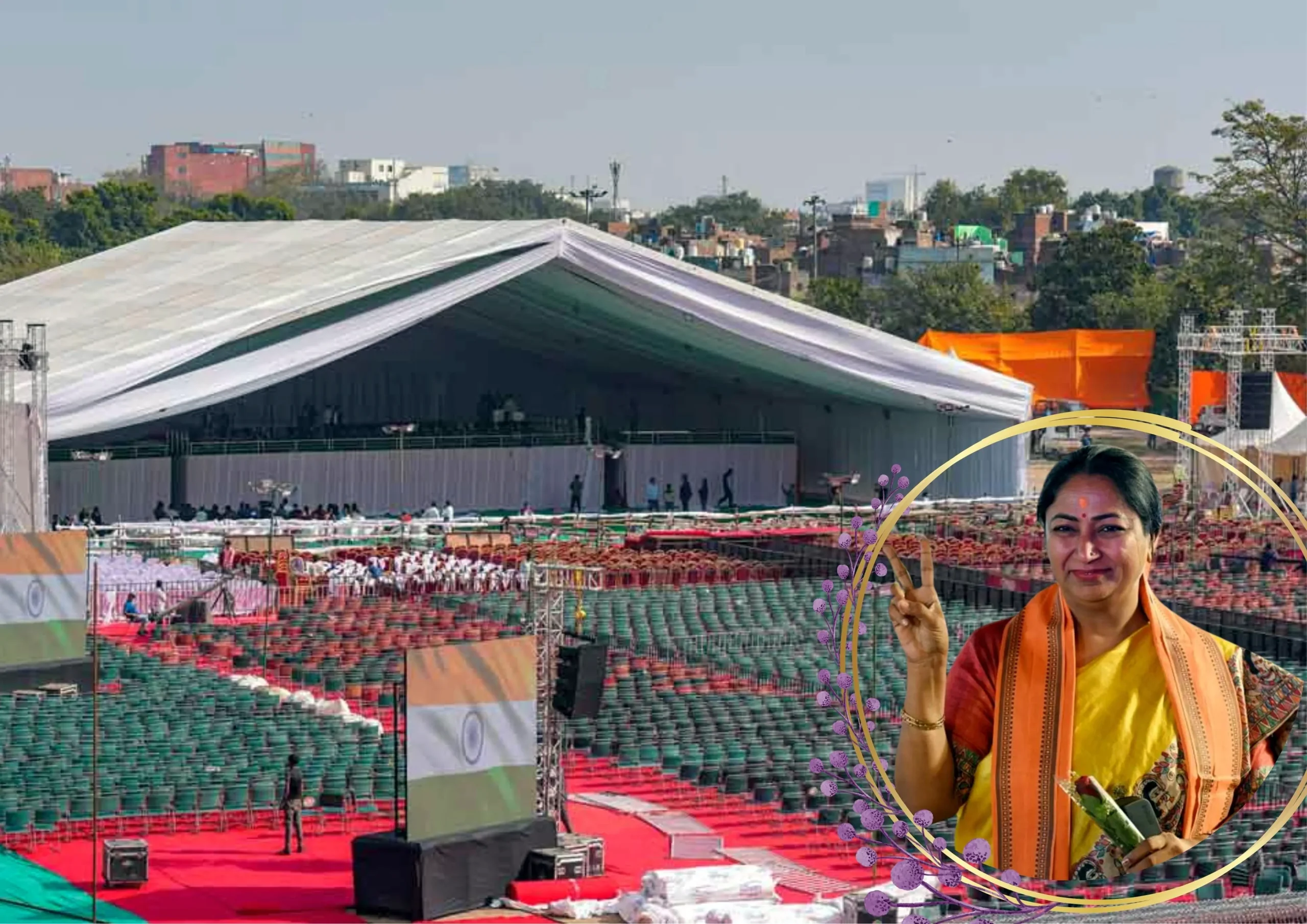
If walls could talk, Ramlila Maidan would narrate the stories of India’s most defining political moments. This historic ground, nestled in the heart of Delhi, has witnessed battles—not of swords, but of ideas, democracy, and leadership. From Lal Bahadur Shastri’s war cry to Jayaprakash Narayan’s anti-Emergency movement, from Atal Bihari Vajpayee’s electrifying speeches to Arvind Kejriwal’s political rise, every leader who has stood on this stage has left an imprint on India’s political landscape.
And today, history is set to repeat itself as Rekha Gupta takes oath as Delhi’s Chief Minister at 12:35 PM, marking yet another political milestone at this iconic venue.
A ground etched in history
Ramlila Maidan’s political significance dates back to the 1960s, when Lal Bahadur Shastri stood here and gave the nation its most powerful slogan—”Jai Jawan, Jai Kisan”. It was 1965, India was at war with Pakistan, and the country was grappling with food shortages. Shastri’s words echoed across the Maidan, urging citizens to stand strong with their soldiers and farmers. That moment cemented the ground’s role as a podium for national leadership.
A decade later, the Maidan became the heartbeat of India’s anti-Emergency struggle. As Indira Gandhi clamped down on democracy in 1975, opposition forces gathered here in defiance. Jayaprakash Narayan (JP), the face of the resistance, led mammoth rallies, demanding an end to dictatorship. The ground shook with the voices of thousands, and the energy of revolution was palpable. George Fernandes, another key figure in the struggle, inspired the working class to rise against the Emergency, turning Ramlila Maidan into a symbol of rebellion and democratic resurgence.
The political stage of every era
Through the 1980s and 90s, Ramlila Maidan continued to be the epicentre of political movements. Atal Bihari Vajpayee’s stirring speeches here laid the foundation for the BJP’s national rise. In the new millennium, the Maidan saw another historic moment when Narendra Modi addressed an electrified crowd in 2013, setting the tone for his journey to becoming Prime Minister in 2014.
But one of the most dramatic turnarounds in Indian politics also began here. In 2011, Arvind Kejriwal stood alongside Anna Hazare during the India Against Corruption movement, vowing to clean up politics. The protest, held at this very ground, led to the birth of the Aam Aadmi Party (AAP), and in just two years, Kejriwal was Delhi’s Chief Minister. The man who once led a common man’s fight from this stage soon occupied the city’s highest office.
Today, a new leader takes centre stage
And now, in 2025, Ramlila Maidan finds itself in the spotlight once again. Rekha Gupta, the BJP’s newly elected leader, is all set to take oath as Delhi’s Chief Minister at 12:35 PM today. Her political journey—from student activism to municipal governance, and now to the highest seat of power in the capital—has been one of perseverance and grit.
Gupta’s rise is symbolic in many ways. She takes oath on the very ground that shaped her biggest political rival, Arvind Kejriwal, whose own story began here in 2011. It’s an irony that cannot be ignored—the same venue that catapulted Kejriwal to power now hosts the oath-taking of the leader who dethroned him. Politics, after all, has its way of coming full circle.
Where the past meets the present
Ramlila Maidan is not just a piece of land—it is a stage where India’s political destiny is scripted, time and again. Leaders rise, movements take shape, and power shifts hands, but the ground remains a constant witness to history.
Today, as Rekha Gupta takes her oath, she steps into a legacy much larger than herself. She is not just becoming Chief Minister; she is becoming a part of a decades-old tradition of leadership, struggle, and transformation that this hallowed ground has upheld.
And as the crowd erupts in applause at 12:35 PM, Ramlila Maidan will add another chapter to its long, illustrious history.
