



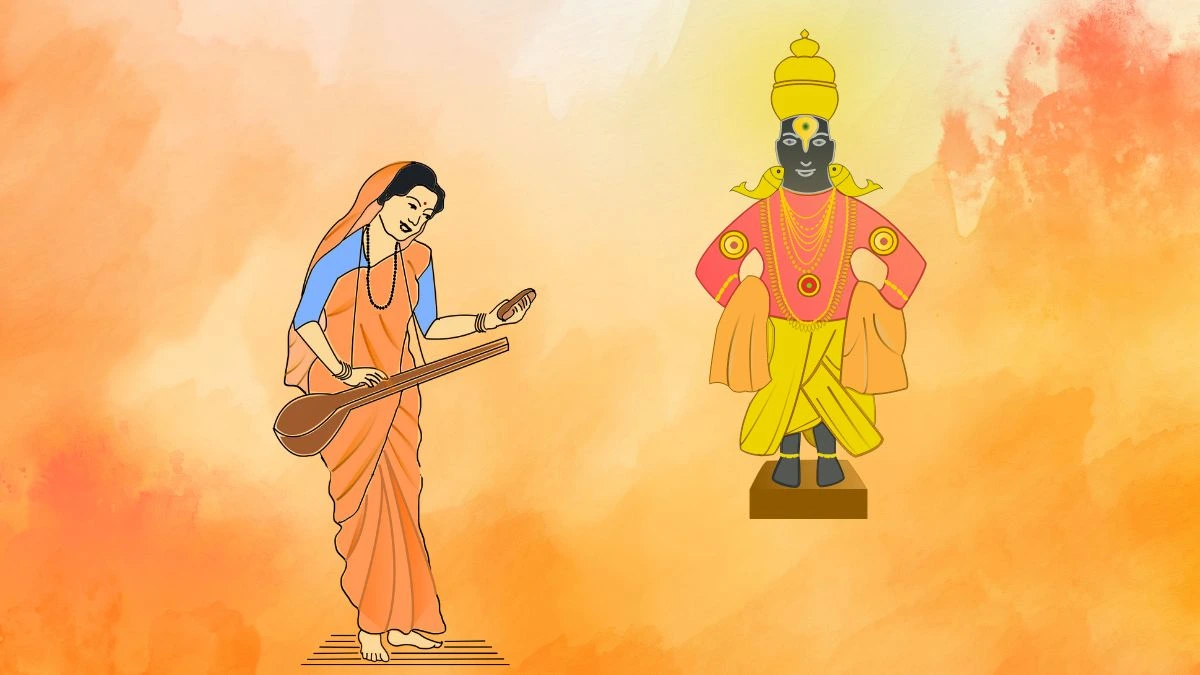
In the vibrant tradition of medieval Maharashtra’s Varkari movement, few figures shine as boldly as Sant Kanhopatra. Living in the 15th century, she emerged from the margins of society to become a symbol of spiritual freedom, feminine strength, and unwavering devotion. Born into a courtesan family, Kanhopatra renounced worldly pleasures and status to surrender her life to Vitthal of Pandharpur. Her life is not merely a tale of bhakti (devotion), but of self-respect, resistance, and the power of love to transcend social injustice.
A Childhood in Shadows
Kanhopatra was born in Mangalvedha, near Pandharpur, to Shyama, a courtesan trained in the classical arts. Her father’s identity remains uncertain, with some folk tales referring to him as a Brahmin or a nobleman, though none are verifiable. From a young age, Kanhopatra was trained in singing, dancing, and ornamentation – the expected skills of women in her mother’s profession. Her beauty quickly became legendary, but it proved to be a curse rather than a blessing. She was relentlessly pursued by wealthy merchants, noblemen, and even royal envoys, all seeking to possess her.
Yet, from early on, Kanhopatra’s heart yearned not for mortal companionship, but for divine union. Her longing found expression in devotional songs, where she would often plead with Lord Vitthal for protection from the lust and dominance of worldly men:
“This beauty brings me pain, O Vitthal –
You alone are my protector.”
A Turning Point: Hearing the Saints
Her path took a radical turn when she heard the abhangs (devotional verses) of saints like Namdev, Tukaram, and Dnyaneshwar. Their words stirred a storm within her. Kanhopatra decided she would no longer live a life of servitude and submission. She renounced all ties to her past and set out for Pandharpur, walking alone while singing songs of surrender and devotion. Along the way, she was offered wealth, marriage, and comfort – but she refused all, committed only to the feet of Vitthal.
In one of her most poignant abhangs, she sings:
“I want no garlands, no ornaments,
I seek no pleasures – only Vitthal, my love.”
This radical rejection of societal expectations – especially from a woman considered impure by birth – was an act of defiance and spiritual awakening.
Devotion at the Temple Gates
Upon reaching Pandharpur, Kanhopatra took residence near the Vitthal temple. Her dance and music, once performed for patrons, were now offered solely to her divine beloved. Her poetry from this period reflects sorrow, spiritual longing, and an unshakeable love for Vitthal. In one verse, she writes:
“I am a courtesan, yet I belong to the house of Vitthal;
My path leads only to Pandharpur.”
Kanhopatra’s presence began to attract attention, not just from common folk but from women of all castes and communities. Her bold declaration that God looks at the heart – not one’s caste, gender, or past – became a message of hope for the oppressed.
The King of Bidar: A Test of Faith
Word of Kanhopatra’s beauty and spiritual fame reached the court of the Bahmani king of Bidar. Determined to bring her into his court, the king sent soldiers to escort her by force. When confronted, Kanhopatra stood her ground. “Vitthal is my master,” she declared. The king’s men tried to seize her, but she fled straight into the Vitthal temple and fell at the deity’s feet.
In her final plea, she cried:
“Take my life, O Vitthal –
But don’t let them dishonour me.”
According to legend, in that sacred moment, Kanhopatra merged into the idol of Vitthal. Her body disappeared, and she was never seen again. The temple authorities, moved by the miracle, built a samadhi (memorial shrine) for her near the temple entrance – a rare honour for someone of her background.
The Abhangs of a Rebel Saint
Kanhopatra’s abhangs remain a treasured part of Marathi devotional literature. They echo with the anguish of societal rejection, the yearning for moksha (liberation), and the fierce determination of a woman who refused to be defined by her origins. Her songs speak of spiritual surrender, but also of a woman’s right to define her path – without the need for a guru, a husband, or male protection.
In one deeply reflective verse, she writes:
“I must die while alive,
In the love of Vitthal alone.”
Her compositions inspired women from all walks of life – particularly those who faced humiliation, bondage, or exclusion. She taught that divinity resided in the soul, not in the body, and that the sacred was open to all, regardless of birth or status.
A Feminist Saint
In many ways, Kanhopatra can be seen as one of India’s earliest feminist voices in the bhakti tradition. She claimed spiritual authority in a world where women were expected to remain silent, subservient, and dependent. Without a male patron, teacher, or protector, she charted her own spiritual course. Her life stood as a rebuke to patriarchy, casteism, and the idea that purity was a privilege of birth.
Her samadhi in Pandharpur continues to draw thousands – especially on Ashadhi Ekadashi, when pilgrims gather to sing her abhangs and honour her spiritual courage.
Legacy and Cultural Impact
Over the centuries, Kanhopatra’s life has been retold in plays, films, and folk performances. Marathi theatre often stages the dramatic confrontation between her and the king’s soldiers – a moment that captures both her vulnerability and her divine strength. She has become a symbol of spiritual and social emancipation.
The renowned scholar John Stratton Hawley, in Songs of the Saints of India, writes:
“Kanhopatra’s story shows how the power of love can transform shame into sanctity.”
Similarly, Eleanor Zelliot, a scholar of Dalit and women’s movements, wrote:
“She was the saint who broke silence and rejected social contempt.”
These academic views echo what her followers have always believed – that Kanhopatra’s life is a timeless reminder of the soul’s ability to rise above even the harshest conditions.
Relevance Today
Sant Kanhopatra’s life remains profoundly relevant. In an age where women still face violence, discrimination, and control over their choices, her story offers a different model of power – one rooted in surrender, not submission. She teaches that the freedom of the soul cannot be chained, and that in the eyes of God, no one is impure.
Her life encourages us to listen to the unheard, honour the marginalised, and see holiness where society sees shame. She stood alone, armed only with devotion – and changed the very idea of what sainthood could look like.
Conclusion
Sant Kanhopatra’s journey is not merely a tale of renunciation – it is a revolutionary act of self-realisation. From the glamour and sorrow of a courtesan’s life to the quiet grace of a saint, she walked a path few dared to tread. She proved that true devotion does not need pedigree, approval, or protection – it only needs a sincere heart.
Her samadhi near Pandharpur stands not just as a religious shrine, but as a monument to every soul that has defied the odds to seek freedom, dignity, and divine love.
