



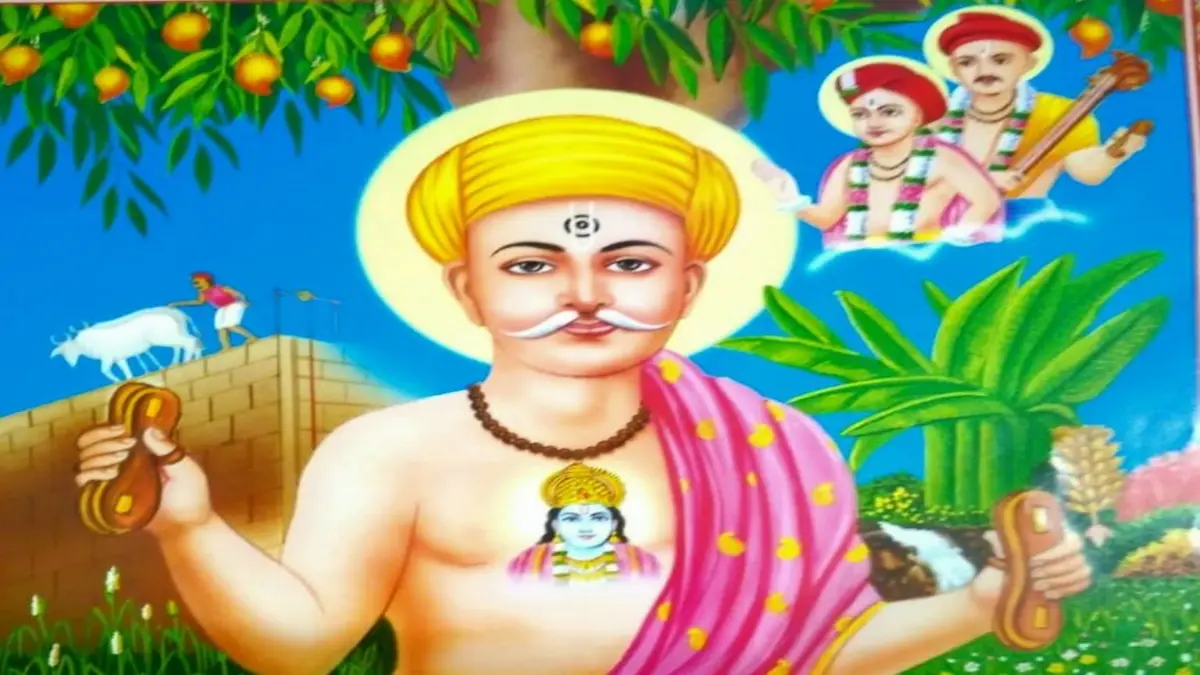
In the dusty fields of Maharashtra, where farmers whisper prayers into furrows of tilled land, the memory of Sant Savata Mali breathes through the breeze. A saint in form, a farmer by birth, and a poet in spirit, Savata Mali lived a life that merged devotion and duty with unshakable grace. He did not don ochre robes nor wander forests in search of truth. He found the divine in onions, garlic, spades, and sweat. His story reminds us that sanctity is not in renunciation, but in mindful work and love for the divine in all that we do.
Born in the late 13th century in Aran-Bhendi, a small village near Pandharpur in present-day Solapur, Savata’s roots were simple and rustic. His father Parsoba and mother Nangitabai belonged to the hardworking Mali community, known for cultivating fruits and vegetables. They tilled the land not just for sustenance, but also as a form of silent prayer. In their hut, God was not a faraway figure in stone temples; He was Vitthal of Pandharpur, ever-present in daily chores, in bhajans sung after dusk, and in every breath taken between work and rest.
From a young age, Savata was drawn to the path of bhakti. But unlike others who left their homes to seek spiritual fulfilment, he stayed put. He married Janai, a woman as rooted in faith and simplicity as he was. They had two children, Vitthal and Nagabai, and together lived the ideal of a householder’s life steeped in devotion. The remarkable part of Savata’s life was his ability to combine worldly duties with spiritual pursuit. He never viewed them as separate paths. To him, ploughing the land and chanting the name of Vitthal were one and the same.
His poetry, composed in Marathi, bears the fragrance of soil and the softness of surrender. Only 37 of his abhangs have survived the centuries, yet they shine with rare insight. In one of his most beloved verses, he writes:
“Amchi Mali yachi jaat, shet lavu bagait. Kanda mula bhaji, avaghi Vithabai mazi.”
“We are of the Mali clan, we till the land with care. The onions and greens we grow – I see my Vithabai there.”
In these lines, Savata offered a radical vision of divinity. He declared that God can be seen not in secluded caves or rituals, but in onions, radishes, and herbs—in everyday toil. This was not mere poetry. It was a lived truth. His spiritual path, like that of other Varkari saints such as Tukaram, Namdev, and Chokhamela, was rooted in egalitarianism. He believed that caste, birth, or occupation could not limit one’s access to God.
His life was untouched by grandeur or myth, save one compelling legend. It is said that Pandurang Himself once appeared in Savata’s field. When asked by the divine child to hide Him from pursuers, Savata, unshaken, slit open his chest and concealed the Lord in his heart. While literalists might dismiss this tale, its meaning remains potent. For Savata, the divine was not external—it lived within him, in his heart, and in the very soil he cultivated.
Savata’s spiritual genius lay in his seamless blending of worldly responsibility and spiritual aspiration. He never shunned family life or avoided responsibilities. Instead, he embraced them as gifts from God. His wife Janai once grew impatient when he ignored guests from her family, too engrossed in bhajan. She rebuked him, and instead of defending himself, Savata turned her words into a philosophical insight. Through her, he reminded everyone that true spiritual growth lies not in escape, but in balance.
This balance made his teachings deeply accessible to common people. He showed that there was no need for complex rituals or grand donations to temples. In his words:
“Na lage sayas, na pade sankat. Name sopi vaat Vaikunthachi.”
“No efforts needed, no trouble occurs. The name of God is the simple path to Vaikuntha.”
Savata’s directness, humility, and insight made him a beloved figure in the Varkari tradition. Even though he never visited Pandharpur, legend says that Lord Vitthal sent His own palkhi to meet him every year—a tradition that continues even today. While others walk to Pandharpur in the grand Ashadhi Wari, Vitthal’s palkhi travels to Aran to honour the saint who never left his village, yet lived with God at every moment.
His teachings also stood against blind superstition and religious pomp. He was critical of showy rituals, caste discrimination, and spiritual pride. To Savata, morality, compassion, inner purity, and humility were the real offerings to God. His work didn’t merely inspire devotion; it encouraged self-inquiry, honesty, and service.
Despite his spiritual stature, Savata lived only 45 years. But the life he led was more meaningful than most who live twice as long. On Ashadh Vadya Chaturdashi in Shaka 1217 (1295 CE), he took samadhi in Aran, and his memorial remains there. Unlike many saints whose samadhis fade into history, Savata’s presence is still felt in the Varkari movement, in village songs, and in the silent strength of every farmer who chants the Lord’s name while sowing seeds.
His legacy teaches a profound truth. You don’t have to renounce the world to find God. You just need to open your heart, do your work sincerely, and see the divine in everything. In a country where spiritual narratives are often linked to escape and otherworldliness, Savata’s life is a reminder that true liberation lies in honest living, loving work, and unwavering devotion.
Sant Savata Mali may have only 37 known abhangs, but their voice echoes far and wide. Through his poems, he transformed farming into worship, family life into a spiritual school, and his tiny village into a temple. He didn’t ask his followers to seek God on distant hills or in holy waters. He asked them to look within—and into the soil beneath their feet.
