










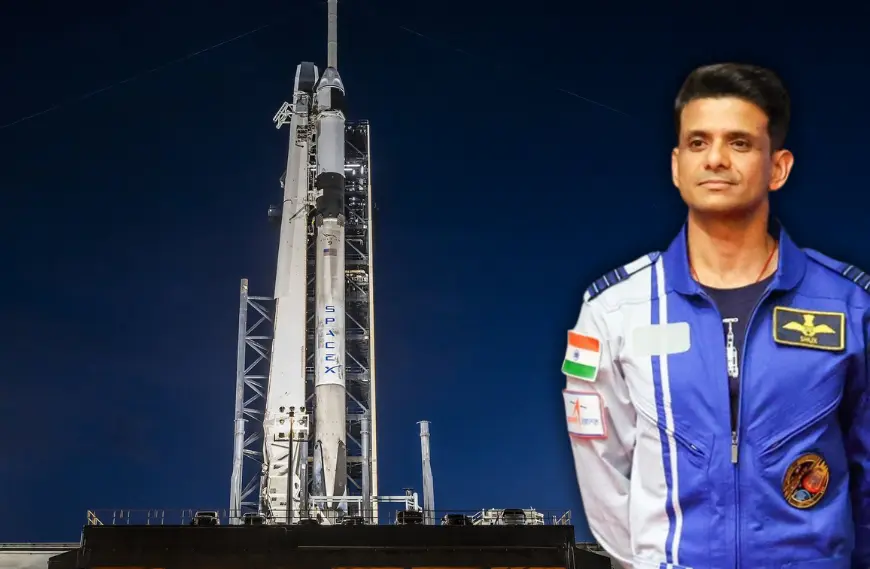
The sky has always been a canvas of dreams for India, a nation that gazes upward with ambition and pride. From the ancient astronomers of Ujjain to the modern rockets of ISRO, the cosmos has whispered promises of greatness to every Indian heart. Shubhanshu Shukla, a 39-year-old Group Captain from Lucknow, embodies this celestial yearning. He is not just an astronaut preparing to soar to the International Space Station (ISS) on the Axiom-4 mission. He is a symbol of India’s relentless pursuit of the stars, a bridge between the grounded dreams of a billion people and the infinite possibilities of space. But what makes Shubhanshu’s journey truly remarkable is not just the mission itself. It is the quiet, almost poetic way he carries India’s soul into the void, blending science with culture, discipline with devotion, and ambition with humility. His story invites us to rethink what it means to be an Indian astronaut in a world where space is no longer a distant frontier but a stage for human unity.
Shubhanshu Shukla was born in 1985 in Lucknow, a city steeped in history and culture. He grew up in a middle-class family, the youngest of three siblings. His father, a retired government officer, and his mother, a homemaker, nurtured values of hard work and curiosity. As a boy, Shubhanshu cycled through the bustling streets of Triveni Nagar, his eyes often fixed on the sky. An airshow sparked his fascination with flight, a memory his sister Suchi recalls vividly. That childhood awe never faded. It propelled him to the National Defence Academy (NDA) in Pune, where he earned a degree in computer science in 2005. A year later, he joined the Indian Air Force, logging over 2,000 hours as a test pilot. Planes like the SU-30 MKI and MiG-21 became his companions. Yet, the sky was only a stepping stone. Space beckoned.
India’s space journey has always been about more than technology. It is about identity, about proving to the world that a nation once colonised can conquer the stars. When Rakesh Sharma became the first Indian in space in 1984, he carried the weight of a young nation’s aspirations. His words from orbit echoed in every Indian home. Four decades later, Shubhanshu steps into this legacy. But he does not merely follow. He redefines it. His mission, originally set for June 10, 2025, but delayed to June 11 due to a liquid oxygen leak in SpaceX’s Falcon-9 rocket, is not just a scientific endeavour. It is a cultural odyssey. Shubhanshu will spend 14 days on the ISS, conducting experiments on food sustainability and microalgae in microgravity. These studies, developed by ISRO and the Department of Biotechnology, aim to support long-term space missions. Yet, beyond the science, Shubhanshu carries something uniquely Indian: a taste of home.
Imagine an astronaut savouring moong dal halwa in the weightless expanse of space. Shubhanshu is doing just that. He is bringing Indian delicacies like gajar ka halwa and aamras to share with his crewmates. These are not mere snacks. They are threads of memory, connecting the ISS to the kitchens of Lucknow. His sister Suchi shared how he experimented with these dishes during training, ensuring they could withstand the rigours of space. This act of sharing food is deeply Indian. It reflects the hospitality ingrained in our culture, the belief that a meal shared is a bond forged. In a sterile, high-tech station 400 kilometres above Earth, Shubhanshu’s halwa is a quiet rebellion against the impersonal. It is a reminder that even in space, India remains rooted in its traditions.
But there is more to Shubhanshu’s mission than food. He carries a soft toy swan named Joy, chosen as the mission’s zero-gravity indicator. The swan holds profound meaning for him. It is the vahana of Goddess Saraswati, symbolising wisdom and purity. Shubhanshu, a man of science, finds balance in this spiritual emblem. His six-year-old son, Kiash, nicknamed Sid, helped choose the swan, adding a touch of familial warmth to the mission. This small gesture reveals Shubhanshu’s humanity. He is not just an astronaut but a father, a son, a man who carries his roots into the cosmos. His crewmates describe him as focused and intelligent. Yet, it is his humility that shines. He calls his crew “friends for life,” a sentiment that echoes India’s ethos of community.
Shubhanshu’s journey is a testament to India’s evolving role in global space exploration. The Axiom-4 mission, a collaboration between ISRO, NASA, and Axiom Space, marks a milestone. India invested ₹600 crore to secure Shubhanshu’s seat, a bold statement of a nation’s dreams. This is not just about one man’s flight. It is about India’s return to human spaceflight after 41 years. It is about a country that dares to dream big, despite challenges on the ground. Shubhanshu’s experiments, seven in total, focus on practical solutions for space living. From studying muscle loss to testing edible microalgae, his work could shape the future of space travel. These experiments are not abstract. They address real problems, like sustaining life on Mars or the Moon. For a nation that has mastered frugal innovation, Shubhanshu’s mission is a natural extension of that ingenuity.
What sets Shubhanshu apart is his ability to inspire. He speaks of changing even one life through his story, a goal that resonates deeply in India. Here, where millions of children dream beyond their circumstances, his journey is a beacon. He is not a distant hero but a relatable figure. He studied at City Montessori School in Lucknow, cycled to tuition classes, and cleared the NDA exam almost by chance. His story mirrors the struggles and triumphs of countless Indian youth. When he looks out from the ISS, he will see Earth not just as a planet but as a home where dreams are born. His European colleague, who trained with him, called him “outstanding.” These praises reflect Shubhanshu’s ability to bridge cultures and nations.
The delays in the Axiom-4 mission, first due to weather and then a rocket leak, add a layer of suspense to Shubhanshu’s story. Yet, they also highlight his resilience. Space is unforgiving, and every delay tests an astronaut’s patience. Shubhanshu’s family in Lucknow prays for his safety, holding a Satyanarayan katha and hawan. Their faith mirrors the collective hope of a nation. His mother, Asha, speaks of pride and excitement. His father, Shambhu, sees his son’s name etched in history. This blend of personal and national pride is uniquely Indian. We celebrate our heroes not just for their achievements but for what they represent: the idea that anyone, from any corner of this vast nation, can touch the stars.
Shubhanshu’s mission also challenges us to rethink space exploration. For too long, space has been the domain of superpowers. India’s entry, through Shubhanshu, signals a shift. It is a reminder that the cosmos belongs to all of humanity. His experiments, his food, his swan named Joy, all carry a piece of India into orbit. They tell the world that India is not just a participant but a leader in this new era. As he prepares to launch from Kennedy Space Center, Shubhanshu embodies a nation’s aspirations. He is proof that dreams, no matter how vast, begin in the heart of a child gazing at the sky.
In the end, Shubhanshu Shukla’s story is not just about space. It is about India’s soul, its ability to blend science with spirituality, ambition with humility. His journey invites us to look upward, not just to the stars but to our own potential. As he floats in the ISS, savouring a taste of home, he reminds us that the sky is not the limit. It is only the beginning.


