







For thousands of Indian entrepreneurs, participating in a trade exhibition feels like a major milestone.
A professionally designed stall, hundreds of visitors, a collection of business cards and a few social media posts often create the feeling that the event was a success.
But six months later, many companies face an uncomfortable reality: the exhibition generated attention, but not enough business.
So, what went wrong?
More importantly, how can an SME ensure that every rupee spent on an exhibition becomes an investment rather than just another marketing expense?
The Biggest Exhibition Myth
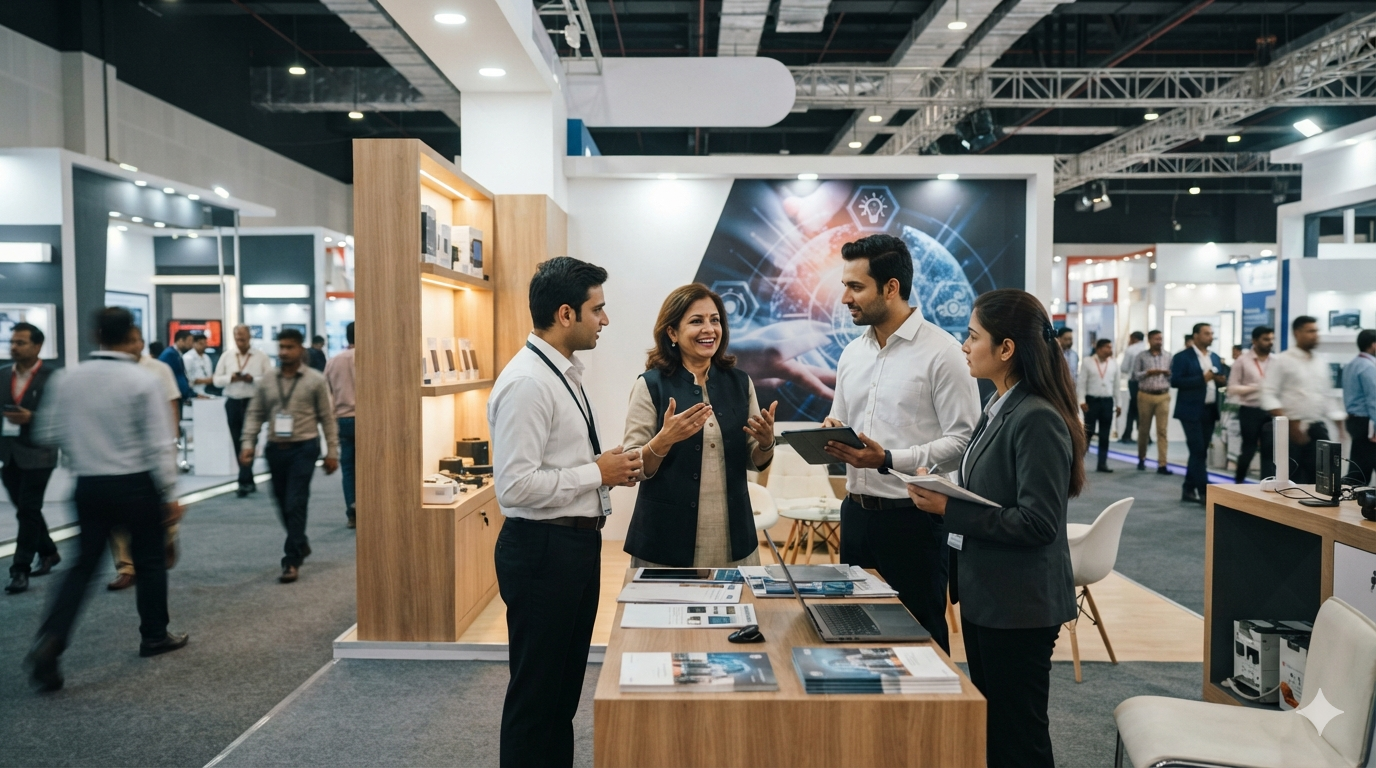
Major trade exhibitions in India are full of energy. Walk into one and you will find:
- Brightly lit booths
- Live product demonstrations
- Large displays
- Crowded aisles
- Thousands of visitors
The atmosphere creates a powerful impression that business is happening everywhere.
For first-time exhibitors, this excitement can create the assumption that simply participating in an exhibition will automatically bring business but that assumption can be costly.
The truth is simple: a stall does not create business on its own.
An exhibition is only a starting point. The real value comes from what happens before, during and after the event. It depends on how well you prepare, whom you meet, how you present your company and how effectively you follow up.
Many SMEs judge an exhibition by the number of visitors they attract, photographs they take, enquiries they collect or business cards they bring back.
Experienced exhibitors look beyond these numbers.
They ask one important question:
How much business will this exhibition generate over the next one or two years?
That shift in thinking separates companies that build long-term growth from those that leave exhibitions disappointed.
Exhibitions Are Not Marketplaces. They Are About Building Trust
Many first-time exhibitors enter a trade show expecting immediate results.They expect visitors to walk into their stall, show interest in the product and place orders instantly but that is rarely how B2B business works.
Think about it.
Would a company purchase a ₹50 lakh machine after a ten-minute conversation?
Would a hotel chain change its food supplier after simply seeing a brochure?
Would a hospital invest in expensive medical equipment after collecting a catalogue?
The answer is usually no.
Large business decisions require time, evaluation and trust.
An exhibition is not the final deal, it is the first conversation.
It gives buyers a chance to understand your company, evaluate your products and decide whether they can trust your business.
In many industries, the actual sale happens weeks or even months after the exhibition ends.
This is where many SMEs become frustrated.
“We collected hundreds of enquiries, but where are the orders?”
The issue is often not the exhibition, the issue is expecting a three-day event to deliver immediate business.
Why Companies Still Invest Crores in Exhibitions
If exhibitions do not always generate immediate sales, why do global companies continue spending millions on them every year?
Because they understand one important fact:
Business begins with relationships before transactions.
A website can showcase a product.
A brochure can explain features.
A video can demonstrate performance.
But nothing replaces a direct conversation.
At an exhibition, buyers can see your product, ask questions, compare competitors and understand whether your company has the capability to deliver. This first impression can decide whether you become part of a buyer’s future plans.
In industries where purchasing decisions involve lakhs or crores of rupees, trust often matters more than price. This is why exhibitions continue to remain relevant even in the age of digital marketing.
Is Exhibiting the Right Choice for Every SME?
The answer is not always yes.
Exhibiting can be one of the most expensive marketing decisions an SME makes. The stall fee is only the beginning. Companies must also factor in additional costs such as booth construction, product transportation, travel and accommodation, printing material, product samples, electricity and internet charges, insurance, temporary staff, demonstration equipment and hospitality expenses.
A modest exhibition participation can easily cost an SME anywhere between ₹5 lakh and ₹25 lakh.
International exhibitions can cost several times more.
This investment makes sense only when the company is prepared.
If a business has limited production capacity, weak customer support, an unfinished product or no sales follow-up system, an exhibition may simply highlight those weaknesses.
Visibility without preparation can become expensive.
Five Questions Every SME Should Ask Before Booking a Stall
Before signing up for an exhibition, companies should answer five important questions.
1. Why are we exhibiting?
Reasons like “Because our competitors are participating” is not a strategy. A clear objective could be building a dealer network, finding export buyers, launching a product or generating OEM enquiries.
Every exhibition should have one primary goal.
2. Who exactly do we want to meet?
The right audience matters more than a large crowd. Many exhibitors proudly talk about meeting thousands of visitors but visitor number alone does not guarantee that an exhibition will be successful.
A manufacturer only needs serious buyers to justify the entire amount invested in the exhibition.
3. Can we handle the business we want to win?
Before chasing new opportunities, businesses must ensure they have the production capacity, supply chain, service support and financial systems to fulfil commitments. Winning new customers is exciting, but failing to deliver on commitments can damage a company’s credibility
4. Do we have a proper follow-up plan?
Collecting 500 enquiries may sound impressive, but converting those leads into business requires discipline and a proper follow-up process. Many SMEs make the same mistake: they invest significant time and money in the exhibition but fail to focus on what happens afterwards. Once the event ends, delayed follow-ups can make leads go cold and valuable opportunities can be lost.
5. Can we wait for results?
Exhibitions are rarely thirty-day investments. In many industries, the real returns appear over a period of 12 to 36 months. Companies expecting immediate orders often walk away disappointed, while those that consistently build relationships are more likely to achieve long-term results.
The Most Expensive Mistake Exhibitors Make
One mistake is repeated by many exhibitors year after year. Companies spend weeks designing their stalls, selecting furniture and investing in lighting, banners, brochures and giveaways. However, they often spend very little time preparing the people who will represent them. This can be a costly mistake.
Visitors may notice an impressive booth, but they remember meaningful conversations. A trained representative who understands the product, listens carefully and answers questions confidently can create far more value than an expensive stall managed by an unprepared team.
A booth may attract attention, but people create business.
The Exhibition Does Not Start on Opening Day
Professional exhibitors understand that the real preparation starts months before the event while first-time exhibitors often make the mistake by believing that an exhibition begins when the doors open.
It involves researching the right exhibition, inviting potential customers, scheduling meetings, preparing products, training employees and creating a clear marketing plan.
The work does not end when the exhibition closes. Systematic follow-ups after the event are equally important because they determine whether conversations turn into business opportunities.
The three or four days of the exhibition are only a small part of the entire journey. An exhibition is not just an event. It is a long-term business development process.
Consistency Creates Competitive Advantage
Many businesses give up on exhibitions after a single disappointing experience and conclude that trade shows do not work but in reality exhibitions often reward patience and consistency.
Buyers notice companies that continue to participate year after year because repeated presence signals stability, commitment and confidence.
A business that is not well known today can become a recognised name over time by consistently showing up at industry events and exhibitions. In business, familiarity builds trust, and trust eventually becomes business.
Coming in Part 2
In the next part, we will explore how SMEs can choose the right exhibition, calculate a realistic budget, design a booth that attracts serious buyers, train their teams and create a six-month preparation strategy to maximise their chances of generating profitable business.
Subscribe Deshwale on YouTube