











India has officially added its 44th site to the UNESCO World Heritage List. The Maratha Military Landscapes, comprising twelve forts, earned their spot in July 2025 during UNESCO’s 47th session in Paris. These forts, built across hills, coasts, islands and forested ridges, showcase the brilliant military planning of the Maratha Empire.
This latest entry is a proud addition. However, it also brings attention back to a bigger question: what are UNESCO World Heritage Sites, and where else in India do we find them? Let’s have a look…
What Is a UNESCO World Heritage Site?
A UNESCO World Heritage Site is not just any historical location. It is a place of “outstanding universal value.” That means it holds meaning for all humanity, not just for the country it is located in.
UNESCO, short for the United Nations Educational, Scientific and Cultural Organization, began listing such sites in 1978. These sites are chosen for their cultural richness, natural beauty, or a unique blend of both. Each selected place is expected to be preserved for future generations.
Being listed can improve global recognition, boost tourism, bring in international funding, and help protect the site with expert guidance.
The Criteria That Decide World Heritage Status
UNESCO uses some strict criteria to decide whether a place qualifies. Here are some simplified examples:
- Cultural Criteria
- Masterpiece of human creativity
- Exceptional architecture or town planning
- Bearer of cultural traditions or beliefs
- Symbol of human interaction with the environment
- Natural Criteria
- Stunning natural beauty
- Example of Earth’s history or geology
- Rare or endangered species habitat
- Exceptional ecosystem or biodiversity
Many Indian sites tick multiple boxes. The Taj Mahal, for example, meets cultural and aesthetic criteria. The Western Ghats meet ecological and scientific ones.
India’s Count So Far: 44 World Heritage Sites
India currently has:
- 34 Cultural Sites
- 7 Natural Sites
- 3 Mixed Sites (which have both cultural and natural elements)
These sites are scattered across the country, from the Himalayas to the coasts, and from ancient cities to untouched jungles.
Spotlight on Cultural Sites
India’s cultural entries show a long timeline of creativity. Here are a few examples grouped by theme:
Ancient Art and Architecture
- Ajanta and Ellora Caves, Maharashtra: Buddhist, Hindu, and Jain rock-cut caves with intricate frescoes and sculptures
- Mahabalipuram, Tamil Nadu: Stone temples and sculptures from the Pallava period
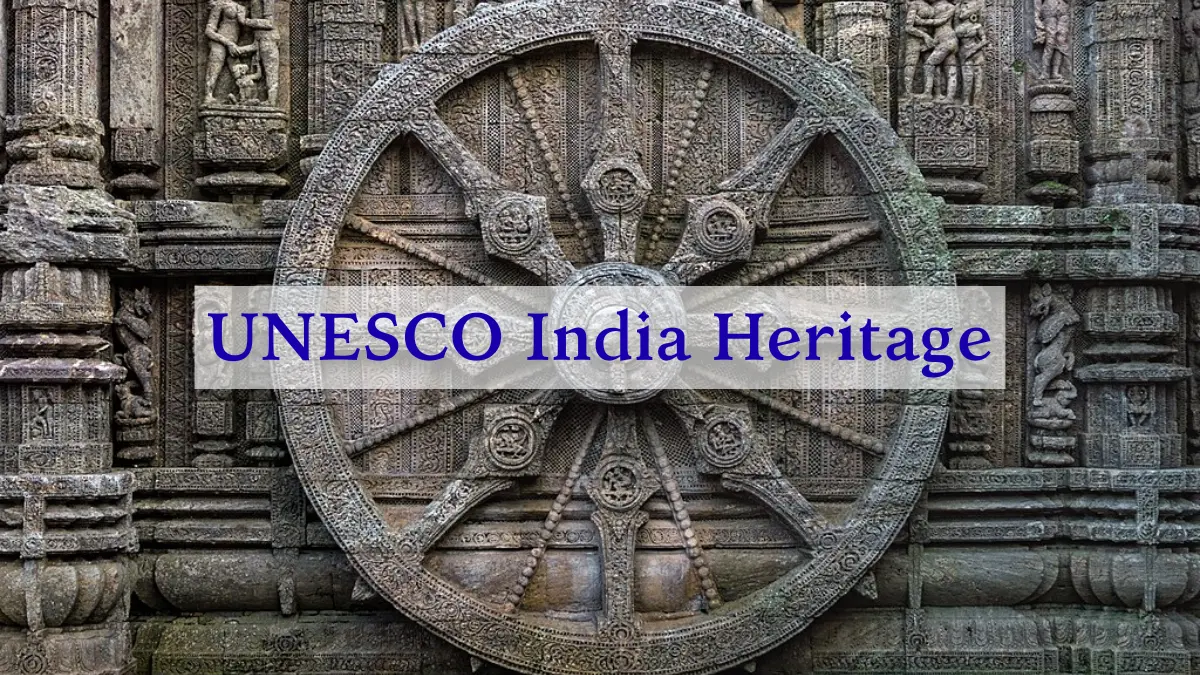
- Konark Sun Temple, Odisha: A chariot-shaped temple with giant stone wheels
Religious Heritage
- Brihadisvara Temple, Tamil Nadu: Example of Chola dynasty temple architecture
- Khajuraho Group of Monuments, Madhya Pradesh: Temples known for their fine carvings
- Churches and Convents of Goa: Reflect Portuguese influence and religious architecture
Forts and Palaces
- Red Fort Complex, Delhi
- Agra Fort, Uttar Pradesh
- Hill Forts of Rajasthan: Includes Chittorgarh, Kumbhalgarh, Ranthambhore
Historic Cities and Towns
- Jaipur City, Rajasthan
- Ahmedabad, Gujarat: India’s first World Heritage City
- Santiniketan, West Bengal: The university town shaped by Rabindranath Tagore
Unique Cultural Expressions
- Rani-ki-Vav, Gujarat: A grand stepwell showcasing water architecture
- Ramappa Temple, Telangana: Also called Rudreshwara Temple, known for its floating bricks and sculptural work
- Sacred Ensembles of the Hoysalas, Karnataka: The latest cultural addition before the Maratha forts
India’s Natural World Heritage Sites
The natural sites represent landscapes rich in flora and fauna. These include:
- Kaziranga National Park, Assam: Home to the one-horned rhinoceros
- Manas Wildlife Sanctuary, Assam: A Project Tiger reserve and biosphere
- Keoladeo National Park, Rajasthan: A birdwatcher’s paradise
- Nanda Devi and Valley of Flowers, Uttarakhand: A mix of alpine beauty and sacred peaks
- Sundarbans National Park, West Bengal: World’s largest mangrove forest and home to the Royal Bengal tiger
- Great Himalayan National Park, Himachal Pradesh: Full of rare wildlife
- Western Ghats: A biodiversity hotspot across four states
Each natural site has to show value not just in terms of species but also in how ecosystems work or evolve.
Mixed Sites: Where Culture Meets Nature
Three sites in India qualify as mixed heritage:
- Nanda Devi and Valley of Flowers
- Khangchendzonga National Park, Sikkim: Combines sacred beliefs of local communities with rich mountain biodiversity
- Elephanta Caves, Maharashtra: Though primarily cultural, its island setting adds strong natural appeal
These sites highlight how spiritual practices, native culture and environment often go hand in hand in Indian traditions.
What Happens After a Site Is Listed?
Once a site is inscribed, it is added to the World Heritage List and must be protected. Governments are expected to:
- Prevent illegal construction
- Avoid excessive tourism damage
- Preserve cultural practices
- Promote sustainable development
If any site is poorly managed, UNESCO can place it on the “List of World Heritage in Danger.” India does not currently have any site on this warning list.
Why It All Matters
These sites are not just pretty places or tourist attractions. They are proof of India’s timeless contributions to art, science, architecture, nature, and belief systems. They remind us that preservation is not a luxury, but a duty.
Every new entry like the Maratha forts renews India’s global commitment to its past. Every site already on the list continues to carry the weight of stories, sacrifices, and skills of those who built or protected it. To explore all 44 sites officially, visit the official UNESCO World Heritage List page:
https://whc.unesco.org/en/list/?order=country&mode=list


