











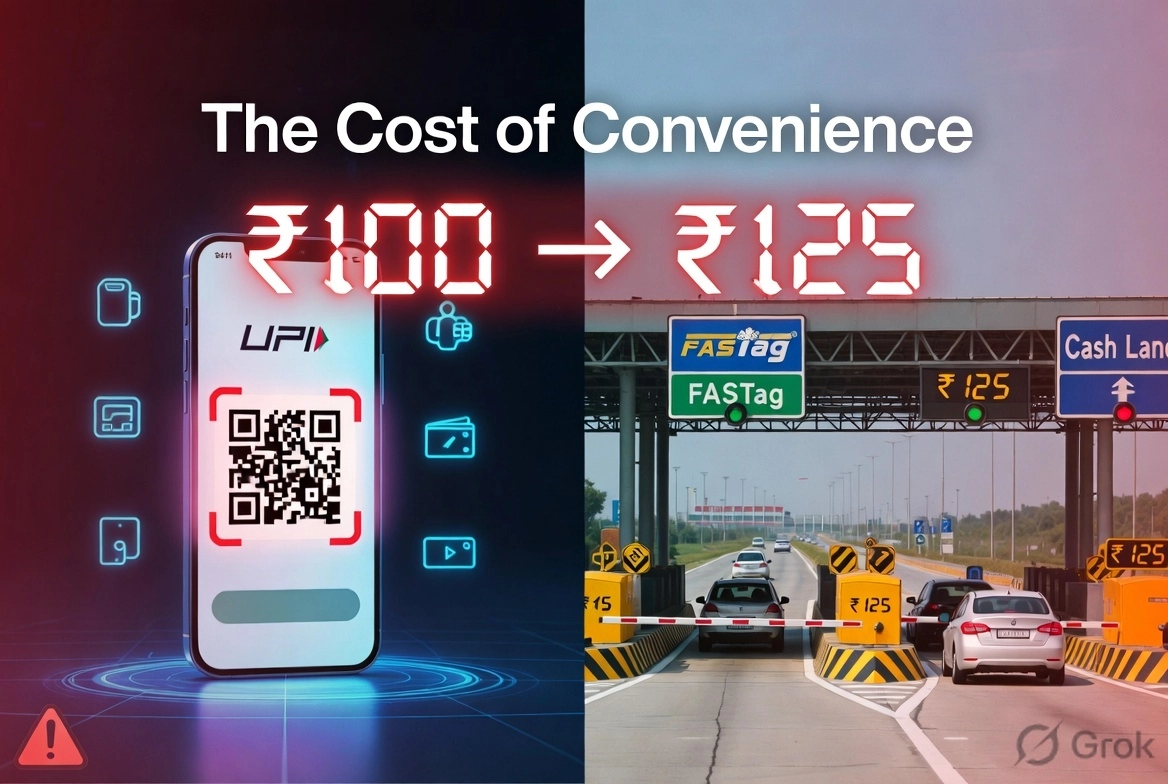
The same government that took UPI to the world stage is now penalising its own citizens for using it. Here’s the quiet contradiction buried inside India’s new toll plaza rules.
There’s a particular kind of irony that only governments can pull off with a straight face.
In 2016, India launched UPI the Unified Payments Interface and told its 1.4 billion citizens that the future of money was digital. No cash, no queues, no friction. Just a phone, a QR code, and a tap. The pitch worked. India today processes more real-time digital transactions than the United States, United Kingdom, and Germany combined. The government didn’t just build UPI it took it on a world tour, proudly deploying it in Singapore, France, the UAE, and Bhutan, presenting it as India’s gift to global finance.
Now, from April 10, 2026, if you pull up to a toll plaza on any national highway in India and open that same UPI app to pay your toll the one the government asked you to download, the one they promoted in every television ad, the one they called the pride of Digital India you will be charged 25% extra for using it.
Let that sit for a moment.
What the New Rules Actually Say
The Ministry of Road Transport and Highways, through a gazette notification, has amended the National Highways Fee Rules, making FASTag compulsory and removing cash payments entirely at toll plazas across the country from April 10, 2026.
The logic, on the surface, is reasonable. FASTag, the small RFID sticker on your windshield that deducts toll automatically as you drive through, is fast, seamless, and requires zero human interaction. It’s the gold standard. Cash, on the other hand, slows everything down. A single cash transaction at a busy toll booth can hold up dozens of vehicles. The queues, the change-counting, the arguments eliminating all of that makes sense.
But here’s where the policy takes a strange turn.
Under the new rules, vehicles entering a toll plaza without a valid FASTag can still pay but only via UPI, and at a surcharge of 1.25 times the applicable toll fee. So if your toll is ₹100, you now pay ₹125. If it’s ₹200, you pay ₹250. The meter runs the moment you reach for your phone instead of your windshield sticker.
The government’s own explanation is that UPI is being kept only as a “fallback” a last resort for those who arrive unprepared. FASTag is the intended method. UPI is the penalty lane.
But calling UPI a penalty lane is, itself, a remarkable sentence to write about a payment system India spent a decade building and exporting.
The People This Hits Hardest
Policies look clean on paper. On the road, they meet real people.
Consider the long-distance truck driver who crosses six or seven toll plazas in a single overnight haul. He may have a FASTag but if his account balance runs out at 2 AM, or if his tag gets flagged as inactive due to a KYC mismatch he doesn’t know about, he’s now paying a 25% surcharge on every single toll until morning when he can sort it out. That’s not a minor inconvenience. For someone doing this every week, it’s a meaningful cut from an already thin income.
FASTag was introduced as a pilot in 2014 and was only mandated for four-wheelers in February 2021. That five years of mandated use and yet inactive tags, blacklisted tags, and tags with failed KYC remain a very real problem for millions of vehicle owners who don’t monitor their FASTag accounts closely. These are not negligent people. They are ordinary people navigating a system that has never been entirely smooth.
The new rules also close another common workaround: individuals from certain government departments had previously been able to display identity cards to claim toll exemptions, even during personal travel. The new notification clarifies that toll exemptions are linked to official vehicles and authorised usage, not individuals. That’s a fair correction. But it means yet another group government employees used to a certain informal arrangement will now encounter the system differently, and sometimes expensively.
The ₹3,075 Question
There is a smarter path built into this system, and the government wants you to find it.
The NHAI’s FASTag Annual Pass costs ₹3,075 for 2026–27 revised upward from the earlier ₹3,000 and covers up to 200 toll crossings per year across over 1,150 fee plazas on national highways and expressways. For a frequent highway user, this is genuinely good value. At roughly ₹15 per crossing on average, it undercuts per-trip tolls significantly.
But not everyone is a frequent highway user. Not everyone knows the annual pass exists. And not everyone who drives on national highways is a salaried professional with a bank-linked smartphone and a perfectly maintained FASTag account.
India’s highways are also used by migrant workers travelling home for a festival, by farmers taking produce to a distant market, by families driving to a hospital in a bigger city. For these users, the system’s architecture FASTag first, UPI as an expensive backup, cash gone entirely was not designed with them at the centre.
The Deeper Contradiction
To be fair, the government’s goal with this policy is legitimate. By removing cash entirely, NHAI expects to significantly reduce waiting times during peak seasons and eliminate the notorious “toll gate crawls” that burn fuel and fray nerves across the country. That’s a genuine public good. Faster highways mean lower logistics costs, which eventually trickle down to the price of goods. The case for going fully digital is not a bad one.
But the specific choice to price UPI as a punishment rather than as an equal alternative reveals something uncomfortable about how policy gets made when the people designing it don’t have to live with its consequences.
UPI works. It is instant, encrypted, and free to use in virtually every other context in India. Your neighbourhood vegetable vendor accepts it. Your auto-rickshaw driver accepts it at par. The government-run canteen on a railway platform accepts it. Only at a national highway toll booth a government-owned, government-operated facility does using UPI suddenly cost you 25% more.
The message being sent, intentionally or not, is that UPI is acceptable enough to sell to Singapore, but not reliable enough to be treated equally on India’s own roads.
This rule change is, ultimately, part of a broader shift toward barrier-free tolling, a future where vehicles don’t stop at all, cameras read number plates, and toll charges are deducted automatically from linked accounts. That vision is genuinely exciting. A highway where you never slow down, never search for your phone, never worry about your FASTag balance. That’s the end goal, and it’s worth working toward.
But transitions matter. The people caught between where India is and where it wants to be deserve a system that doesn’t charge them extra for doing something the government spent ten years telling them was the right thing to do.
India built UPI to free its citizens from the tyranny of cash.
At a toll booth, starting tomorrow, the price of that freedom is ₹25 on every ₹100.
Subscribe Deshwale on YouTube


