










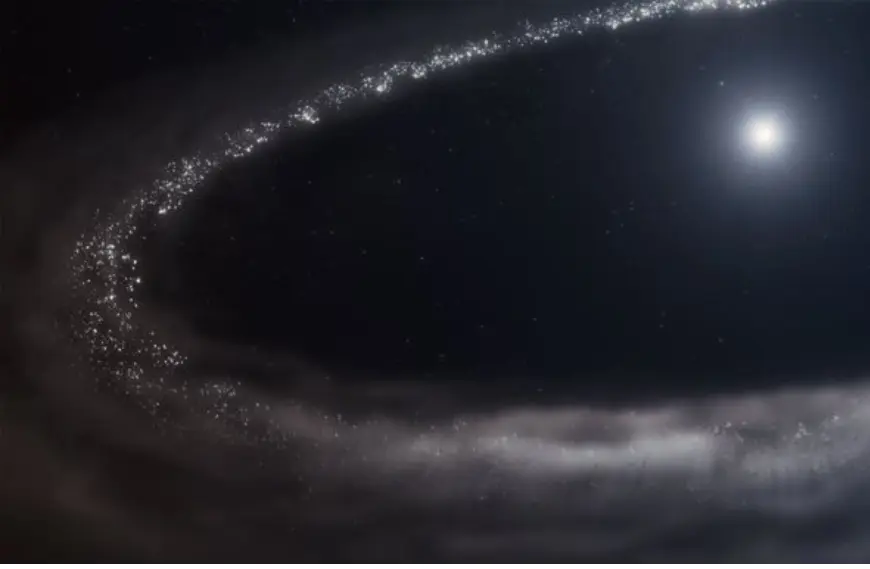
A star system holds icy secrets. NASA’s James Webb Space Telescope has confirmed crystalline water ice in a dusty disk around a young star. Named HD 181327, this Sun-like star lies 155 light-years away. The discovery, published in Nature on 14 May 2025, marks a first in astronomy.
Astronomers long suspected frozen water in other star systems. Water vapour and solar system ice offered clues. In 2008, NASA’s Spitzer Telescope hinted at ice in HD 181327’s disk. Its data lacked precision. Webb’s Near-Infrared Spectrograph (NIRSpec) changed that. It captured detailed spectra, proving water ice exists.
The star, aged 23 million years, is young. Our Sun, by contrast, is 4.6 billion years old. HD 181327 is slightly hotter and more massive. Its debris disk, like our Kuiper Belt, brims with icy bodies. Collisions create “dirty snowballs” of ice and dust. Webb detected these particles clearly.
Ice distribution varies. The disk’s outer regions, coldest and farthest, hold over 20% water ice. The middle contains about 8%. Closer to the star, ice nearly vanishes. Ultraviolet light likely vaporises it. Some ice may hide in planetesimals, rocks too large for Webb to detect.
This finding excites scientists. Water ice shapes planet formation. It helps giant planets form and may reach rocky planets via comets. The disk’s activity mirrors our Kuiper Belt’s past. Regular collisions release icy dust, offering a glimpse into planetary system growth.
Christine Chen, an astronomer at the Space Telescope Science Institute, co-authored the study. She noted the data’s similarity to Kuiper Belt observations. “Webb’s sensitivity is unmatched,” she said. Previous telescopes couldn’t confirm ice in such disks.
The discovery opens new doors. Researchers will study ice in other star systems. They aim to understand planet formation better. Water ice’s role in delivering water to habitable planets is key. This could reveal how Earth became life-friendly.
Webb’s work continues. Its instruments probe distant worlds and cosmic origins. This icy breakthrough is just the start. As more disks are studied, the puzzle of planetary systems will unfold.


