









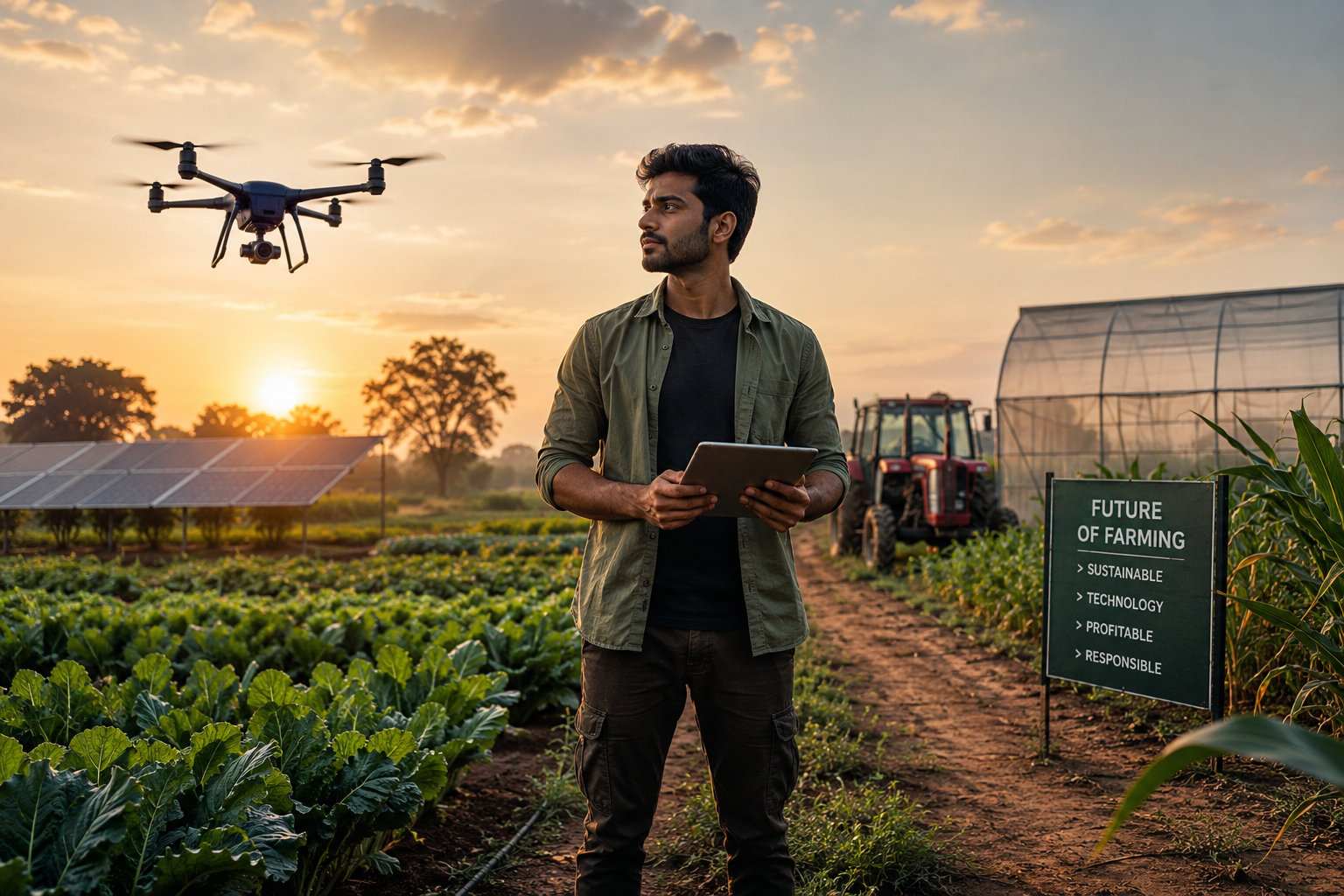
There is a particular kind of courage in walking away from everything you were told to want. An engineering degree. A city job. A salary that impresses people at family gatherings. And then choosing, of your own free will, to go back to the village. Back to the land. Back to the farm that your parents spent their entire lives trying to escape.
This is the choice a quiet but growing number of young Indians are making. And the world they are returning to looks nothing like the one their parents left.
Agriculture has always been the backbone of this country, a fact India both celebrates and quietly resents. The sector employs about 42% of the country’s workforce yet contributes only around 16% to its GDP. For decades, that gap told one story: farming was survival, not ambition. It was what you did when you had no other option. Education was the ladder out. The city was the destination. The farm was the past.
But something shifted. Between 2019 and 2022, roughly 56 million Indians returned to agriculture, according to the India Employment Report 2024 jointly published by the International Labour Organization and the Institute for Human Development. The report noted that the COVID-19 pandemic had reversed a 20-year trend of youth moving away from farming into non-farm sectors. Job losses in cities pushed many back. But not all of them stayed reluctantly. Some looked at the land they had returned to and saw something they had never seen before possibility.
The ones choosing farming consciously are not doing it out of desperation. They are doing it with laptops, drones, YouTube channels, and business plans. They are part of a new wave of what researchers and agri-entrepreneurs are now calling “agripreneurs” young, often educated Indians who are approaching the farm not as a field to till, but as a business to build.
Take the story of Gnana Saravanan and Krishnasudha, a couple who left their IT careers to take over a 36-acre family farm and turn it into Deesan Farms. They combined organic cultivation with biodigesters, dairy units, and intercropped fruit trees. They produce value-added products like cold-pressed coconut oil and ghee, host thousands of visitors, and have trained over 15,000 farmers in sustainable practices. Their farm is not a step back. It is a startup.
Stories like theirs are no longer rare. Across Tamil Nadu, Karnataka, Maharashtra, and Andhra Pradesh, a generation that studied science and business is now applying that knowledge to soil health, supply chains, and direct-to-consumer markets. They are skipping the middlemen who have historically eaten into farmers’ margins. They are selling organic produce directly to urban consumers who are increasingly willing to pay more for food they can trace back to a face and a field.
The technology backing this return is real and rapidly growing. India now has over 4,990 active agritech companies as of early 2026, and the sector has collectively raised over $6.44 billion in funding. The agritech market, valued at around $974 million in 2025, is projected to reach $2.52 billion by 2034. These are not small numbers. They signal that investors and entrepreneurs have recognised what young farmers on the ground already know Indian agriculture, at barely 1% technology penetration, is one of the largest untapped opportunities in the world.
The move toward natural and organic farming is another defining feature of this new wave. In Andhra Pradesh alone, about 1.76 million farmers have now embraced natural farming a number that stood at just 40,000 when the state government launched its community-managed natural farming scheme in 2016. Research has found that natural-farm paddy generates 27% higher net returns compared to conventional farming, primarily because it slashes input costs. Across India, over 2.7 million hectares of land are now under organic certification, according to FSSAI data from 2024. The shift is not just ideological. It makes financial sense.
What is driving young Indians back to the farm is also, in part, a disillusionment with the world they were chasing. The city promised a certain kind of life and delivered a certain kind of exhaustion. Long hours. Rising rents. Work that felt disconnected from anything tangible. The farm, by contrast, offered something harder to quantify but impossible to dismiss ownership, purpose, and the particular satisfaction of watching something you planted actually grow.
None of this is easy to romanticise without being honest about the challenges that remain. Farming in India is still deeply vulnerable to climate shocks, water scarcity, and volatile market prices. According to research by the Council on Energy, Environment and Water (CEEW) using IMD data, 75% of India’s districts are classified as extreme climate event hotspots. Erratic monsoons and falling groundwater levels make every season a gamble. The infrastructure for cold storage and fair market access remains inadequate. And for every young agripreneur who makes it work, many more struggle without the safety nets that city jobs provide.
But the direction of the movement is unmistakable. A generation that was told the farm was a dead end is looking at it again with fresh eyes and finding that the dead end was actually an open field. They are not returning to the past. They are building something that has never existed before: a version of Indian agriculture that is ambitious, connected, and deeply, stubbornly alive.
Subscribe Deshwale on YouTube


