



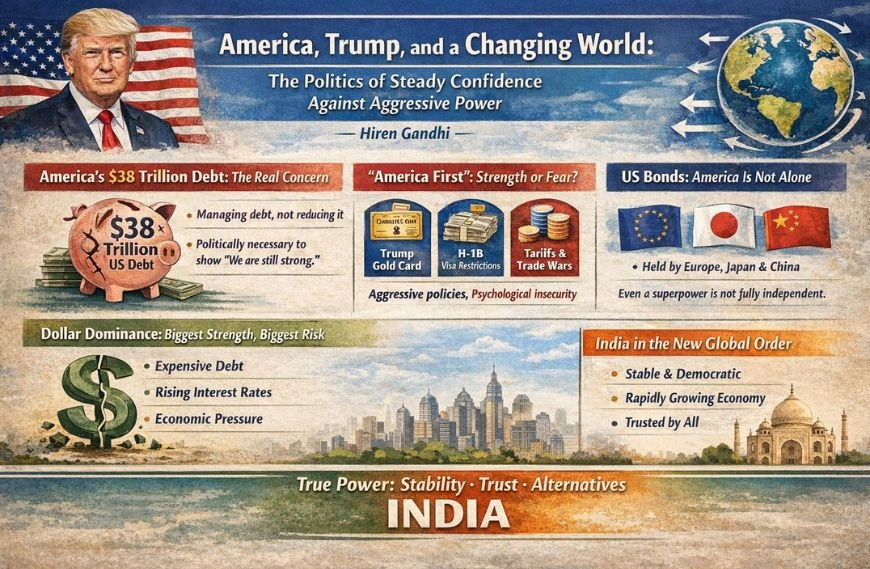
By: Hiren Gandhi
A growing body of geopolitical analysts believe that the United States’ increasingly assertive foreign and economic policies reflect deeper internal economic pressures rather than pure strategic confidence. With government debt nearing USD 38 trillion, America faces mounting fiscal challenges that are shaping political decisions and global diplomacy.
Observers note that when major powers come under economic strain, they often project strength externally to maintain domestic confidence. Former US President Donald Trump’s policy framework is widely seen through this lens, particularly his “America First” approach, which emphasised economic nationalism, border control and trade protection.
Rising Debt Puts Pressure on US Leadership
The United States’ expanding debt burden has become a central concern. Annual interest payments alone now represent a significant strain on federal finances. Economists point out that the country is no longer focused on reducing its liabilities, but rather on sustaining debt servicing without destabilising the economy.
This financial reality has increased political pressure on leaders to demonstrate economic strength to voters, often through symbolic policy moves and strong nationalist messaging.
“America First” Policy Signals Economic Anxiety
Trump’s flagship slogan focused on keeping capital, jobs and industrial capacity within US borders. Measures introduced during his tenure included tighter immigration controls, increased visa fees, remittance charges, higher tariffs and reduced engagement with international organisations such as NATO and the World Health Organization.
While these actions were presented as protective measures, analysts argue they offered psychological reassurance more than long-term economic stability.
Trump Gold Card Draws Mixed Reactions
One such initiative was the introduction of the Trump Gold Card programme, which allowed wealthy foreign investors to obtain residency in exchange for capital inflows. Although the scheme attracted attention, experts believe its financial impact was limited when compared to the scale of America’s debt obligations.
They describe it as a short-term revenue tool rather than a sustainable fiscal solution.
Immigration and Currency Control Measures
Trump-era immigration restrictions and visa reforms were also aimed at controlling capital outflows. The US dollar remains America’s strongest global asset, underpinning its economic dominance. However, economists warn that excessive restrictions risk weakening international confidence and encouraging countries to reduce reliance on the dollar.
Trade Wars Create Long-Term Risks
The aggressive tariff policies adopted during the trade war period were designed to protect domestic industries. However, economists caution that such measures often lead to inflation, weakened trade partnerships and market uncertainty.
Trade experts emphasise that global commerce is driven by stability and trust rather than confrontation.
Reduced Global Engagement Raises Concerns
Washington’s reduced financial contributions to NATO and the WHO were justified on cost-saving grounds. While this lowered immediate expenditure, foreign policy analysts argue that America’s global leadership credibility suffered as a result.
Dollar Dominance Faces Structural Challenges
The US dollar’s role as the world’s reserve currency remains central to America’s economic influence. However, any significant reduction in its use in international trade could lead to higher borrowing costs, rising interest rates and increased economic stress.
Foreign Bond Holdings Highlight Interdependence
Europe, Japan and China collectively hold large volumes of US government bonds. Analysts note that large-scale sell-offs could disrupt financial markets and place pressure on US borrowing capacity, underlining the interconnected nature of the global economy.
Europe, Canada and Britain Seek Strategic Balance
European nations have increasingly pursued cautious engagement with Russia, driven by energy dependence and war fatigue. Meanwhile, Canada’s outreach to China has been viewed as a signal that alternative partnerships remain available if US trade pressure intensifies.
Post-Brexit Britain has also strengthened diplomatic engagement with China, seeking economic stability amid changing global alliances.
India Emerges as a Stable Global Player
In contrast to confrontational responses, India adopted a measured approach when faced with US trade pressure. Rather than escalating tensions, New Delhi diversified export markets, strengthened domestic consumption and maintained consistent diplomatic engagement.
Analysts believe this strategy has helped India strengthen its economic position without damaging international partnerships.
India’s Role in a Multipolar World
As the global order shifts towards multipolarity, India is increasingly viewed as a balanced power capable of engaging with multiple blocs. Its diplomatic flexibility allows cooperation across regions without becoming dependent on any single alliance.
India’s economic indicators continue to support this perception. The country’s GDP stands between USD 3.6 trillion and USD 3.8 trillion, while foreign exchange reserves are close to USD 700 billion, reinforcing investor and partner confidence.
Changing Definition of Global Power
Experts argue that global influence is no longer defined by military aggression or political pressure alone. Stability, economic resilience and strategic partnerships are becoming the new markers of power.
In this evolving landscape, India’s steady growth model and diplomatic positioning are increasingly being recognised as key strengths shaping the future of international relations.

Secretary — InGlobal Business Foundation (IBF)
Director — ReNis Agro International LLP, Ahmedabad, India
Subscribe Deshwale on YouTube
