



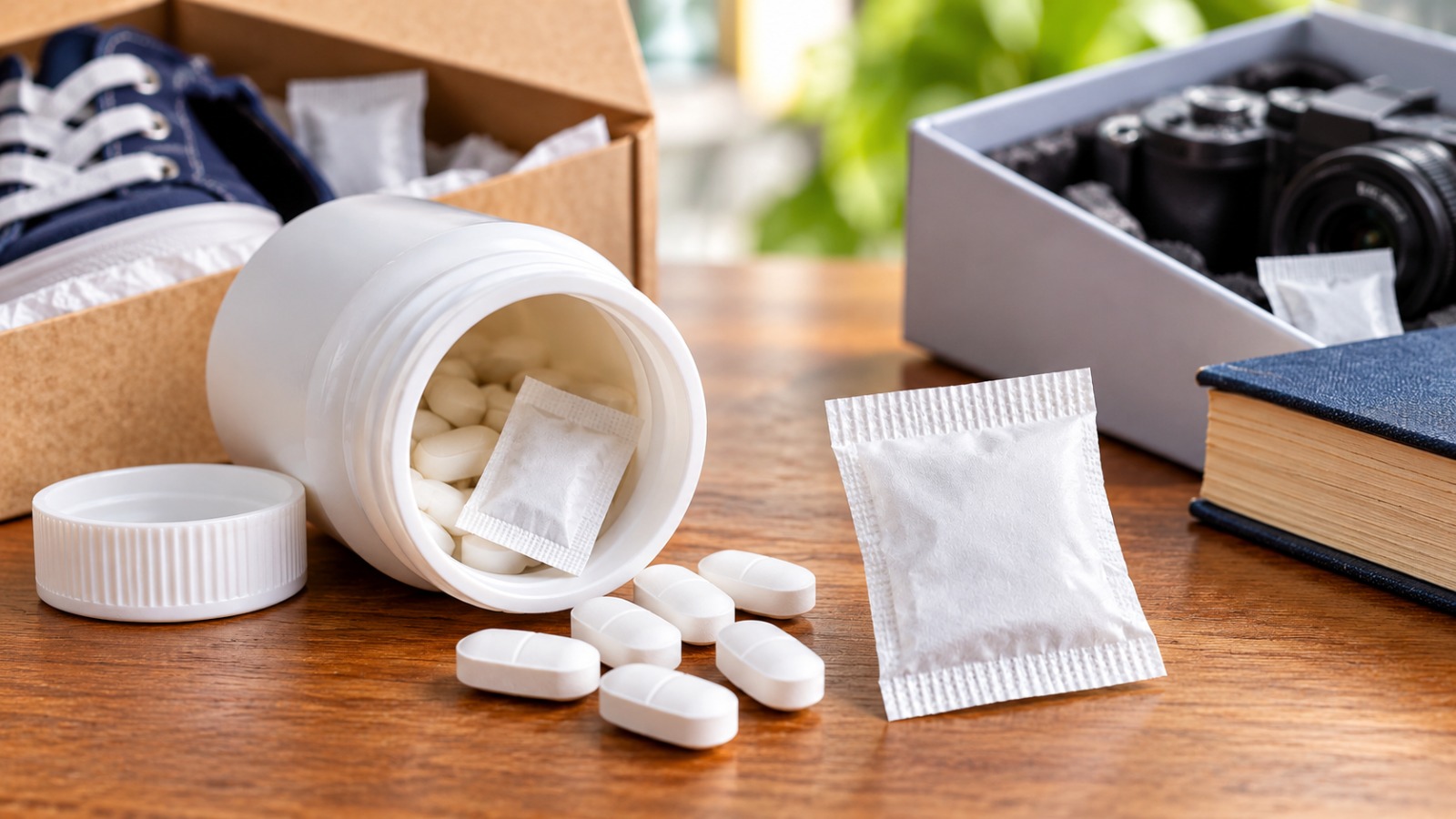
It sits quietly inside medicine bottles, shoeboxes and electronic gadgets. Most people barely notice it. Yet, this tiny packet performs an important task, protecting everyday products from an invisible enemy: excess moisture.
Have you ever opened a bottle of medicine and found a small white packet inside? Perhaps you have spotted a similar one in a new pair of shoes, a handbag or a box containing an electronic gadget. It often carries a warning: “Do Not Eat.”
Many people throw it away without a second thought. Some wonder what it contains. A few may even mistake it for a small packet of powder.
The answer is usually silica gel, a material that quietly protects many of the things we use every day.
A Tiny Packet with a Remarkable Job
Silica gel is a porous form of silicon dioxide, a compound also found in sand and quartz. Unlike ordinary sand, however, silica gel has a structure filled with countless microscopic pores. These provide an enormous surface area on which water molecules can collect.
Depending on the type, just one gram of silica gel can have a surface area of several hundred square metres.
This unusual structure makes it an effective desiccant, a substance used to control moisture. It attracts and holds water molecules from the surrounding air through a process known as adsorption. In simple terms, moisture clings to the surface of the material and occupies its tiny pores.
Unlike a sponge, silica gel does not need to become visibly wet to do its job. The beads may look almost unchanged even after collecting moisture.
Why Is It Inside a Medicine Bottle?
Moisture can affect certain medicines. Depending on their formulation, exposure to humidity may cause tablets to soften, break down, become sticky or lose stability.
Manufacturers therefore use suitable packaging to protect medicines from environmental conditions. In some bottles, a small desiccant packet or container helps control the moisture inside.
That little packet is not an extra medicine, nor is it meant to be consumed. It is part of the packaging’s moisture-control system.
There is an important distinction, though. Not every packet found in a medicine container necessarily contains silica gel. Other moisture-control materials may also be used, depending on the product and its packaging.
The safest approach is to follow the instructions on the medicine label and packaging. Do not remove or discard a component if the manufacturer instructs you to keep it in place.
From Shoes to Electronics
Silica gel’s usefulness extends far beyond medicine cabinets.
New shoes and leather goods may be packed with desiccant sachets to reduce moisture during storage and transport. Excess humidity can encourage mould growth and contribute to unpleasant odours or damage to certain materials.
Electronic equipment presents another challenge. Moisture can contribute to corrosion and interfere with delicate components. Desiccants help protect sensitive products while they are stored or shipped.
Similar moisture-control methods are used in packaging, industrial equipment and other products that need protection from humid conditions.
The principle is simple: by reducing moisture in a suitably enclosed space, a small quantity of desiccant can help prevent a much larger problem.
Is Silica Gel Dangerous?
The warning “Do Not Eat” is there for a reason. The contents are not intended for consumption, and the packet itself can present a choking hazard, particularly to young children.
Silica gel is generally considered to have low toxicity. However, swallowing it is not advisable, and the contents may cause irritation if they come into contact with the eyes or are inhaled. Some desiccants also contain indicator substances or use different chemical materials, so it is unwise to assume that every packet is identical.
Keep these packets away from children and pets. Never open one to taste or examine its contents. If a child swallows a packet or its contents, seek appropriate medical advice, particularly if choking, breathing difficulty or other symptoms occur.
A Small Innovation with a Long History
The scientific development of silica gel stretches back centuries, although its practical applications expanded considerably with advances in chemistry and manufacturing.
During the First World War, silica gel was used in gas-mask canisters to help adsorb vapours and gases. In 1918, chemist Walter A. Patrick patented a method for producing synthetic silica gel, contributing to its wider commercial use.
Today, silica gel remains valuable because it is lightweight, porous and effective at controlling moisture in many enclosed environments.
Some varieties contain special indicators that change colour as moisture accumulates. These can help users judge when the material has reached a particular moisture level. Such indicators are not present in every type of silica gel.
The Value of What We Overlook
The next time you find a little packet inside a medicine bottle or a new pair of shoes, pause for a moment. It may look insignificant, but it represents a practical application of science to an everyday problem.
We often associate innovation with machines, smartphones or spectacular inventions. Yet, some of the most useful ideas are quiet ones. They work in the background, preventing damage before we even realise that a problem could arise.
The little white packet is one such example. It reminds us that progress does not always need to announce itself. Sometimes, its greatest contribution is simply helping the things we value last a little longer.
Subscribe Deshwale on YouTube
