



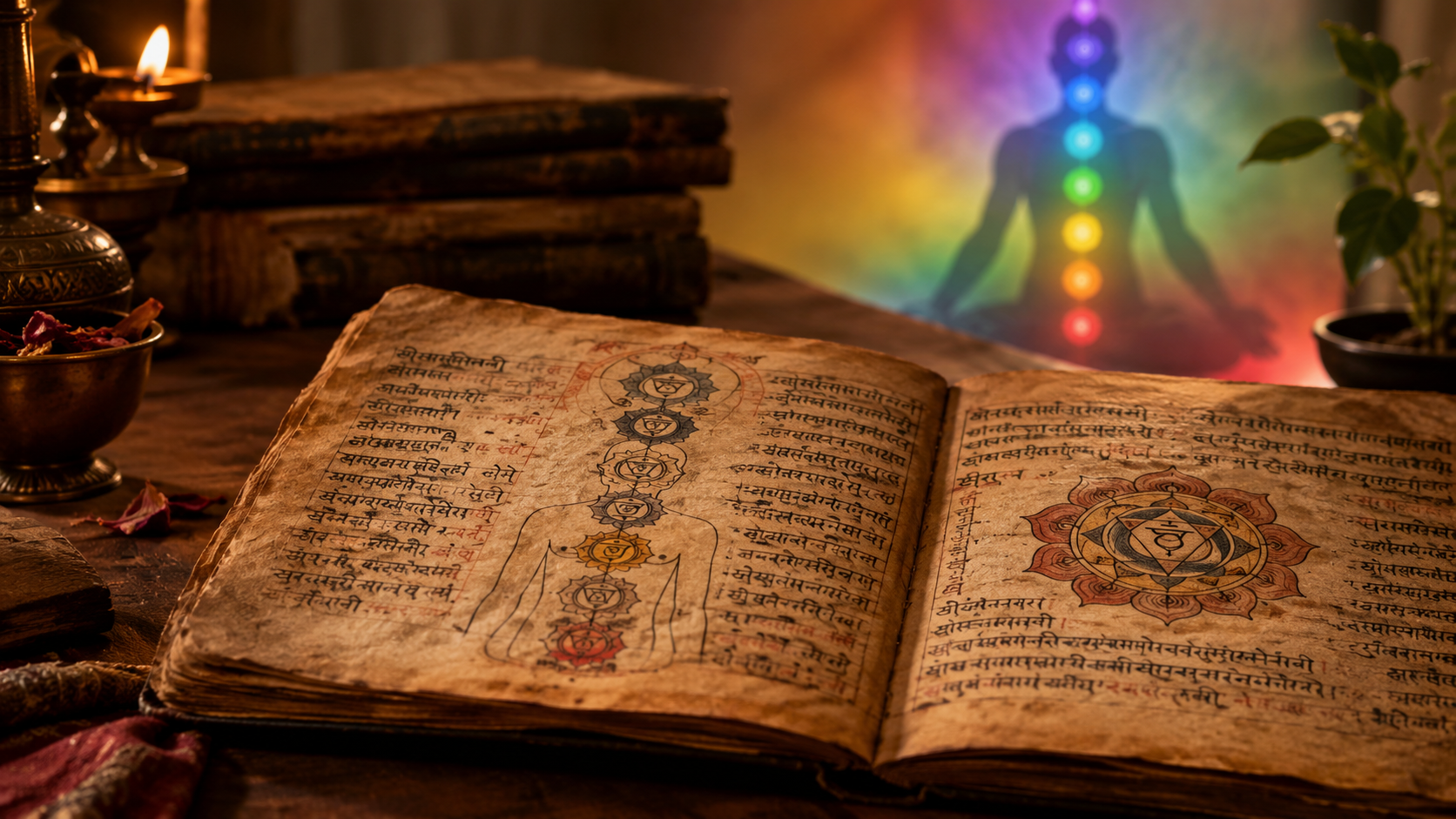
Walk into any yoga studio or open a wellness app, and you will see the same picture: seven glowing wheels along the spine, coloured like a rainbow from red to violet. Most people assume this diagram is thousands of years old. The real story is much shorter, and much more interesting.
The word “chakra” means wheel or circle in Sanskrit. Early references to energy centres in the body appear in the Upanishads, but they look nothing like the seven-chakra diagram seen in yoga studios today. Later traditions gave very different counts. Buddhist texts from around the 8th century mention four or five chakras, while Hindu sources give various numbers. One text linked to the Nath yogi Gorakhnath maps nine chakras, not six or seven. So there was never one fixed, agreed map.
The system we know today took shape in a Bengali tantric text. The standard model of six chakras, plus a final one at the crown, settled into place only in the 16th century, in the Sat-Cakra-Nirupana by Purnananda Yati. The title means “Description of the Six Centres.” It is actually the sixth chapter of a larger work by the same author, the Shri-tattva-cintamani, which was composed in 1577. Notice one detail here. The text names six chakras, with the crown lotus standing as the highest point beyond them. The tidy “seven chakras” label came later.
The idea then travelled to the English-speaking world in stages. The Western chakra system began in the 1880s with the writings of H. P. Blavatsky and other Theosophists. Two books then played a key role. Arthur Avalon’s The Serpent Power (1919) and C. W. Leadbeater’s The Chakras (1927) shaped how the West understood the system. Arthur Avalon was the pen name of Sir John Woodroffe, who translated Purnananda’s text into English. Leadbeater’s book was a Theosophical reading of the idea, not a simple copy of the Indian original.
The biggest surprise is the rainbow. The colours are not in the old Indian texts. In the Indian sources the chakras do have colours, but there is no rainbow. The classical text describes the lotuses in shades such as crimson, vermilion, rain-cloud and smoky purple. The rainbow came much later. Colour-therapy practitioners in the United States and England began assigning the spectrum colours to the chakras in the early to mid 20th century. The two strands finally met in print in 1977, in a book called Bodymind by Ken Dychtwald, who was linked to the Esalen Institute in California. Around the same period, a five-chakra model grew into the seven-chakra model that is popular today. Later authors, such as Anodea Judith with her book Wheels of Life (1987), made it even more widely known.
So, is the seven-chakra model “ancient”? The honest answer is: partly. The idea of energy centres in the body is old, and tantric yoga has worked with it for over a thousand years. But the specific picture most people know, with seven chakras, rainbow colours and a list of emotional meanings, is a modern blend of Indian tantra, Theosophy, colour therapy and 20th-century self-help. This does not make chakras “fake” or the old traditions less important. It only means that the popular version and the traditional version are not the same thing. Scholars such as David Gordon White have pointed out that the seven-chakra model is one version among many. It is also worth remembering that chakras are a spiritual idea, and modern science has not shown them to be physical structures in the body.
The next time you see a seven-colour chakra chart, remember that it is the end of a long journey. It started in old Indian manuscripts, passed through a British translator and Theosophist writers, and was finally colour-coded in the 20th century. The wheels are old. The rainbow is new.
Subscribe Deshwale on YouTube
