



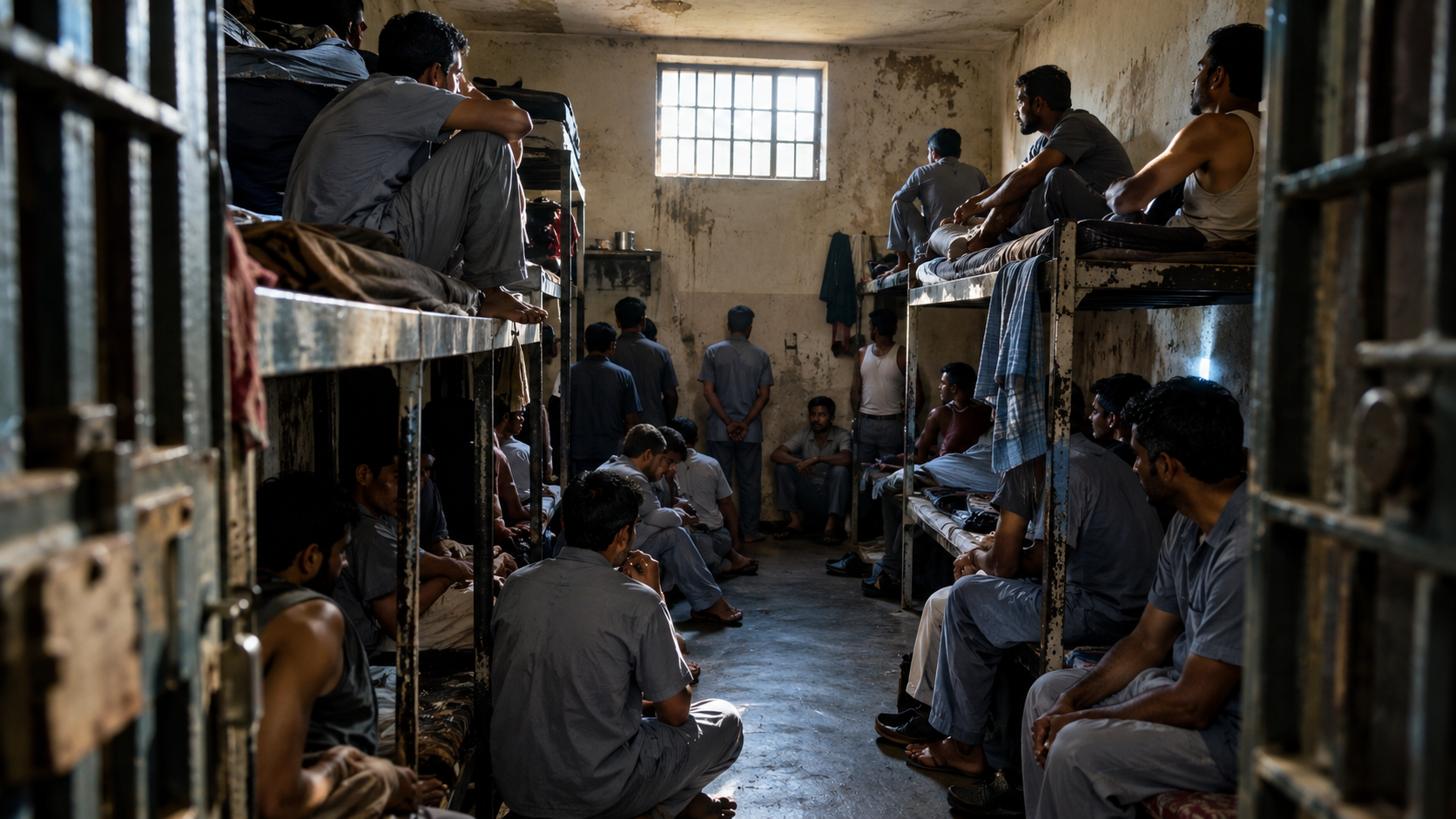
Imagine a room built for ten people. Now imagine thirty living in it, sleeping, eating and waiting there, sometimes for years. This is daily life in many of the world’s jails. And the reason for it is often not what most of us think.
The title suggests one single prison, but experts usually compare whole prison systems, country by country. They use a measure called the occupancy rate, which shows the number of prisoners as a percentage of a system’s official capacity. A score of 100% means every bed is taken, and anything above that means overcrowding.
Around 11.5 million people are in prisons across the globe, and 118 nations hold more prisoners than their prisons were built for.
Ask which country sits at the top, and the answer depends on the list. In the World Prison Brief ranking for 2023, the Republic of the Congo came first at about 617% of its capacity. It was followed by Haiti at 454%, Uganda at 367%, the Philippines at 362% and Cambodia at 346%.
More recent figures for 2025 put Haiti at 302%, still the highest in Latin America and the Caribbean. The numbers change with the year and the source. So the real story is not about one winner. It is about why so many prisons end up this crowded.
Most of us assume that the countries that jail the most people must have the most crowded jails. The data says otherwise.
El Salvador now has the highest incarceration rate in the world, at 1,659 prisoners per 100,000 people. The United States has slipped to fifth place at 541. Yet American prisons are not overcrowded overall. The World Prison Brief put the system at about 86% of its capacity in 2022, although federal prisons ran at about 110%.
India is the opposite case. Its prison population rate is only about 35 to 38 per 100,000, among the lowest anywhere. Even so, Indian jails held 573,220 prisoners in 2022 against a capacity of 436,266. That is an occupancy rate of 131.4%.
So crowding is not about how many people a country locks up. It is about how much space the system has and how fast it moves. A country can jail a few people and still have packed cells if it builds too few prisons or its courts are slow.
The biggest reason is people who have not been convicted of anything. In India, more than 75% of prisoners in 2022 were undertrials, meaning people still waiting for their trial to finish. That share fell to about 74% in the next year’s data, which is still very high.
The wait can be long. In 2021, over 88,000 undertrials, about 21%, had spent one to three years in prison.
India is not alone. In the Congo, around 60% of detainees have not been given a trial. In Haiti, more than 80% of inmates are in pre-trial detention. The pattern is clear. Where trials are slow, jails fill up.
A country’s average can look manageable while some jails are in a terrible state. Cameroon’s overall occupancy was 138%, yet in 2008 New Bell Prison in Douala held four times the number of prisoners it was designed for.
India shows the same gap. The India Justice Report found that 391 of its 1,314 prisons were more than 150% full, and twenty-two were above 500%. Delhi is a clear example. In 2022, its prisons held 18,497 people in space meant for 10,026, an occupancy of 184.5%.
Overcrowding is also shaped by government choices. In the Philippines, the high occupancy rate is partly explained by the anti-narcotics campaign of the Duterte government. El Salvador’s crackdown on gangs, which began in 2022, pushed its incarceration rate to the top of the world.
When a country chooses to arrest more people for certain offences, but does not build more space or speed up its courts, the prisons absorb the pressure.
The good news is that numbers can come down. India’s prison occupancy fell from around 140% in 2002 to about 112% in 2012. But progress did not last. It rose again to over 130% in 2021 and 2022, before easing to 120.8% in 2023.
This up-and-down trend shows there is no one-time fix. Building more jails helps only for a while. The lasting solution lies in the courts: faster trials, fewer people kept in custody before trial, and a justice system that does not treat jail as the first answer.
The next time you read that a country has the world’s most overcrowded prison, remember that the ranking changes from year to year. What does not change is the pattern behind it.
Overcrowded prisons are not simply a sign of a country with too much crime. More often, they point to a system that moves too slowly, with too little space, and too many people waiting for a verdict.
Behind every percentage is a real person sharing a small space with too many others, often without knowing when the wait will end. The ones who pay the price are often those who have not yet been proven guilty. Fixing that is less about building more walls and more about the road that leads people to them.
Subscribe Deshwale on YouTube
