



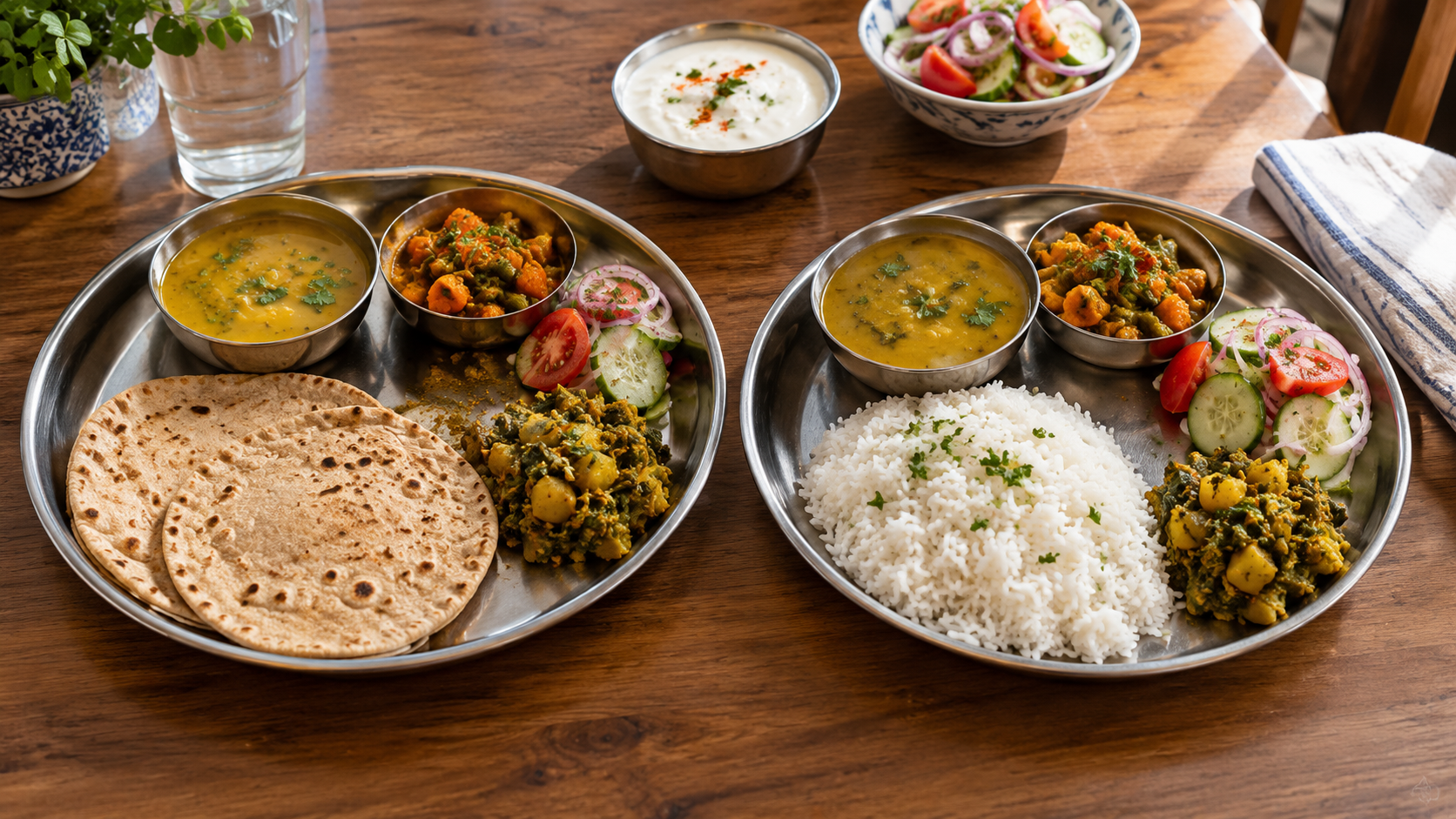
In many Indian homes, there is an unwritten rule about diabetes. If someone’s sugar goes up, rice goes off the plate and roti comes in. Aunties say it, neighbours say it, and even some WhatsApp forwards say it. Roti is “light”. Rice is “heavy”. Case closed. But is it really that simple? Let us take a closer look.
The idea is not completely baseless. Whole wheat roti does have fibre, and fibre slows down how fast sugar enters the blood. White rice, on the other hand, is polished. Most of its fibre is gone, and it is often eaten in big portions. Researchers measure this with something called the glycaemic index, or GI. It tells us how quickly a food raises blood sugar compared to pure glucose. A lower number is generally better. In a study by the Madras Diabetes Research Foundation on 18 healthy volunteers, whole wheat roti had a GI of about 45, which is in the low range. White rice is often reported at around 70 or higher, which is high. On paper, roti wins easily.
Here is the part that rarely makes it to the family dining table. GI is measured on equal amounts of carbohydrate, not on the plate you actually eat. And the numbers are not fixed. Studies have reported a wide range for both foods. Roti made from whole wheat atta behaves very differently from roti made from refined flour. The same goes for rice. Variety, cooking method and how the food is prepared can change the result.
There is also a small study published in 2017 in the Journal of Clinical and Diagnostic Research. Researchers in Mumbai gave 50 grams each of boiled rice and whole wheat chapatti to eight people with type 2 diabetes and six people without it. Rice led to a lower blood sugar and insulin response than chapatti. But the gap between rice and chapatti was not statistically significant. Still, it went against popular belief.
We should be careful here. The study was very small and tested only one variety of rice. Both foods were given in equal weight, not equal carbohydrate. Cooked rice is mostly water, so the rice portion had fewer carbohydrates, and that alone could explain part of the result. It does not prove that rice is better than roti. But it does show that “roti is always safer” is not a rule we can trust blindly.
Now think about how most of us actually eat. One person has two rotis with a little sabzi. Another has a small bowl of rice with plenty of dal and vegetables. Which meal is better? It is the second one, and the grain has nothing to do with it. Protein, fibre and vegetables slow down digestion. That is why dal with rice or roti works better than either of them alone. A big plate of rice with only pickle is a very different meal from a small portion of rice with dal, sabzi and curd.
Portion size matters too. Four or five rotis at one sitting can add up to a similar amount of carbohydrate as a big plate of rice. Roti just looks smaller. And then there is the way we live. Many of us now sit for eight to ten hours a day, whether in an office, at a laptop or in a BPO. Many of our grandparents ate similar food but worked in fields. Their bodies used up that energy. Ours often do not.
So what should you do? There is no need to be afraid of rice or to treat roti as a magic cure. A few simple habits can help more than a swap. Look at the whole plate: fill about half of it with vegetables, keep a part for protein like dal, curd, eggs or paneer, and leave the rest for roti or rice. Choose less refined grains, such as whole wheat atta, millets like jowar, bajra and ragi, and brown rice, which are generally better options than maida or polished white rice. Watch the portion by counting your rotis and being honest about the size of your rice bowl. Never eat the grain alone, and pair it with dal, vegetables or curd. Finally, move more, because a short walk after meals may also help.
The roti-versus-rice debate is popular because it gives us an easy answer. But the body does not work on easy answers. Roti is not automatically healthy, and rice is not automatically harmful. What matters is the type of grain, the portion, what goes with it, and how active you are. So the next time someone tells you to drop rice and eat more roti, smile and ask one question: “What else is on the plate?”
Subscribe Deshwale on YouTube
