









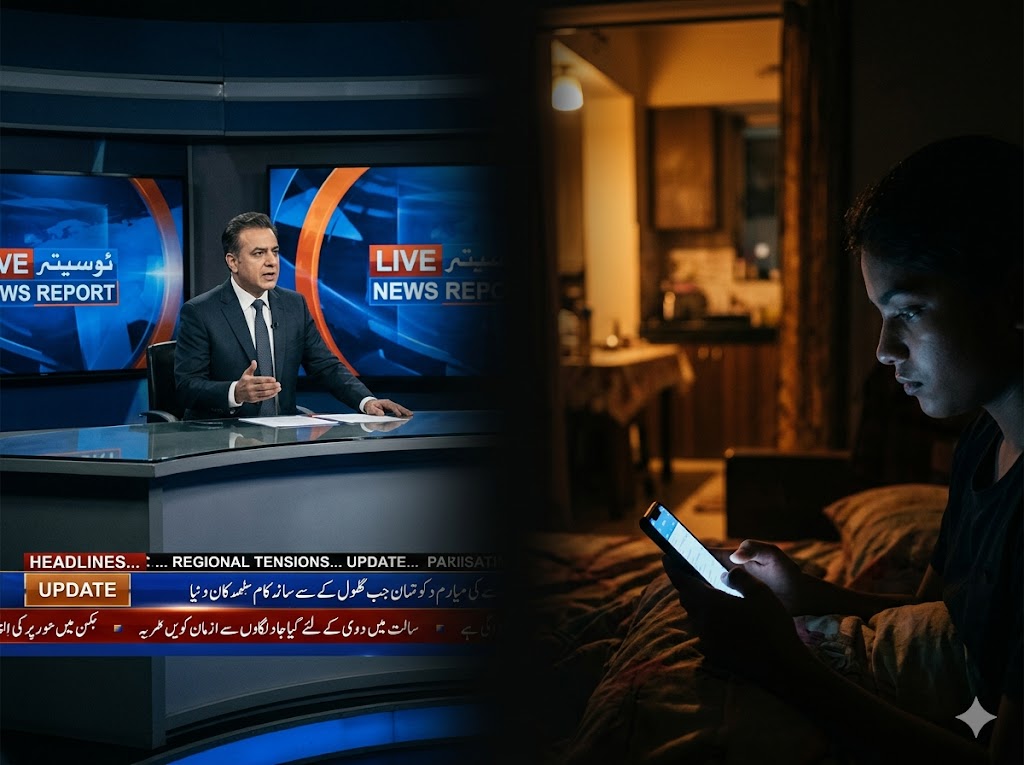
A retired Pakistani diplomat threatens Mumbai and New Delhi on national television. The clip reaches millions of Indian phones within hours. This is not the story of one man’s remarks. It is the story of a war that never stopped, and the new machinery that now fights it at zero cost.
It was an ordinary evening on a Pakistani news channel. The studio looked like all the others: the panel desk, the dramatic lighting calibrated to suggest gravity, the host leaning forward with the kind of performance-grade seriousness that Pakistani prime-time television has made its signature register. The lower-third ticker moved in its continuous scroll. The guests, as always, were men with long careers in the Pakistani state and long opinions about India.
And then Abdul Basit, former Pakistani High Commissioner to India, former resident of the official residence on Shantipath in New Delhi, began to speak about nuclear war.
His argument had the quality of a man thinking aloud, which made it more disturbing, not less. If the United States were to threaten Pakistan’s nuclear programme, he said, and if Pakistan could not reach American soil, and if Israel was also beyond range, then what option would remain? India. Pakistan would strike Mumbai. It would strike New Delhi. Without thinking, he said. Without a second thought.
The studio received this with the mild nodding that Pakistani television panels reserve for remarks sitting within the expected bandwidth of the conversation.
The clip ran for a few minutes. Then it was uploaded. Then it was shared. By the time most of Mumbai was sitting down to dinner, the city had already been named as a nuclear target.
This article is not, in its essential nature, a profile of Abdul Basit. He is a significant actor in this story but he is not the point of it. The real story is about a system. A system that uses retired diplomats as nuclear threateners, television studios as weapons platforms, and the global internet’s algorithm-driven attention economy as a free delivery mechanism. A system that cultivated Indian socialites and opinion-makers over dinner tables in New Delhi while simultaneously supporting separatist violence in Kashmir. A system guided, at its deepest ideological level, by a book written in 1979 that most Indians have never read.
Basit is the face on the television screen. The system is what put him there and what happens after he goes home.
Who Is Abdul Basit, Actually
He served as Pakistan’s High Commissioner to India from 2014 to 2017. Before New Delhi, he had been posted to Germany and Bangladesh, the standard biography of a mid-to-senior Pakistani foreign service officer with a talent for European-style diplomatic comportment and a harder set of ideological commitments underneath.
He arrived in India at a moment that looked, briefly, like something could shift. Narendra Modi had just won a sweeping general election and had, in an early gesture of South Asian diplomatic ambition, invited regional leaders including Pakistan’s Prime Minister Nawaz Sharif to his swearing-in ceremony. The photographs existed. The handshakes happened. The mood in both capitals, among those who wanted to believe in it, was cautiously optimistic.
Basit was sent to manage Pakistan’s end of whatever this opening might become.
He was, by most accounts of people who encountered him during his Delhi years, good at the social dimensions of the job. He was articulate in English. He understood the register of India’s intellectual and cultural elite. He could discuss Partition literature and subcontinental history with the ease of someone who had thought about these subjects and not simply memorised talking points. He was, in short, the kind of diplomat that India’s liberal commentariat tends to find reassuring: a Pakistani official who seemed to understand complexity, who spoke about dialogue without making it sound like a tactical concession.
None of that social fluency was accidental. It was professional.
In August 2014, the diplomatic relationship that everyone had been carefully tending collapsed. Pakistan announced its intention to consult with leaders of the Hurriyat Conference before the scheduled foreign secretary-level talks. India had communicated clearly, using language that left no interpretive space, that such consultations would be unacceptable interference in its internal affairs.
Basit held the meetings with Hurriyat leaders regardless.
India cancelled the foreign secretary talks. There was no ambiguity about why. South Block stated its reasons directly. The meetings with separatist leaders constituted interference in India’s domestic affairs and could not be treated as consistent with the conduct of bilateral diplomacy.
What Basit’s decision in August 2014 revealed, and what the subsequent years of his commentary have continued to confirm, is that his understanding of his role in New Delhi was never what it appeared to be. He was not there primarily to advance bilateral normalisation. He was there to manage Pakistan’s interests, which included maintaining pressure on the Kashmir question through every available channel, including ones that India had explicitly objected to.
Since leaving India in 2017, Basit has been a regular and increasingly hawkish presence on Pakistani television. His commentary on India has grown more extreme over time, not less. The recent remarks about Mumbai and New Delhi are not an aberration in his public record. They are a logical destination.
In Pakistan’s strategic culture, the retired senior official serves a specific and understood function. He provides the state with deniable articulation of positions that official spokespersons cannot state openly. When a former High Commissioner threatens Indian cities on national television, the Pakistani foreign ministry can note, accurately, that he is a private citizen with no current official standing. The statement was never officially made. And yet it was made, it was distributed, and it did its work.
This is not a novel instrument. Pakistan has used it for decades. What is new is the amplification infrastructure that now exists around it.
The Book That Built a Military’s Mind
To understand where Basit’s worldview originates, and where the Pakistani military’s approach to India has its deepest ideological roots, it is necessary to understand a text that receives almost no serious attention in mainstream Indian commentary.
In 1979, Brigadier S.K. Malik of the Pakistani Army published a work called “The Quranic Concept of War.” The book was not a fringe publication. It carried a foreword by General Muhammad Zia-ul-Haq, who was at that time Pakistan’s head of state and the most powerful figure in its military establishment. The book was distributed within the Pakistani Army as doctrinal reading material. It was, in the most precise sense of the term, official thinking about war.
Malik’s central argument was that the Quran provides a complete and self-sufficient guide to the conduct of warfare, and that the highest objective of war, as derived from Quranic principles, is to strike terror into the hearts and minds of the enemy. Not to capture territory. Not to destroy military assets. Not to achieve specific tactical objectives in the conventional sense. To terrorise. To produce a state of psychological collapse in the adversary so complete that their will to resist is destroyed before their military capacity necessarily is.
The book states this with the kind of directness that military doctrine rarely achieves in print. Terror is not, in Malik’s reading, merely an instrument of war. It is the end of war. Everything else, the manoeuvre, the logistics, the conventional engagement, these are means toward the production of terror in the enemy’s consciousness.
The implications for Pakistan’s conduct toward India are not subtle. If the objective of war is psychological collapse rather than military defeat, then the distinction between military targets and civilian targets largely dissolves. Civilian populations are not incidental casualties in this framework. They are the primary audience. Their terror is the metric of success.
Western analysts began citing this book seriously after 2001. Indian strategic thinkers had been tracking it for longer. Its influence is visible in the specific targeting logic of Pakistan-backed operations against India: the 2008 Mumbai attacks were not designed to defeat the Indian Army. They were designed to terrorise a city, to produce globally broadcast scenes of carnage in iconic locations, to make the Indian state look helpless in its own financial capital.
That objective was achieved, at least temporarily. And the choice of Mumbai was not arbitrary. It was the financial capital, the city of maximum symbolic and economic weight, the city whose suffering would produce the most globally resonant images of Indian vulnerability.
When Abdul Basit names Mumbai as a nuclear target on television, he is not departing from Pakistan’s strategic culture. He is expressing, in the idiom of the retired official, the core logic that Malik articulated in 1979 and that Zia endorsed. The civilian population of Mumbai is the target because that is where the terror objective has always pointed.
This is worth sitting with properly. Pakistan’s nuclear signalling against Indian cities is not irrational if you accept the framework that guides it. It is coherent. It is consistent. And it has been consistent for forty-five years.
The Nuclear Grammar: A New Kind of Threat
Pakistan’s nuclear doctrine is deliberately ambiguous. This is not a policy failure. It is the policy itself.
A country with a smaller conventional military than India, with memories of the 1971 war in which it lost half its territory and roughly ninety-three thousand soldiers went into Indian captivity, has every strategic incentive to keep its nuclear threshold undefined. If India does not know where Pakistan’s red lines are, India cannot be certain that any conventional military action will remain below the nuclear threshold. That uncertainty is deterrence, and it has served Pakistan well.
India, by contrast, maintains a No First Use posture. It states clearly that it will not initiate nuclear use, while reserving the right to massive retaliation if struck first. This is a coherent doctrine with clear strategic logic, but it creates an asymmetry in the deterrent space below the nuclear threshold.
Pakistan has exploited this asymmetry through what strategic theorists call the stability-instability paradox. Because both countries have nuclear weapons, neither can risk full conventional war. But precisely because neither can risk full conventional war, Pakistan has an exploitable space for sub-conventional operations: supporting terrorism, funding separatist movements, conducting proxy conflict, all while relying on the nuclear deterrent to prevent Indian conventional retaliation from escalating uncontrollably.
That framework is familiar territory and has been written about extensively. What Basit’s remarks reveal is something less discussed and considerably more significant: a qualitative shift in how Pakistan is now deploying nuclear language in public.
For most of the nuclear era between the two countries, Pakistan’s nuclear signalling operated in what strategists call the deterrence mode. The implicit message was: do not escalate conventionally against us, because we have nuclear weapons and we will use them if existentially threatened. That message was directed primarily at India and was calibrated to prevent Indian military responses to Pakistani-backed provocations.
Basit’s remarks operate in a structurally different mode entirely. He is not warning India against attacking Pakistan. He is telling India that it will be struck as a consequence of American actions against Pakistan’s nuclear programme, actions over which India has no control and in which India has no role. This is compellence logic rather than deterrence logic. Deterrence says: do not act, or we will respond. Compellence says: you will pay for what others do to us, whether you are involved or not.
This shift in public rhetoric from deterrence to compellence is meaningful and has not been adequately analysed in the coverage of this story. Brahma Chellaney, Professor Emeritus at the Centre for Policy Research in New Delhi and one of India’s most rigorous strategic thinkers, has written extensively on what he has characterised as the institutionalisation of nuclear blackmail in Pakistan’s foreign policy toolkit, documenting in his published work how Pakistan’s nuclear posture has, over two decades, migrated from a genuine deterrence instrument into an all-purpose shield behind which every variety of Pakistani state aggression is conducted with effective impunity.
What Basit has done is extend that logic to its most naked public expression: India is not just the target of Pakistan’s deterrence. India is the collateral hostage of Pakistan’s relationship with every other power it has a dispute with. If Washington presses Islamabad, Mumbai burns. If the international community tightens attention on Pakistan’s nuclear programme, Delhi is the invoice.
Happymon Jacob, Professor at Jawaharlal Nehru University’s School of International Studies and founder of the Council for Strategic and Defense Research, has argued in his published scholarship that India has consistently underestimated the degree to which Pakistan’s nuclear signalling is designed for third-party audiences rather than for India itself. The target of Pakistani nuclear rhetoric, in his analysis, is frequently Washington or Beijing rather than New Delhi. India is the named object of the threat. The intended reader is the American policymaker who must now factor Indian civilian casualties into any calculation about pressuring Pakistan’s nuclear establishment.
That reading makes Basit’s statement considerably more calculated than it appeared in the initial Indian media coverage, which treated it primarily as the reckless outburst of a hawkish former diplomat. It may be both things simultaneously: personally felt and institutionally useful.
The March 2026 report from the Office of the Director of National Intelligence in the United States, which flagged Pakistan as a significant nuclear threat alongside Russia and China, provides the precise context for why this compellence logic is surfacing now. For Pakistan’s strategic establishment, being named in an ODNI threat assessment in that company represents a qualitative shift in American perception. Pakistan has for decades presented its nuclear programme as a deterrent specifically calibrated against India. Being categorised as a broader global nuclear threat is a different kind of international pressure and a considerably less comfortable one. Basit’s remarks are the public processing of that pressure, and the processing takes the form of a threat against Indian civilians. India did not ask to be leverage in a conversation between Islamabad and Washington. Here it is regardless.
Operation Sindoor and the Limits of the Military Instrument
In May 2025, India conducted Operation Sindoor. Following the massacre of tourists at Pahalgam in April of that year, India struck terrorist infrastructure in Pakistan and Pakistan-occupied Kashmir with precision munitions. The operation was conducted with deliberate restraint in its targeting, designed to signal that India’s tolerance for Pakistan-based terrorist operations had reached a defined limit while avoiding the escalation of a broader conventional conflict.
In the weeks immediately following the operation, Pakistani television commentary on India shifted perceptibly. The volume dropped. The nuclear rhetoric that normally fills prime-time panels was quieter. Pakistani officials who had been the loudest voices on anti-India programming maintained a noticeably lower profile.
That period ended faster than most Indian analysts expected, and the evidence of its ending is specific rather than merely impressionistic.
The speed of that rhetorical recovery was, in itself, instructive. Within days of the ceasefire, Moeed Yusuf, former National Security Adviser to Pakistan and a figure whose public commentary reliably indicates where Pakistan’s establishment wants its narrative to land, was already in active circulation across international media. In a Belfer Center interview published on 22 May 2025, he characterised Prime Minister Modi’s post-ceasefire speech as jingoistic and described India’s approach as marked by intransigence and hubris. In a separate Al Jazeera appearance from the same period, he argued that India had lost an opportunity due to what he called its ideological bent and its compulsion to demean and threaten Pakistan. The destabilisation framing, the standard pre-Sindoor rhetorical register, had not been suspended. It had simply been briefly lowered in volume and was now back at full strength before the ceasefire ink was dry. By the final quarter of 2025, Pakistan’s Institute of Strategic Studies Islamabad had resumed publishing commentary framing India’s post-Sindoor posture as aggressive and expansionist, and the broader Pakistani television circuit within which Basit operates had returned entirely to the register that preceded the operation.
This is not surprising to anyone who has studied Pakistan’s institutional response to Indian military signalling over several decades. The late B. Raman, who served as head of the Counter Terrorism Division of India’s Research and Analysis Wing and whose published writings remain among the most precise analyses of Pakistani intelligence and information operations available in the open domain, documented repeatedly in his post-retirement commentary the pattern he described as Pakistan’s elastic resistance: the temporary compression of aggressive posturing under immediate military pressure, followed by a gradual return to baseline as the direct threat of escalation receded. Raman’s documented analysis of Pakistani behaviour after the 1999 Kargil conflict, after the 2001 Parliament attack and the subsequent military standoff, and after the 2008 Mumbai attacks showed the same pattern each time. The timeline of recovery shortened with each iteration.
The recovery after Operation Sindoor followed the same pattern and compressed the timeline further. Less than a year after India’s most significant cross-border operation in decades, a former Pakistani High Commissioner is on national television proposing counter-value nuclear targeting of Indian cities.
This tells us something important and uncomfortable. India struck terrorist infrastructure. India cannot, through military means alone, alter the ideological framework within which Pakistan’s strategic community conceptualises India as a legitimate target for nuclear signalling. The doctrine that Malik wrote in 1979, endorsed by a head of state, distributed within a military, and absorbed into the institutional culture of Pakistan’s security establishment over forty-five years, does not dissolve under the pressure of a precision strike. Guns do not close book chapters. The military instrument is necessary. It has never been, on its own, sufficient.
The Algorithm Fought for Free
Here is what most Indian analysis of this story completely misses.
Pakistan did not distribute Basit’s threat. The global internet did. And it did so at zero cost to the Pakistani state, with greater reach and speed than Pakistan’s official media infrastructure could have achieved independently.
The forensics of this specific clip’s journey are instructive and worth examining carefully. ARY News, one of Pakistan’s largest private television networks, has a YouTube channel with a subscriber base running into the tens of millions, placing it among the most-watched South Asian news channels on the platform, with a reach that substantially exceeds most Pakistani and Indian print publications. Geo News, Pakistan’s other dominant private broadcaster, has comparable digital reach. Together, these two channels have a combined online audience that exceeds the readership of most major Indian print publications by a significant margin.
The clip was on YouTube within the hour of broadcast. From there, the pathway was mechanical rather than directed. A network of Indian aggregation channels and WhatsApp broadcast lists, which exist specifically to circulate Pakistani news content for Indian audiences and which have their own substantial subscriber bases, picked up the clip within hours. Indian television channels, operating in an attention economy where Pakistani nuclear threats are among the highest-performing content categories, ran the clip with their own packaging the same evening.
The framing divergence between the two media ecosystems is worth examining closely. ARY News presented the segment under a headline that, translated roughly, positioned Basit’s remarks as strategic analysis within a broader geopolitical discussion about American pressure on Muslim-majority countries with nuclear capabilities. The studio graphic was measured. The host’s commentary was contextualising. The word “hypothetical” appeared in the Pakistani framing.
On Indian channels, the same footage arrived stripped of all contextual scaffolding. Breaking news banners. Dramatic background audio. Chyrons that rendered Basit’s conditional, three-step hypothetical argument as a direct and immediate threat. The word “warns” featured heavily across multiple channels. The word “hypothetical” did not appear at all. Two channels ran the clip alongside archival footage of nuclear tests, a framing choice that no editorial meeting would have been required to approve because the incentive structure of Indian television in 2026 makes such choices automatic rather than deliberate.
Neither presentation was, strictly speaking, inaccurate about the content of what Basit said. Both were comprehensively misleading about its context, its conditionality, and its institutional meaning. And the algorithmic machinery of YouTube, WhatsApp, and Instagram does not distinguish between calibrated analysis and weaponised outrage. Both are content. Both are processed by the same engagement-maximising systems. Both are rewarded with distribution proportional to the emotional response they generate.
Pakistani television anchors with large digital followings, retired officials who understand precisely which statements will generate maximal Indian outrage, former diplomats with the social formation to know which cities to name for maximum psychological effect: these actors form a distributed information warfare network that the Pakistani state neither fully controls nor needs to direct. It runs on its own incentive structure.
On the Pakistani side, extreme statements about India generate ratings, studio invitations, and domestic prestige. On the Indian side, Pakistani threats generate clicks, views, and advertising revenue. Both media economies are financially rewarded by escalating psychological temperature between two nuclear-armed countries.
There is something genuinely strange, and genuinely serious, about the fact that the most efficient vector for Pakistani psychological operations against Indian cities in 2026 runs through servers in California, operated by companies that have no awareness of their role in this dynamic and would not find the question urgent if they did.
The Dinner Table as Strategic Instrument
This section is probably one that a certain part of Delhi’s social circuit would prefer not to exist. But it needs to be written.
During his three years as Pakistan’s High Commissioner to India, Abdul Basit was not only meeting Hurriyat leaders and navigating the formal dimensions of bilateral diplomacy. He was working Delhi’s cultural and intellectual scene with the kind of energy and skill that reflects institutional investment, not personal enthusiasm alone.
The residence of Pakistan’s High Commissioner on Shantipath is an attractive property and Basit used it well. There were dinners. There were literary events. There were receptions that included journalists of influence, senior academics, prominent novelists, businesspeople with interests on both sides of the border, and the broader layer of Delhi’s English-speaking public life that occupies the opinion pages and television panels and think-tank seminars that shape how the foreign policy conversation is conducted in India.
It should be stated precisely: this is normal diplomatic practice. Every high commission in every country cultivates local opinion-makers. The American Embassy does it. The British High Commission does it. This is not a conspiracy theory. It is a job description.
What made Basit’s social cultivation worth examining is the parallel track he was running simultaneously. The man who discussed Partition literature at Shantipath over dinner was the same man who was meeting Hurriyat Conference leaders in defiance of explicit Indian diplomatic objections. The urbane voice of dialogue was, at the same time, the operational supporter of separatist politics. The social register of reasonableness was, professionally speaking, the cover story for the harder work.
Running both tracks requires a specific kind of skill. And Basit had it. He was genuinely good at the intellectual register of the dialogue-with-India conversation. He could engage with questions of shared history, cultural continuity, and the tragedy of Partition with sufficient substance that conversations felt real rather than scripted. Many of the Indians who attended events at his residence, or who sat across from him at panel discussions, did so in entirely good faith and came away with the impression of a Pakistani official who was at least capable of nuanced thinking.
That impression was not valueless to the Pakistani state. Every Indian commentator who came away from an evening at Shantipath thinking that perhaps there was something to dialogue, that this man at least seemed reasonable, was, in a small and not always conscious way, a softened voice in the Indian public discourse. The job was not to convert anyone to the Pakistani position. The job was to make the Indian conversation about Pakistan slightly more complicated, slightly less unanimous, and slightly more likely to recommend patience and engagement rather than pressure and accountability.
The former novelist and social commentator Shobha De had a public exchange with Basit in 2016 that illustrates this mechanism precisely. When De made pointed remarks about Pakistani cricketers and the Indian Premier League, Basit responded in public. His response carried the practiced register of the diplomat who has learned that performing mild offence generates more column inches than ignoring a provocation. He positioned himself, for an Indian public audience, as the voice of the aggrieved but measured Pakistani: asking only for fairness, for the separation of sport from politics, for the good faith that he himself was not extending to India behind the dinner party circuits.
The exchange generated coverage. It produced the impression of a reasonable Pakistani diplomat being treated unfairly by an excitable Indian commentator. That impression, at least within the specific audience that consumes English-language commentary and op-ed culture, was a small soft-influence success. That is the point.
Several Indian journalists who covered Basit during his Delhi tenure have noted, on reflection, the gap between the diplomat they thought they were encountering and what his actual priorities revealed themselves to be over time. That gap was not accidental. It was the product of three years of careful social investment.
The lesson for Indian civil society is uncomfortable but necessary. The presence of a charming foreign diplomat at your dinner party does not mean the dinner serves your interests. The most effective influence is invisible influence. Basit was good at invisible influence. The individuals who found him charming were not foolish. They were operating in good faith in a social environment that was being used, without their knowledge, for purposes they would not have endorsed if those purposes had been named plainly across the dinner table.
What the Threat Does to People Who Live in the Named City
Here is where the coverage of Basit’s remarks has been almost entirely inadequate. Every analysis focuses on the strategic dimension. Very few ask what the clip actually does to the twenty-one million people whose city was named in it.
Consider first what it does to Mumbai’s Muslim population, roughly twenty percent of the city’s residents. These are people with no relationship to the Pakistani state, no sympathy for its foreign policy positions, no desire to be associated with a retired Pakistani diplomat’s television programme. But in the social media environment that follows the clip’s circulation, the oldest and most corrosive question of post-Partition Indian life, the question of Muslim loyalty, surfaces again. It surfaces not in formal political discourse but in the ambient register of the workplace conversation, the housing society meeting, the WhatsApp group that someone’s uncle runs.
Hilal Ahmed, Associate Professor at the Centre for the Study of Developing Societies in Delhi and one of India’s most rigorous researchers on Muslim political identity, has documented in his published work how security-related events involving Pakistan create what he describes as a secondary displacement effect on Indian Muslim communities, requiring individual Muslims to perform patriotic loyalty in contexts where no other community faces the same demand. His research tracks the social cost of this repeated performance across communities in multiple Indian cities. The cost is not dramatic in any individual instance. It accumulates.
That accumulation is paid in specific, ordinary interactions. It is paid by the Muslim professional in Andheri who is asked, with performative casualness, what she thinks about what Pakistan said. It is paid by the Muslim student who arrives at university the morning after a Pakistani threat goes viral and finds that the ordinary invisibility of belonging, the freedom to simply be present without representing anything, has been temporarily withdrawn. These are not large violences. They are small and persistent ones, and their persistence is part of their damage.
A Kashmiri student studying in Pune carries a different burden that is no less real. Pakistan’s narrative on Kashmir, which Basit promoted throughout his career, has made Kashmiri identity in Indian cities a source of perpetual social negotiation. A young man from Srinagar preparing for his semester examinations, who has never engaged with Pakistani politics in his life, finds himself again in the position of having to account, at least socially, for a political establishment that has used Kashmir as a geopolitical instrument while delivering Kashmiris nothing except decades of violence and economic stagnation. He did not ask for this accounting. It arrives regardless.
The demographic reality of who would actually die in a Pakistani nuclear strike on Mumbai is not a political statement. It is arithmetic. Mumbai’s population is approximately eighty percent Hindu. A nuclear detonation in a densely populated district of the city would kill hundreds of thousands of ordinary people: families in Ghatkopar and Borivali and Chembur, shopkeepers, students, domestic workers, office commuters, people who have no soldiers in this war and no vote in its direction. These are the actual human contents of the targeting logic that Basit described so casually over a television panel. Hapless, ordinary Hindu families going about their lives in a city that a retired Pakistani diplomat has decided serves as an appropriate instrument of pressure on Washington.
Simin Patel, a Mumbai-based historian and founder of Bombaywala, a project documenting the city’s social memory, has written about what she describes as Mumbai’s permanent state of security-adjacent readiness, the low-level vigilance that has settled into the city’s civic culture since 2008. She has documented, through interviews and archival work, how the city’s response to security events differs from other Indian cities precisely because of what November 2008 deposited in its collective memory. Each new threat does not arrive in a neutral space. It arrives in a space that is already carrying something.
The 2008 attacks were conducted by Lashkar-e-Taiba, a Pakistan-based organisation, with logistical and intelligence support that Indian and American investigators documented extensively. David Coleman Headley’s testimony in the United States, entered into public court record in full, described in granular detail how the operation was planned, how targets were reconnoitred, and what institutional connections existed between the operational planning and Pakistan’s state intelligence structure. That testimony is not speculation. It is sworn public record. As of this writing, the organisation continues to operate, as evidenced by the April 2025 Pahalgam attack conducted by its affiliate the Resistance Front and the subsequent July 2025 killing of LeT-affiliated operatives by Indian security forces inside Kashmir. The ideology that produced it is the same ideology that runs, in a more academically dressed form, through Malik’s 1979 book. The continuity is institutional, not coincidental.
The Collaboration Question: What the Public Record Shows
The scenario Basit describes is low probability in its most extreme form. Pakistani nuclear planners are not making targeting decisions based on a retired diplomat’s television programme.
But the broader question this story raises, about hostile networks operating within India, deserves more careful engagement than it typically receives in mainstream commentary.
Pakistan’s Inter-Services Intelligence has cultivated assets inside India over several decades. This is not speculation or inference. It is documented in the public records of multiple trials that have concluded in Indian courts, in the testimony of convicted individuals, and in the published analyses of former intelligence officials whose careers gave them direct knowledge of these operations.
B. Raman, in his extensive post-retirement writing, documented the ISI’s multi-track approach to India, which he consistently described as targeting not one community or one ideology but multiple access points: political figures under financial pressure, businesspeople with cross-border economic interests, ideologically motivated individuals from various backgrounds, and people who had been compromised through personal vulnerabilities. Raman was explicit in his published work that the ISI’s India operations were not organised around religion but around exploitable access, and that the most valuable assets were frequently those who did not think of themselves as assets at all.
The National Investigation Agency’s documented findings across multiple cases over the past decade reflect the same pattern. Individuals convicted in espionage cases before Indian courts have included people from multiple religious and regional backgrounds. The common thread is not identity. It is vulnerability and access.
In a conflict scenario, the concern is specific. It is not about any community as a whole. It is about a small number of individuals, defined by specific operational commitments made in specific circumstances, who have been cultivated through targeted programmes over long periods. And, separately, about the broader population of individuals who have been socially cultivated in the manner the Basit dinner party circuit exemplified: not operationally active, not ideologically committed to any Pakistani agenda, but softened in their analysis and more likely to find reasons for equivocation than for clarity.
Both categories exist in the public record. Neither is the subject of adequate institutional response.
The appropriate response is not communal suspicion, which is morally wrong and, as every serious intelligence professional will confirm, operationally counterproductive. Communities that feel suspected do not cooperate with intelligence agencies. Communities that feel included do. The mathematical relationship between inclusion and national security is not sentimental. It is empirical.
What the public record does support is the need for better-resourced counter-intelligence, clearer legal frameworks for handling those found to be acting against national interest, and more honest public conversation about the nature and scope of hostile influence operations that are conducted against India through social and cultural channels rather than through overtly coercive ones.
Will India Choose the Path of the Buddha
There is a sentiment that surfaces periodically in Indian public discourse, particularly among those who identify with the country’s civilisational heritage, that India’s proper response to Pakistani belligerence is not counter-belligerence but moral authority. That a nation which gave the world the Buddha, which sent the Ashoka Chakra to the centre of its flag, should answer nuclear threats with the kind of restraint that makes the aggressor look small by contrast.
This is not a foolish argument. It has genuine roots in Indian philosophy and in the anti-colonial tradition that shaped the country’s political identity. There is also a practical version of it, distinct from the spiritual one, that carries real strategic content: India’s long-term interest in being seen internationally as a responsible nuclear power, in contrast with Pakistan’s posture of deliberate ambiguity and escalatory rhetoric, is a genuine geopolitical asset worth protecting carefully.
But there is a version of this argument that tips into strategic naivety, and the distinction matters considerably.
Restraint in international relations derives its value from recognition by the other party. Pakistan’s strategic culture, shaped by four decades of institutional investment in the logic of Malik’s book and in the use of terror as a primary instrument of policy, has historically read Indian restraint not as moral authority but as exploitable space. The history of the relationship from 1989 onward supports this reading more consistently than it contradicts it.
India does not need to abandon restraint. India needs to be clear-eyed, internally, about what restraint is for and what it is not for. Restraint in nuclear signalling serves India’s international standing. Restraint in allowing Pakistani influence operations, narrative management, and the cultivation of Indian public opinion to run without systematic counter-effort is a completely different matter and should not be confused with the first kind. These two things are routinely conflated in Indian public discourse, and the conflation serves Pakistani interests.
The Buddha taught ahimsa. He did not teach a suspension of clear sight about those who wish you harm. He also, it is worth noting, was not a doctrine for the management of nuclear-armed adversaries conducting hybrid warfare through social media algorithms and retired diplomat television appearances. The civilisational inheritance is real and worth honouring. It does not map cleanly onto the security environment of 2026.
The Architecture of the Long War
Step back far enough from Abdul Basit and his television appearance and a system comes into focus that is more coherent and more durable than any individual actor within it.
Pakistan has waged an undeclared war against India for more than three decades through a portfolio of instruments designed to impose costs below the threshold of conventional military conflict. Terrorism supported by the state but deniable by the state. Separatist movements funded and directed from Rawalpindi but presented to the world as indigenous grievances. Diplomatic disruption of India’s international standing. Influence operations targeting Indian civil society and opinion-making institutions. Nuclear signalling designed not to trigger a war but to keep India permanently aware that war is possible and that the cost of responding would be catastrophic.
Each instrument has its own institutional home. The ISI manages the terrorism and the separatist networks. The Foreign Office manages the diplomatic disruption and the social cultivation of Indian opinion-makers. The retired official class, people like Basit, manages the public rhetoric and the nuclear signalling. And the platform infrastructure of American technology companies manages the amplification, entirely for free, without any instruction from Islamabad or Rawalpindi.
What is new in 2026 is not the strategy. The strategy is the same one Pakistan has been running since 1989, refined by institutional learning over thirty-five years of consistent application. What is new is the delivery mechanism and its efficiency. A retired diplomat in a studio somewhere in Pakistan can now reach a Mumbai resident’s phone before the official diplomatic machinery of either country has assessed what was said. The marginal cost of that reach to the Pakistani state is zero. The marginal cost to Indian society, measured in ambient anxiety and communal suspicion and the social tax paid by Muslim and Kashmiri communities who bear the secondary blast of every Pakistan-generated security crisis, is real and continuous and almost entirely unaccounted for in how India thinks about the damage it is absorbing.
Operation Sindoor demonstrated something important: India is willing to use military force against terrorist infrastructure when provoked past a defined threshold. That willingness is strategically valuable and its demonstration was necessary. But it is one instrument of response to a multi-instrument threat, and the evidence of the months since the operation is that it has not altered the broader trajectory of Pakistani hybrid warfare against India in any durable way. The system absorbed the strike and resumed operations.
South Block’s Silence, and What It Costs
India has not officially responded to Basit’s remarks. The Ministry of External Affairs has issued no statement. No Pakistani envoy has been summoned on this specific matter. No formal protest has been lodged.
The official logic for this is understandable and probably defensible at the formal diplomatic level. Responding ministerially would elevate a statement made by a private citizen with no current official standing and give it a legitimacy it does not, in formal terms, possess.
Fair enough, as far as it goes. Which is not, actually, all that far.
There is something sitting uncomfortably in the gap between formal correctness and public adequacy. Millions of Indians watched a retired Pakistani diplomat name their cities as nuclear targets. The Government of India said nothing publicly. That silence, however strategically defensible in the corridors of South Block, is not experienced as strategic restraint by the person in Kurla who received the WhatsApp forward before dinner. It is experienced as silence. The distinction between those two things is significant and the government’s communications strategy does not currently bridge it.
A middle path is available and is underutilised. Through the statements of credible retired officials, through the analytical output of India’s strategic think-tank community, through consistent placement of a specific counter-narrative in the public domain, the government can respond without formally responding. That counter-narrative writes itself: Basit’s threat reflects a failing state’s panic, not a strong state’s confidence. Pakistan’s nuclear bluster has become measurably more extreme as Pakistan’s conventional military capabilities, its economic position, and its international standing have simultaneously deteriorated. India’s restraint is the posture of a country that does not need to threaten civilian populations to demonstrate its seriousness. Pakistan’s escalatory rhetoric is the posture of a country that has run out of other options.
That counter-narrative is true. It is analytically defensible. It needs more deliberate and consistent placement in the public domain than it currently receives. The absence of a communications strategy for managing Pakistani psychological operations is itself a policy gap with real costs.
The City That Was Named, and the Question That Remains
Come back, at the end, to Mumbai.
Someone in this city, on the evening Basit spoke, was doing something ordinary. Helping a child with homework, perhaps. Cooking. Watching something on their phone. And then a WhatsApp message arrived, from one of the dozens of news aggregation groups that populate every Mumbai resident’s phone, and the message contained a video of a man in a suit in a studio somewhere in Pakistan saying that this city could be struck with nuclear weapons.
What do you do with that information? The honest answer is that most people do not do very much with it. You cannot alter Pakistan’s nuclear doctrine from a kitchen in Kurla. You can be afraid, which helps nothing, or you can be outraged, which also helps nothing in any practical sense, or you can put the phone down and go back to the dinner getting cold on the stove.
Most people do the third thing. And that is, in its own way, a form of resilience. The city that was back at work within forty-eight hours of the worst terrorist attack on Indian soil since Partition is not a city that will be paralysed by a retired diplomat’s television programme.
But the clip keeps coming. The forward keeps arriving. The outrage cycle keeps rotating. And each rotation deposits something small but real: a slightly higher ambient anxiety, a slightly more suspicious social atmosphere, a slightly wider distance between communities that have vastly more in common with each other than with any external power that claims to speak for them. The Muslim neighbour who has to field the loaded question. The Kashmiri student whose presence becomes, briefly, a political fact rather than an ordinary one. The Hindu family in Ghatkopar who went to sleep having been told, on a television channel they trust, that their neighbourhood is a nuclear target.
That accumulation is the strategy. The nuclear weapon is not the weapon. Pakistan will not use the nuclear weapon because using it would mean the end of Pakistan as a functioning state, and every planner in Rawalpindi knows this. The psychological weapon is the weapon. The weapon that costs nothing to fire, that the global platform infrastructure delivers with perfect efficiency to every phone in every named city, that does its damage quietly and cumulatively in the space between the geopolitical headlines, in the kitchen conversations and the housing society WhatsApp groups and the slightly changed atmosphere at the office the morning after.
India has the deterrent. India has the doctrine. India demonstrated, through Operation Sindoor, the willingness to use force when provoked past a defined point. These are not small things. They matter. What India does not yet have is a fully developed theory of the cheaper war: the war that runs on television studios and WhatsApp forwards and algorithmic amplification and the social dinner table circuits of its own capital city. The war that costs the aggressor almost nothing and costs the society it targets in ways that are genuinely difficult to measure and therefore persistently easy to underprioritise.
Building that theory is not a matter of matching Pakistan’s belligerence with Indian belligerence. It is a matter of understanding, with the same analytical seriousness that India brings to its nuclear doctrine and its defence procurement, the full architecture of what is being done to Indian society through cheap, scalable, deniable psychological instruments. And then building the institutional capacity to respond to that architecture with something more sophisticated than official silence and something more durable than military strikes that dissipate within months.
Until that theory exists, and until the institutional architecture to act on it is built and resourced, the forwards will keep coming. The cities will keep being named. And somewhere in a studio, a retired diplomat will lean forward and say something that reaches Mumbai before dinner is finished.
That is the question this piece cannot answer for India. It can only insist that the question is being asked too quietly, in too few rooms, with too little of the urgency it deserves. The cheaper war is already well underway. The theory for fighting it is still being written.
This analysis is based on publicly available statements by named public figures, published strategic doctrine, documented diplomatic history, publicly available academic research, public court records, and open-source reporting. All references to statements by public figures reflect verified remarks made in documented public forums. References to named analysts and researchers reflect positions documented in their published work and public commentary. References to court proceedings reflect material in the public domain. No classified or privileged material has been referenced or relied upon. Nothing in this article constitutes a statement of fact about any individual beyond what is established in the verified public record.


