









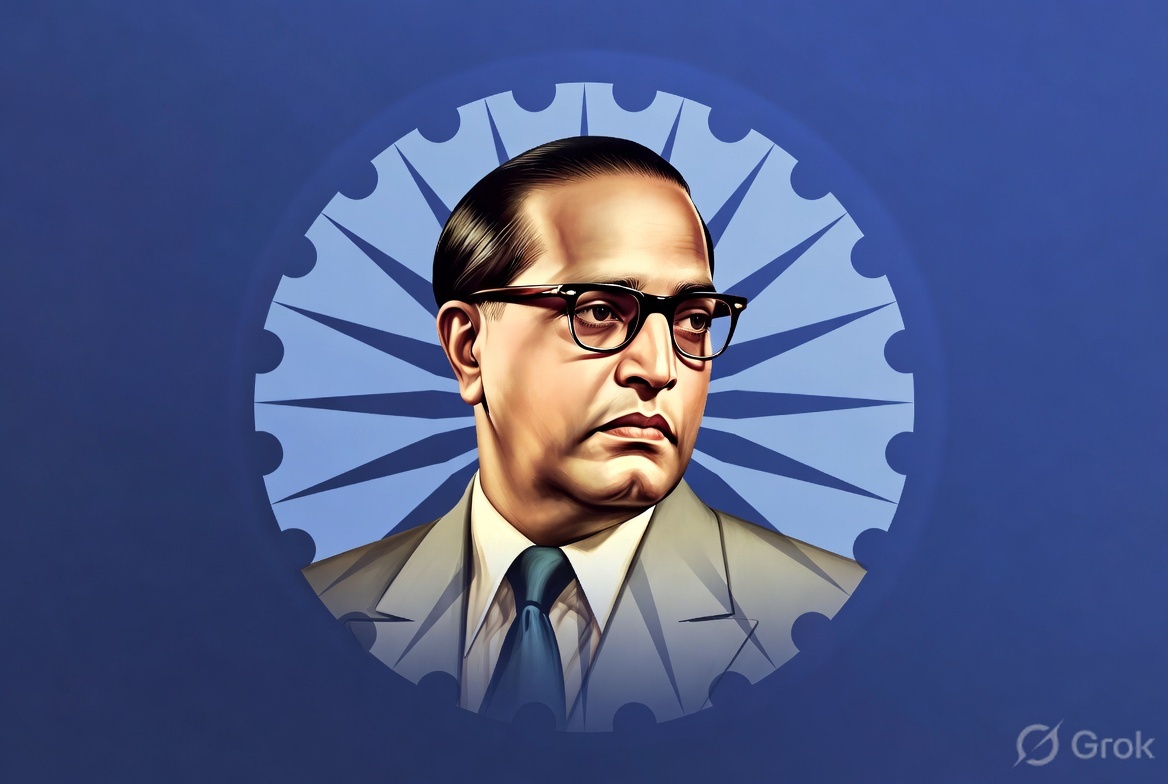
Every year, on Ambedkar Jayanti, India pauses to remember B. R. Ambedkar. Streets fill with processions. Statues are washed, garlanded, and illuminated. Social media timelines overflow with quotes, many of them half-understood or stripped of context. It is a day of reverence, of pride, and of collective acknowledgement.
Yet, beneath this visible celebration lies an uncomfortable question. Do we truly follow Ambedkar, or have we reduced him to a ritual?
Ambedkar was not a figure meant for passive admiration. He was a thinker who unsettled the status quo. He challenged structures that most people accepted as natural. He questioned religion, hierarchy, and power with a clarity that was often inconvenient. His life was not built on symbolism. It was built on resistance and reform.
And that is where the contradiction begins.
India today celebrates Ambedkar more than ever before. His image is everywhere. His words are quoted across political lines. His legacy is claimed by many. But the society he sought to transform still carries the deep marks of inequality.
Caste discrimination, despite legal safeguards, has not disappeared. It has merely adapted. In education, students from marginalised communities still face exclusion, subtle or overt. Dropout rates and access gaps continue to reflect structural disadvantages. In employment, hiring practices often carry unspoken biases. Surnames, backgrounds, and networks still influence opportunity in ways that are rarely acknowledged in public discourse.
Housing tells a similar story. In many urban spaces, where modernity is expected to dilute prejudice, discrimination quietly persists. Rental refusals, segregated neighbourhoods, and coded language continue to shape who gets to live where. These are not relics of the past. They are lived realities in present-day India.
Ambedkar had warned against exactly this kind of contradiction. He believed that political equality, guaranteed by the Constitution, would remain fragile without social and economic equality. One person, one vote, he argued, would not be enough if society continued to deny dignity to large sections of its people.
More than seven decades later, his warning feels less like history and more like a mirror.
There is also a growing tendency to simplify Ambedkar. He is often reduced to the “architect of the Constitution” alone. While that role is monumental, it risks flattening the breadth of his thought. Ambedkar was also a sharp economist, a critic of majoritarian politics, and a fierce advocate of individual liberty. He was not comfortable, and he was not meant to be.
By turning him into a symbol, we risk removing the discomfort he brings.
Celebration, in itself, is not the problem. Societies need icons. They need moments of collective remembrance. But when celebration replaces introspection, it becomes hollow. When Ambedkar Jayanti becomes only about processions and speeches, it loses its transformative potential.
The deeper issue is not whether we remember Ambedkar. It is how we remember him.
To follow Ambedkar would mean confronting the inequalities that still exist, even when they are inconvenient to acknowledge. It would mean questioning systems that benefit us, not just those that harm us. It would require moving beyond symbolic gestures to meaningful action.
For institutions, this could mean ensuring real inclusivity rather than token representation. For individuals, it could mean examining personal biases that often go unnoticed. For society at large, it would mean accepting that equality is not a finished project but an ongoing effort.
Ambedkar’s vision was not of a society that merely honours him once a year. It was of a society that lives by the principles he fought for. Liberty, equality, and fraternity were not decorative ideals. They were demands.
There is also a need to listen to Ambedkar in full, not in fragments. Selectively quoting him to suit present narratives dilutes his message. He spoke about caste, but he also spoke about democracy, rights, and responsibilities. He challenged oppression, but he also emphasised the duty of citizens to uphold justice.
Ignoring this complexity makes it easier to celebrate him, but harder to follow him.
Perhaps the most honest way to mark Ambedkar Jayanti is not through louder celebrations, but through deeper reflection. It is a day to ask uncomfortable questions. A day to measure how far we have come, and how far we still have to go.
Because the real tribute to Ambedkar is not in the number of statues we build, but in the society we shape.
And right now, the gap between the two remains difficult to ignore.
Subscribe Deshwale on YouTube


