










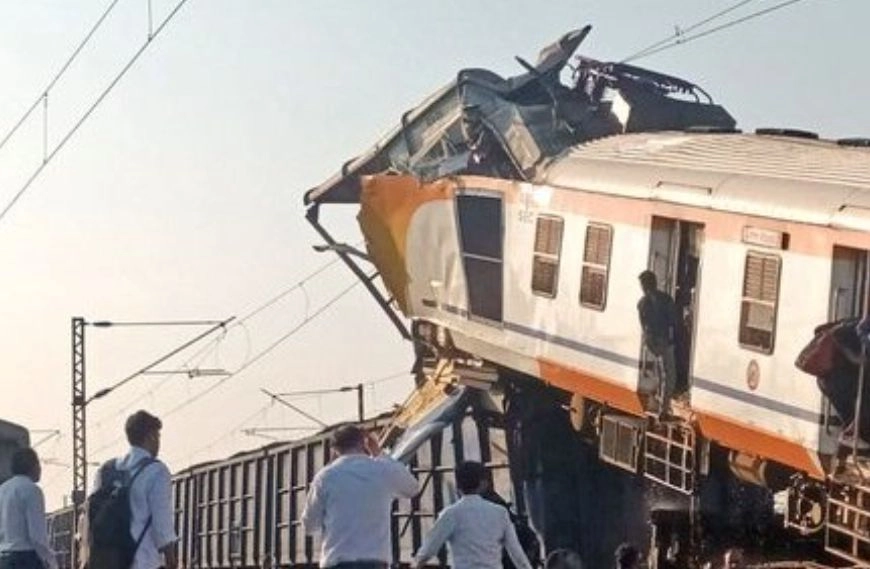
A tragic train collision in Chhattisgarh’s Bilaspur district has once again exposed deep concerns about safety on India’s vast railway network. On a quiet Tuesday evening, a local MEMU passenger train rammed into a stationary goods train near Lal Khadan Torva Phatak, close to Bilaspur railway station, leaving at least eight people dead and more than fourteen others injured. The crash occurred around 4 pm and caused extensive damage to the front coaches of the passenger train.
According to railway officials, preliminary findings suggest that the MEMU train may have overshot a red signal before the collision. The impact was severe enough to crush the first few compartments, trapping several passengers under the twisted metal. Eyewitnesses described scenes of panic and horror as they tried to pull injured passengers out of the wreckage. “My leg got trapped under the seat,” recalled one survivor, while another said, “I was pinned under the seat when the crash happened.”
Rescue teams from the Railway Protection Force, local police, and the National Disaster Response Force (NDRF) reached the site quickly. Heavy cranes were used to separate the two trains and remove debris from the tracks. Passengers with serious injuries were rushed to Apollo Hospital and the Chhattisgarh Institute of Medical Sciences (CIMS) in Bilaspur for emergency treatment. Bilaspur Collector Sanjay Agrawal confirmed that rescue efforts began immediately and continued until everyone trapped was freed. He described the accident as “a big accident” and assured that every possible step was being taken to help victims and their families.
Deputy Chief Minister Arun Sao, who visited the spot, said the goods train was stationary on the same track when the passenger train hit it from behind. He promised a detailed investigation to establish whether the crash was caused by human error or a signal failure. The Ministry of Railways has already ordered an inquiry to determine accountability and prevent similar incidents in the future.
In a swift response, the Railways announced compensation for the affected families. The next of kin of those who lost their lives will receive ₹10 lakh, while those seriously injured will get ₹5 lakh, and passengers with minor injuries will receive ₹1 lakh. Special helpline numbers were also released to help families get updates about their loved ones.
The tragedy triggered a political storm as opposition leaders questioned the government’s commitment to rail safety. Congress leaders called it a case of “extreme negligence” and demanded the resignation of the railway minister. Some critics also alleged that freight traffic, especially coal transportation, has been given more priority than passenger safety, saying that “the value of human life seems less than coal.”
Experts point out that this accident is another reminder of the urgent need to strengthen India’s railway safety systems. The country has introduced modern signalling technology and anti-collision devices such as ‘Kavach’, but these systems are yet to be installed across all routes. Rail safety analysts believe that human error, fatigue, and outdated infrastructure still remain major challenges, particularly in high-traffic zones like the South East Central Railway, where the Bilaspur accident occurred.
As rescue work ended and tracks were cleared for operation, the sense of loss remained heavy. The sight of mangled metal and abandoned luggage told the story of how one mistake whether human or technical could change many lives in seconds. For now, the focus is on determining what exactly went wrong, but the larger question remains: how many more warnings will it take before India’s railway safety becomes foolproof?
The Bilaspur train accident stands as a painful reminder that modernisation must go hand in hand with strict safety enforcement. Whether it was a signal failure or a lapse by the crew, the tragedy underlines that accountability, technology, and continuous vigilance are the only ways to ensure that such accidents never happen again.
Subscribe Deshwale on YouTube


