



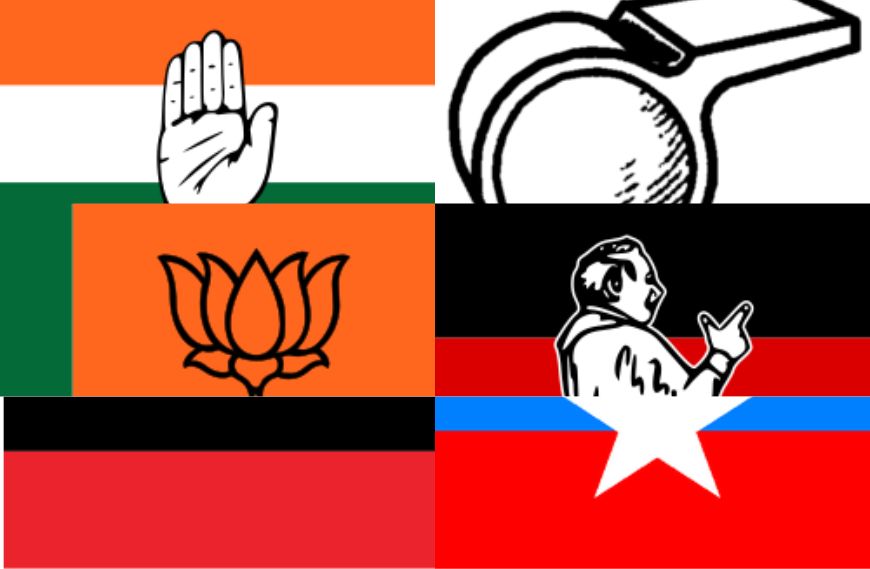
Tamil Nadu does not reject the BJP emotionally. It rejects it structurally.
Political Analysis | Tamil Nadu | Strategic Affairs
For six decades, the state’s politics has been organised around a Dravidian axis: social justice, linguistic pride, welfare expansion, and calibrated regional autonomy. Any party seeking power here must operate within that grammar.
The Bharatiya Janata Party has made incremental gains. But it remains an outsider to the Dravidian consensus.
Now, the emergence of actor Vijay and his political formation, Tamilaga Vettri Kazhagam, complicates the chessboard further.
The 2026 Assembly election will not merely test the BJP’s growth. It will test whether Tamil Nadu is ready for a post-Dravidian transition, or merely a reshuffled Dravidian order.
What the BJP has in Tamil Nadu
The BJP has steadily expanded its footprint since 2014. Under state leadership such as K. Annamalai, it has built visibility, sharpened rhetoric, and positioned itself as the principal anti-DMK force. In urban pockets, Coimbatore, parts of Chennai, and segments of western Tamil Nadu, the party now commands respectable vote shares.
But expansion does not equal viability. Tamil Nadu is not won through urban enthusiasm. It is won through rural social engineering.
The ruling Dravida Munnetra Kazhagam, led by Chief Minister M.K. Stalin, benefits from welfare continuity and administrative stability. Yet fatigue is visible: allegations of dynastic consolidation, corruption accusations, and rising cost-of-living anxieties all provide the BJP with ammunition. However, Tamil Nadu voters historically replace one Dravidian party with another, not with a national ideological alternative.
The BJP also controls the Union government, and infrastructure funding, national visibility, and administrative clout are tangible advantages. But in Tamil Nadu, overt central assertion often backfires. The state’s political culture valorises autonomy. Central power is an asset, but it is simultaneously a liability.
What the BJP fundamentally lacks
The central barrier is Dravidian legitimacy. Tamil Nadu politics rests on four enduring pillars:
- Anti-Hindi imposition sentiment
- Social justice rhetoric
- Welfare populism
- Regional cultural pride
The BJP’s ideological vocabulary, nationalism, Hindutva, and centralisation, does not organically align with this matrix. Until the BJP crafts a distinctly Tamil idiom of conservatism, it remains externally coded.
The AIADMK and DMK perfected competitive welfare politics across decades. Free bus travel for women, subsidised food schemes, educational assistance, and targeted caste outreach are not marginal programmes. They are the spine of electoral loyalty. The BJP critiques fiscal populism but has not yet articulated a Tamil Nadu-specific welfare alternative. In this state, ideology does not trump entitlements.
While Annamalai has energised the urban and youth demographic, booth-level machinery in the Cauvery delta, southern districts, and northern rural belts remains thin compared to entrenched Dravidian networks. Tamil Nadu elections are hyper-local. Without micro-alliances at the panchayat level, momentum stalls.
The Vijay disruption
The entry of Vijay alters the equation in three distinct ways.
Vijay commands cross-caste youth appeal. His fan clubs already function as quasi-political mobilisation networks. If successfully institutionalised, they can convert cultural fandom into booth-level machinery, something neither the BJP nor smaller regional parties possess at scale.
Traditionally, anti-DMK votes consolidated behind the AIADMK. If Vijay captures a slice of that space, particularly among first-time voters and urban lower-middle classes, the BJP’s growth corridor narrows considerably. The BJP requires bipolar consolidation to win. A triangular contest benefits the incumbent.
Unlike the BJP, Vijay is not ideologically anchored in Hindutva. Unlike the DMK, he is not structurally tied to Dravidian orthodoxy. This ambiguity could attract floating voters, but it also creates organisational vulnerability. Cinema charisma does not automatically translate into electoral arithmetic. Tamil Nadu has seen this before.
Can the BJP win in 2026?
Realistically, an outright majority is improbable under current conditions. The BJP’s plausible pathways are:
- A broad pre-poll alliance with a revived AIADMK that restores bipolar competition
- Significant erosion within the DMK’s urban base combined with minority vote fragmentation
- Positioning itself as kingmaker in a fractured Assembly
However, if Vijay consolidates even 8 to 12% of the vote independently, the BJP’s expansion trajectory slows materially. The BJP’s most realistic medium-term goal may not be immediate regime change, but long-term cultural normalisation within Tamil politics.
The structural reality
Tamil Nadu does not reject the BJP because of hostility alone. It rejects it because its political ecosystem evolved without the need for a national alternative. The Dravidian model has been self-contained.
For the BJP to win here, it must do something unprecedented. It must speak Tamil political language fluently. It must reconcile Hindutva with Dravidian social justice. It must offer welfare without ideological dilution. And it must produce a Tamil leader whose legitimacy is organic, not imported.
That transformation is possible. But it remains incomplete.
Final assessment
The BJP in Tamil Nadu is no longer irrelevant. It is visible, vocal, and expanding. But it remains peripheral to the state’s core political identity.
Vijay’s emergence further fragments the opposition space, potentially strengthening the DMK in the short term. The BJP’s challenge is not merely electoral. It is civilisational within the Tamil political imagination.
Until it becomes culturally Tamil in instinct, not merely organisationally present, the Dravidian fortress stands.
And in Tamil Nadu, fortresses fall only when the people believe the alternative belongs to them.
Subscribe Deshwale on YouTube
