



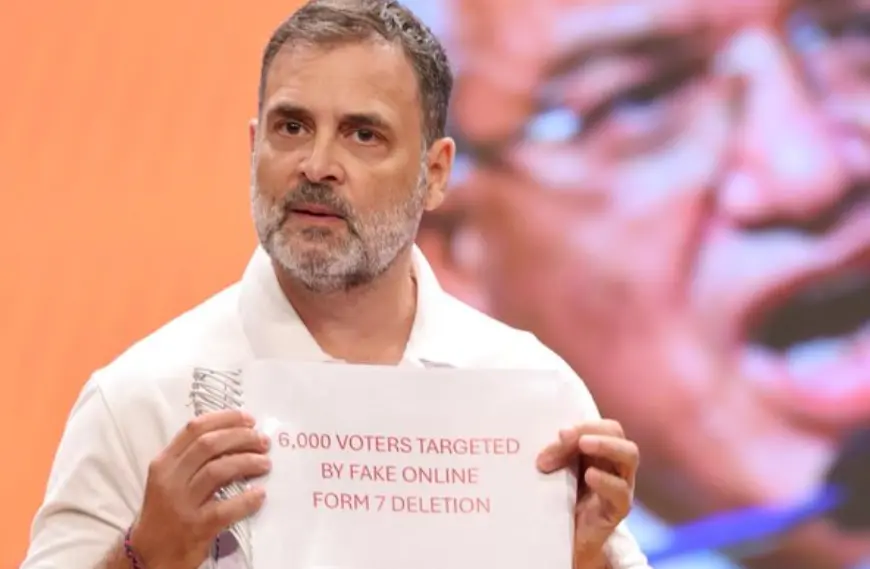
Rahul Gandhi, Leader of the Opposition in the Lok Sabha and senior Congress MP, has made serious claims that large numbers of voters’ names have been illegally removed from electoral rolls in India. He says this is not random; that it’s a coordinated effort (“vote chori,” meaning vote theft) which threatens the foundation of democracy.
Here are the facts as known so far, what the Election Commission (EC) has said, and what the implications might be for democratic trust.
What Rahul Gandhi claims
- Voter deletions in Karnataka’s Aland constituency
Rahul Gandhi alleged that in Aland (Karnataka) roughly 6,018 voter names were deleted. He says this was identified when a booth-level official discovered even her own uncle’s name had been removed. - Use of software, fake applications, and automated systems
He says fake applications were used to delete voter names. There are claims of fake logins, mobile numbers from outside the state, forms being filled very quickly. For example, someone named Suryakant is said to have submitted 12 voter deletion forms within 14 minutes. - Targeting of certain communities
Gandhi alleges the deletions impact Dalits, Tribals, Other Backward Classes (OBCs), and minorities groups that tend to vote for opposition parties. - Requests for data ignored
According to him, the Karnataka CID (Criminal Investigation Department) has written 18 letters in 18 months to the Election Commission asking for digital evidence (like IP addresses, device details, OTP trails) connected to the alleged deletions. He claims these requests have not been properly answered. - “Hydrogen bomb” promised, not yet delivered
Rahul Gandhi had earlier said he would drop a ‘hydrogen bomb’ of revelations meaning absolutely clear, explosive evidence. In this press conference, he said what he presented was not yet that bombshell but a preview, which he claims is already ‘100% bulletproof.’
What the election commission has said
- Claims baseless and incorrect
The Election Commission of India has rejected the allegations, calling them “incorrect and baseless.” They say no deletion of voters can be done online by any member of the public. - Due process required
EC says that no name can be removed from the electoral roll without giving the person affected a chance to be heard. - Aland 2023: “unsuccessful attempts”
EC acknowledges that in 2023, in Aland constituency, there were ‘attempted deletions’ of electors. An FIR (First Information Report) was filed by the EC itself to investigate. But EC says those were unsuccessful.
What is still not clear
- Scale of deletions: While Rahul Gandhi gives specific numbers (like ~6,018 in Aland), it is unclear how many voters in total across multiple states may have been affected. He claims it is much more, but concrete verified totals are not yet published.
- Full evidence: The “hydrogen bomb” of evidence is yet to be presented. What has been shown so far is the preview he claims is bulletproof, but the EC disputes eligibility and validity of the claims.
- Verification by independent or judicial bodies: Would impartial bodies (court, audit, etc.) examine the evidence, the software, the logs, mobile/OTP trails etc., in a manner accepted by all? That has not yet happened in the public domain.
- Role of EC & accountability: EC’s involvement in oversight, how responsive it is to requests (for example the 18 letters from Karnataka CID), and whether there was negligence or collusion, are disputed.
Trust in elections is the foundation of any democracy. When people start believing that voter names are being unfairly removed or that votes are being manipulated, their confidence in free and fair elections weakens. This problem becomes even more serious when marginalised groups such as tribals, minorities, and lower-income communities are disproportionately affected, as it deepens inequalities and reduces their political voice. At the same time, institutions like the Election Commission play a critical role in safeguarding democracy. If their impartiality is questioned or they are seen as failing to uphold legal protections, it directly undermines the rule of law and the integrity of democratic institutions. Finally, the Indian Constitution and electoral laws guarantee every citizen the right to vote. Any removal of names from electoral rolls without following due process not only violates those rights but also shakes the very principles on which democracy rests.
What to watch next
- Will Rahul Gandhi publish the full evidence soon (the promised ‘H-bomb’)?
- Will the EC respond with data (IPs, OTPs, device logs etc.) to prove or disprove the claims?
- Will independent audits, courts, or investigative journalism verify the claims?
- What actions will affected voters take will people whose names were deleted be able to challenge it?
- Will this impact upcoming elections, voter turnout, or public sentiment?
These allegations are serious. If true, they strike at the heart of democracy by undermining the idea that every eligible citizen’s vote counts. But at this time, many claims are still contested. The Election Commission denies the deeper charges, and many of the details remain unverified in the public domain. Democracy depends not just on making claims but on verifiable, transparent processes that maintain trust.
For democracy to stay strong, institutions must be accountable and responsive, and citizens must believe that their voice matters.
