









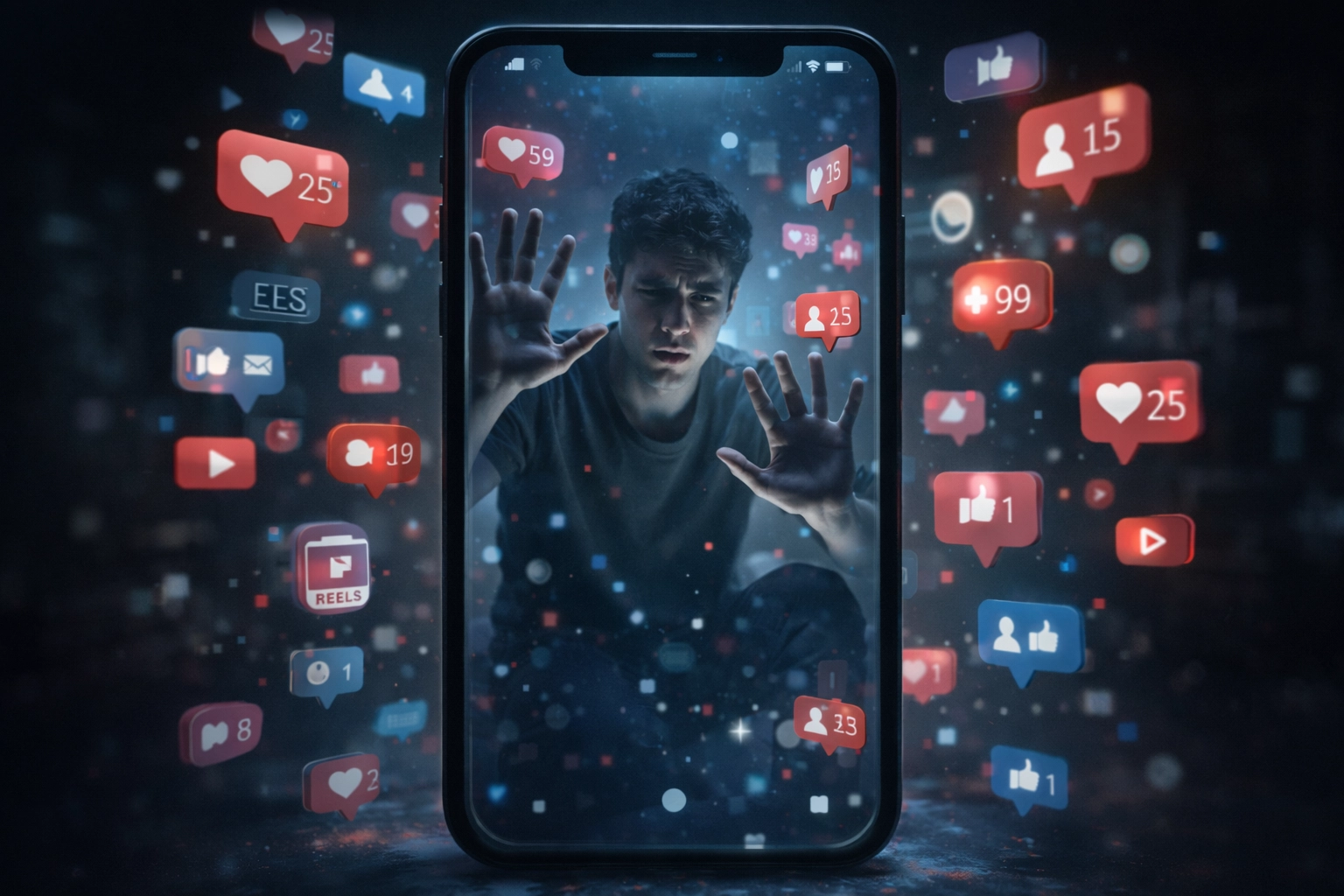
There is a moment, familiar to almost everyone alive today, when you pick up your phone to check the time and put it down twenty minutes later without ever having looked at the clock. You went down a rabbit hole of reels, headlines, notifications, and posts you cannot quite remember. You are back in the room now. But were you ever really gone?
That question deceptively simple sits at the heart of one of the most urgent and under-examined crises of our era. We are the first generation of human beings to carry, in our pockets, a device engineered specifically to capture and hold our attention against our own interests. And by almost every measure, it is working.
The Numbers Nobody Wants to Talk About
Let us start with the data, because it is staggering.
According to a 2023 report by data analytics firm DataReportal, the average person now spends roughly six hours and thirty-seven minutes online every single day. That is more time than most people spend sleeping soundly. Over a lifetime assuming you start at age fifteen and live to eighty that adds up to approximately nineteen years of continuous screen time.
Nineteen years.
The World Health Organization does not yet formally classify “internet use disorder” or “social media addiction” the way it does substance dependence, though it did include gaming disorder in its International Classification of Diseases in 2019. But researchers are increasingly using the language of addiction, and for good reason. Smartphone use triggers dopamine release in the brain’s reward centres, the same neurochemical response that underlies dependency on alcohol, gambling, and drugs. Every notification, every like, every new post is a small, unpredictable reward. And unpredictable rewards, as behavioral scientists have known since B.F. Skinner’s experiments with pigeons in the 1950s are the most addictive kind.
The apps know this. They were designed around it.
Built to Hook You
In 2017, former Google design ethicist Tristan Harris gave a now-famous TED Talk in which he described Silicon Valley’s most powerful companies as operating what he called a “race to the bottom of the brain stem.” Their business model depends on attention. Attention is sold to advertisers. And so every engineering decision — the infinite scroll, the autoplay video, the red notification badge is optimized to keep your eyes on the screen for one more second.
Sean Parker, one of Facebook’s founding presidents, said it plainly in a 2017 interview: “How do we consume as much of your time and conscious attention as possible?” He described the platform’s design philosophy as deliberately exploiting “a vulnerability in human psychology.” He was not apologising. He was explaining the business.
This is not an accident. It is an architecture.
The result is an attention economy in which your focus has become a commodity, harvested at scale, and sold to the highest bidder. And the cost of that transaction is borne not by the platforms but by you.
What We Are Losing
Consider what happens to the mind under constant digital stimulation.
Attention span, for a start. A widely cited Microsoft study from 2015 suggested that the average human attention span had fallen from twelve seconds in 2000 to eight seconds by 2013 shorter, the report noted with uncomfortable irony, than that of a goldfish. Researchers have since debated the methodology, but the directional truth is hard to dispute: sustained, deep focus has become genuinely difficult for millions of people. The novelist who once sat with a book for three hours now checks her phone every few pages. The student who was meant to study for an hour finds himself, at the end of it, having watched forty minutes of YouTube.
Then there is memory. When we photograph every meal, every view, every moment neuropsychologists call this the “photo-taking impairment effect” we outsource the experience to the device. The camera sees it, so the brain does not have to. Studies by Dr. Linda Henkel at Fairfield University have found that people remember fewer details of objects they photograph than objects they simply observe. We are trading lived experience for documented experience, and the trade is not even.
Sleep, too, is a casualty. The blue light emitted by screens suppresses melatonin production, disrupting the body’s natural sleep cycle. The National Sleep Foundation found that 90 percent of Americans use an electronic device in the hour before bed. Poor sleep is linked to depression, cognitive decline, weakened immunity, and a shorter life. We are, quite literally, losing sleep over our phones.
The Loneliness Paradox
Here is perhaps the cruelest irony of the digital age: the more connected we become, the lonelier we feel.
In 2023, the United States Surgeon General, Dr. Vivek Murthy, declared loneliness an epidemic, noting that roughly half of American adults reported measurable levels of loneliness even before the COVID-19 pandemic. The United Kingdom had, in 2018, appointed the world’s first Minister for Loneliness, an acknowledgment that something had gone badly wrong in the social fabric.
Social media promises connection. It delivers comparison. You do not see your friends’ actual lives on Instagram, you see their highlight reels, the best light, the most enviable angle. And the brain, which did not evolve to process three hundred curated versions of other people’s happiness in a single afternoon, responds predictably: with inadequacy, anxiety, and the vague, gnawing suspicion that everyone else is doing better than you.
This is not speculation. A landmark study published in the Journal of Social and Clinical Psychology in 2018 found a direct causal link between social media use and increased feelings of depression and loneliness. When participants limited their use to thirty minutes a day, their wellbeing improved significantly not just their mood, but their sense of connection to the people around them. The real world, it turned out, was more nourishing than the virtual one.
Children in the Crossfire
If the effects on adults are troubling, the effects on children and adolescents are alarming.
Psychologist and NYU professor Jonathan Haidt has spent years documenting what he calls “the great rewiring of childhood.” His research, published in the book The Anxious Generation in 2024, argues that the arrival of smartphones and social media in the early 2010s correlates precisely with a sharp rise in adolescent mental health crises depression, anxiety, self-harm, and suicidal ideation particularly among girls.
The data is sobering. Rates of teenage depression in the United States have nearly doubled since 2012. Emergency room admissions for self-harm among girls aged ten to fourteen have tripled. In the UK, Australia, and Canada, the curves look almost identical suggesting something global, not local, is at work.
Haidt’s critics argue the causal link is not fully proven. But his broader point is hard to refute: we gave children access to an unprecedented, unregulated, psychologically powerful technology with essentially no understanding of what it would do to developing minds. We are now living with the results.
The Economy of Distraction
There is also an economic argument to be made, though it receives far less attention than it deserves.
Microsoft researcher Linda Stone coined the term “continuous partial attention” to describe the state most of us now inhabit, never fully present, always half-listening for the next ping. This state, she argues, is fundamentally different from multitasking. It is not efficient. It is exhausting. And it is becoming the default mode of the modern worker.
A study by researchers at the University of California, Irvine found that it takes an average of twenty-three minutes and fifteen seconds to fully regain concentration after an interruption. If you receive even a modest dozen notifications a day phone calls, emails, messages the cumulative cost in lost focus is enormous. The Global Economy loses trillions in productivity annually to digital distraction, though the figures are notoriously difficult to pin down.
The irony is that we often feel busy while being distracted. The sensation of being plugged in mimics the feeling of being engaged. But scrolling through your feed is not thinking. Reading a hundred headlines is not understanding. Activity is not the same as progress.
The Question Nobody Asks
Amid all this data, one question is rarely posed: what are we not doing while we are online?
We are not sitting quietly with our own thoughts. We are not bored and boredom, neurologists have found, is not wasted time. It is when the brain consolidates memory, solves problems it could not solve when busy, and generates creative insight. The shower-thought, the midnight breakthrough, the slow dawning of clarity these require mental space. Constant stimulation forecloses that space entirely.
We are not having the long, uninterrupted conversations that build deep relationships. We are not reading books that change the way we see the world. We are not sitting still long enough to know what we actually feel, as opposed to what we have been prompted to react to.
In a very real sense, the digital world offers us an escape from ourselves. And for many people, that is precisely the appeal. The tragedy is that we are escaping into something far smaller than the life we could be living.
Finding Our Way Back
None of this is an argument for throwing your phone into the sea. Technology is not inherently the enemy. The internet has connected the world, democratised information, enabled revolutions, and saved lives. The smartphone in your pocket is a marvel of human ingenuity.
But marvels can be misused. And the first step toward using this one wisely is to see it clearly to understand that it has been designed to seduce you, and that your attention, your time, and your inner life have genuine value that deserves protection.
The evidence suggests the interventions are simple, if not easy. Keeping phones out of the bedroom. Turning off non-essential notifications. Designating phone-free hours. Having dinner without the device on the table. Teaching children that screens are tools, not companions. Choosing, sometimes, to be bored and seeing what the mind does with the quiet.
These are small acts of resistance in a world built to distract. But resistance, even in small doses, compounds over time.
There is a line from the philosopher Blaise Pascal, written in the seventeenth century, long before the first screen ever glowed: “All of humanity’s problems stem from man’s inability to sit quietly in a room alone.”
He could not have known how prophetic he would prove to be. We have built an entire civilisation of noise to avoid doing exactly that.
The question worth sitting quietly, without checking your phone is this: what would you think about, feel, create, or become, if you gave yourself the chance?
That answer belongs to you. But first, you have to be present enough to find it.
Subscribe Deshwale on YouTube


