



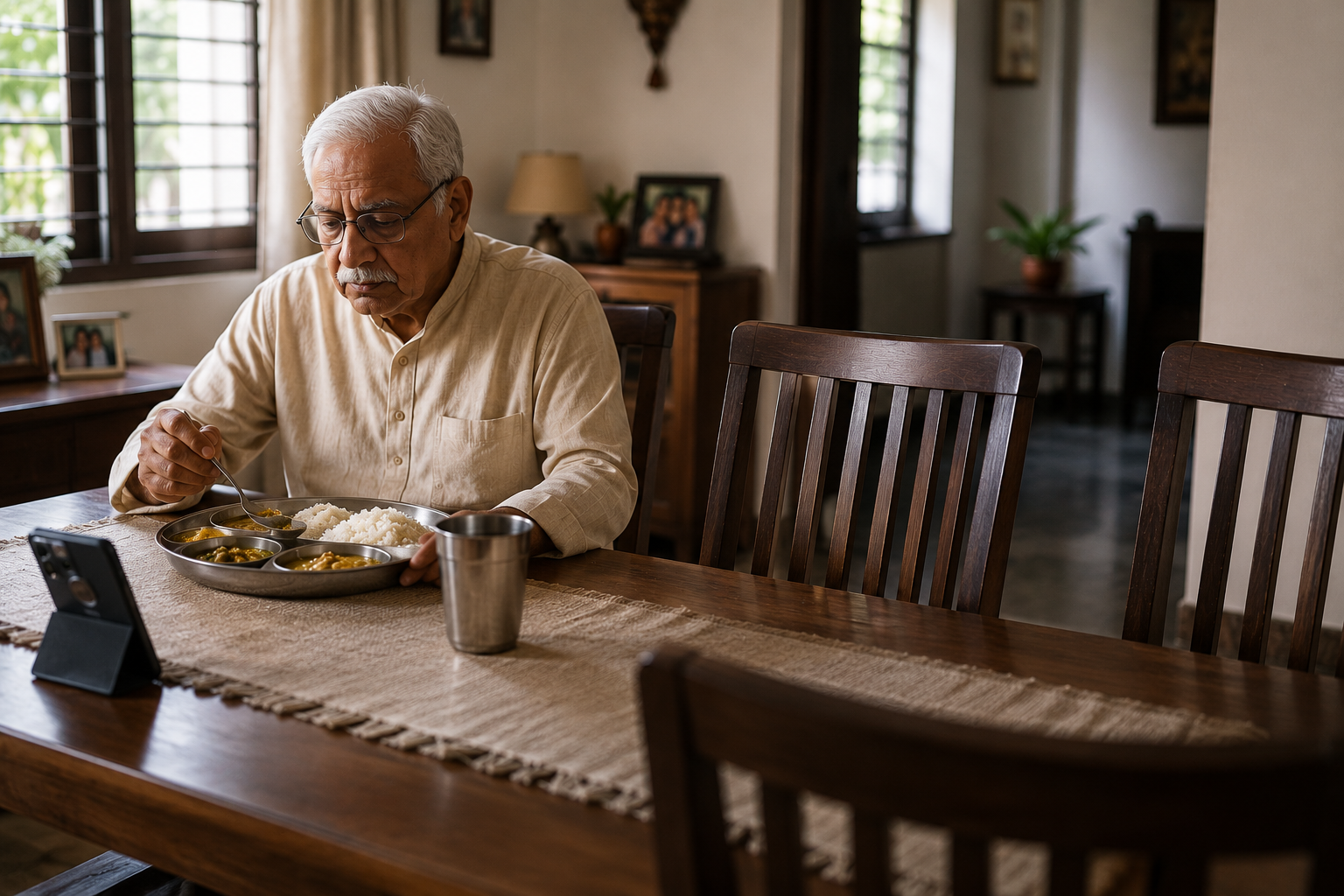
Think about the last time you called your parents. You probably asked if they had eaten. But did you ever ask who they ate with?
For a lot of Indian families today, the answer is nobody. Children move to cities for work, sometimes abroad, and parents stay back in a house that used to be full of noise. The phone calls happen every day. The meals, most days, happen alone.
New research suggests this small, easy-to-miss detail might matter more than we think. It’s not just about loneliness anymore. Scientists are now looking at whether eating alone regularly could actually change the brain.
What the research actually found
The idea has a name: commensality, which simply means eating and sharing food with other people. Researchers have been studying whether this simple act carries benefits that go far beyond company at the table.
One study followed 9,361 people aged 60 and above in China. It found that the number of people present at meals was linked to the risk of depression, an effect that was particularly strong among women and those in the 60-74 age group. This connection held even after accounting for health, wealth, and whether the person lived alone or with family.
A separate study from Japan focused on adults aged 65 to 74 and found something worth pausing on. Older adults who lived with their families but regularly ate alone were around five times more likely to show depressive symptoms compared to those who ate with others. In other words, simply living under the same roof as your family didn’t protect against loneliness. Sharing the actual meal did.
The part that goes beyond mood
The more striking findings come from a 2025 Japanese study that looked at brain scans. Researchers found that people who regularly ate alone had lower brain volume in areas involved in memory and thinking, including the hippocampus and the medial temporal lobe.
Diet was one possible explanation, since people eating alone may have less nutritious habits. But the researchers said diet alone didn’t account for the full difference. They believe reduced social interaction itself may play a role. A conversation over a meal offers mental stimulation. The comfort of company can lower stress. Both stress and isolation have separately been linked to poorer brain health over time.
It’s important to be clear about what this study does not say. It did not prove that eating alone causes dementia. Every participant had normal cognitive function at the time of testing. What researchers observed were early differences that could potentially matter for the future, not diagnoses in the present.
Why this hits differently in Indian households
This is where the research stops being an abstract health story and starts feeling personal for a lot of readers.
The traditional Indian household was built around shared meals. Grandparents, parents, and children eating together wasn’t a scheduled activity, it was just how the day worked. That structure has been quietly disappearing for a generation now. Migration for jobs, nuclear families, and elderly parents choosing to “not be a burden” and stay in their hometown have all added up to something researchers would recognise instantly: older adults living alone, eating alone, most days of the year.
A phone call is not nothing. But the research suggests it may not be doing the job we assume it’s doing. Presence, it turns out, is different from connection.
A happiness link too
The World Happiness Report looked at this from another angle entirely. Using data from around 150,000 people across 142 countries, it asked how often people shared lunch or dinner with someone they knew. People who shared more meals reported higher emotional wellbeing and life satisfaction overall.
Researchers are careful here too. People who eat together often already have stronger social networks, so it’s hard to separate cause from correlation. Still, the pattern shows up again and again, across very different studies and countries.
So what should you actually do with this?
Nobody is saying every solo meal is dangerous. People eat alone because of work timings, personal choice, or simply because that’s how the day unfolds. An occasional meal by yourself is not the concern.
The concern is when eating alone becomes the pattern, especially for someone already living far from family. For an ageing parent, that pattern day after day may be doing more than making mealtimes quiet. It may be quietly reshaping brain health too.
If there’s one small takeaway from all this research, it’s this: the next time you speak to your parents, maybe don’t just ask if they’ve eaten. Ask if they’re eating with someone. And if the answer keeps being no, that phone call might be worth turning into a visit, even an occasional one.
Because according to this research, showing up for a meal might be doing more for your parents than any conversation ever could.
Subscribe Deshwale on YouTube
