










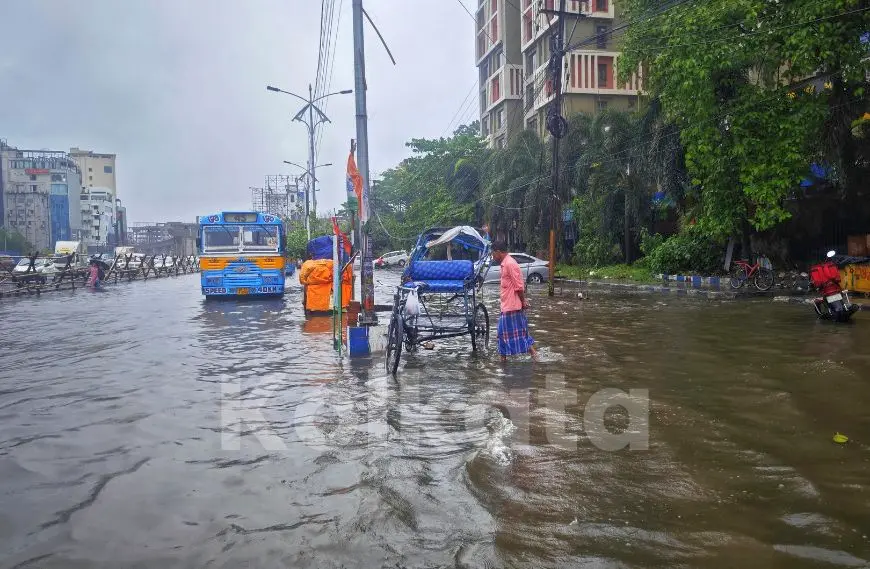
Have you ever faced water gushes through your doorstep? The pedestrian and road you walked, turned into a river? I am talking about the situation in Kolkata right now. The recent incessant rain and waterlogging in Kolkata has left Durga Puja pandals submerged, idols damaged, and roads flooded. But beneath the chaos lies a deeper story. The story of a drainage system, which was built over a century ago, once celebrated as an engineering marvel, now exposed as the city’s biggest weakness.
So, the British planned Kolkata’s drainage network in the 19th century, they were designing for a population of half a million people. The system was sophisticated for its time, with underground brick sewers and stormwater channels that kept the colonial capital functional during monsoons.
Fast forward to today. Kolkata’s population is 15 million+ in the metropolitan region, and the same outdated blueprint still carries the city’s burden. Add to that years of neglect, encroachment, unplanned construction, and clogged canals, and you get a city where even a few hours of rain can bring life to a standstill.
Kolkata’s monsoon is always dramatic. Some years, it is just the daily struggle of knee-deep water and traffic jams. And other years, like September 2025, it becomes a deluge. The city recorded over 250 mm of rain in a single day. It is one of the heaviest spells since 1978. Streets turned into rivers, power cuts spread across neighbourhoods, and at least nine people tragically lost their lives to electrocution in waterlogged areas.
Yet, the story of water logging in Kolkata is not new. Old-timers recall the floods of 1978, when the city was under water for days. In between, there have been countless smaller floods, from the infamous September 2006 waterlogging to the monsoon chaos after Cyclone Amphan in 2020. Each time, promises of drainage upgrades are made. Each time, the city goes back to waiting for the next flood.
Well, let’s talk about Durga Puja, which is Kolkata’s heartbeat. Months of preparation go into building elaborate pandals and sculptures. And now, the rain and waterlogging crash the festival. Pandals in South Kolkata collapsed, Kumartuli’s idol-makers watched their workshops flood, and organisers scrambled to save whatever artwork they could.
But Pujo does not stop. Volunteers pump water out of pandals, artisans repaint damaged idols, and residents wade through waist-deep water to offer anjali. The resilience of the city is legendary, but so is the neglect that forces people to rebuild joy after every flood. And most importantly, the dedication of Bhakts will never be forgotten.
If we think, why does this keep happening? The answer lies underground. Kolkata’s drainage was designed around gravity flow, canals, and outfalls into the Hooghly. With rising population, encroached waterways, and silted drains, the system has collapsed. Pumping stations often fail to keep up during heavy spells. What was once a marvel of Victorian engineering is now a relic, mismatched to modern Kolkata’s needs.
This is not unique to Kolkata. Delhi faces waterlogging every monsoon despite its status as the national capital. Mumbai floods when the Mithi River overflows. Bengaluru drowns in rain-fed lakes that have been encroached upon. Across India, colonial or post-colonial cities face the same paradox. Rapid urbanisation with outdated or broken infrastructure.
Who pays for this? So, the answer is common man. They have to pay the price of life, money and education. Local vendors watch their goods float away. Daily wage workers lose their earnings because streets are impassable. Families spend nights without electricity, stuck in damp houses with no relief. For idol-makers in Kumartuli, one rain-soaked night can erase months of labour and investment.
And yet, people adapt. They walk barefoot through the flood to buy groceries. They sit on chairs stacked on bricks to avoid water seeping indoors. They repair pandals with bamboo and tarpaulin, because festivals cannot wait for drainage upgrades.
Dilip Dave, who has lived in the city for over 40 years, said:
“This is not the first time in Kolkata. We faced it in 1978. Back then, boats were used to commute. Cars, buses, even the city’s iconic tram lines gave way to rowing boats. Amherst Street, in the heart of North Kolkata, had turned into a waterway.
I was just out of college, and we were surprised to see boats on the road where cars, buses, and Kolkata’s famous tram were plying. The exact area was Amherst Street, a central and North Kolkata area. It was Calcutta then, not the Kolkata of the present time.”


He said again: “We have a very old drainage system installed by the British, as Calcutta was the capital in the British era. It has a capacity to drain out only 20 mm of accumulated water.
Now in South Kolkata, it is the worst. Waterlogging, power shutdowns, everything. We had a power cut for almost five hours yesterday.
This is Durga Puja time, and many big pandals are damaged. Just three more days to go when the entire Kolkata will be decked up like a bride. But the festive spirit is affected.
The state government has declared Puja vacations from today in government offices and schools. Dekhte hain kitni jaldi saaf safai karta hai administration kyunki Durga Puja is the biggest festival of Bengal.”
His words tie two eras together. Calcutta of 1978 and Kolkata of today. Different names, same struggle. A city submerged by rain, held afloat only by its people’s resilience.
The city’s weather department has already warned of more rain systems forming over the Bay of Bengal. Even if skies clear, the fear of another downpour lingers. The bigger question remains: how long can a city depend on an outdated colonial system before it builds something new?
Upgrading drainage requires political will, heavy investment, and long-term planning. It also demands a change in mindset – canals cannot remain garbage dumps, wetlands cannot keep shrinking, and every monsoon cannot be treated like an ‘unexpected event.’ Kolkata is not sinking because of one freak spell of rain. It is drowning because its foundations are still stuck in the 19th century.
And yet, this is Kolkata. A city where resilience is as famous as its floods. Where Pujo lights shine even on waterlogged streets. Where neighbours pull each other out of waist-deep water and still crack jokes about the rain. Where history, neglect, and spirit collide every monsoon.
The forgotten drainage of Kolkata is more than an engineering failure. It is a metaphor for every Indian city caught between the past and the future. And until we decide to rebuild with the present in mind, every monsoon will bring the same story. A city that drowns, and yet, somehow, never sinks.


