



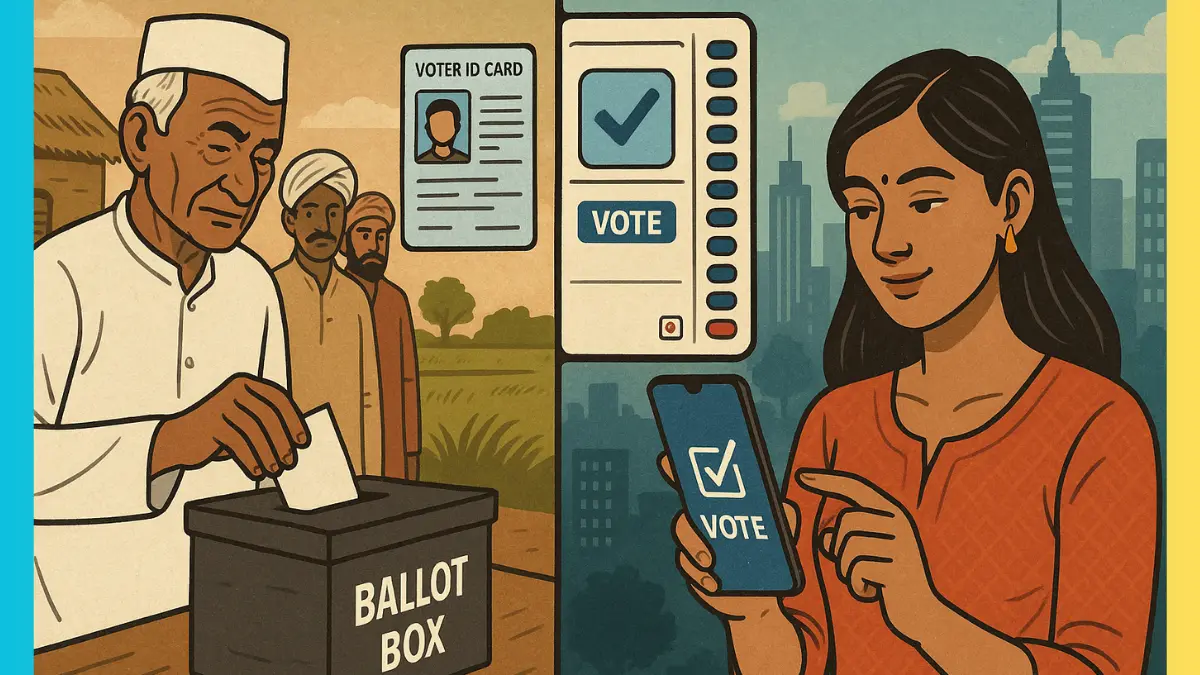
If someone had told your grandfather in the 1950s that one day people in Bihar would vote using their smartphones, he probably would have laughed. But fast forward to 2025, and that is exactly what happened. In one of India’s heartland states, voters including migrant workers and pregnant women cast their votes using a mobile app. This was not just a matter of convenience. It showed how far Indian elections have come.
The Paper Ballot Days: Humble Beginnings of a Democracy
India’s first general election in 1951–52 was a huge task. There were no computers or digital tools. Election workers had to write down names and carry ballot boxes to faraway villages. Since many people could not read, symbols next to candidate names helped them vote.
Even with all these challenges, almost half of the country voted. This showed how strongly people believed in democracy. But there were problems. Votes were counted slowly, and cases of fake voting and booth capturing reduced people’s trust in the system.
EVMs: Speed Meets Accuracy
In the late 1990s, India began using Electronic Voting Machines (EVMs). These small grey machines changed the way we voted. Voting became faster, results came in quicker, and there was less chance of fraud or mistakes.
By 2004, EVMs were used in every election. Later, VVPATs (Voter Verified Paper Audit Trails) were added to give voters proof of their vote. This was a big step toward a more transparent and trustworthy system.
Postal Ballot and Proxy Voting
For those who could not vote in person, postal ballots have been a key option since the early years. Service voters, such as members of the armed forces and government employees on election duty, could vote through post.
Later, proxy voting was introduced. This allowed service voters to authorise a trusted person back home to cast their vote. Proxy voting reduced the need for service voters to be physically present and made participation easier for those in remote postings.
Bihar’s 2025 Pilot: Voting on Your Phone
In 2025, Bihar tried something new. For the first time, mobile voting was tested in six municipal councils. Voters used apps called e-SECBHR and SECBIHAR to cast their votes from their phones.
The results were impressive. The app had nearly 70% turnout, more than physical polling stations. It used technologies like facial recognition, OCR which scans voter documents, and blockchain for security. The goal was to help people who could not reach polling booths like migrant workers, elderly citizens, pregnant women, and people with disabilities.
The first vote on the app was cast by Bibha Kumari from East Champaran. If this system works on a larger scale, India could become the second country after Estonia to adopt mobile voting.
The Dark Side of Digital Voting
But not everything went smoothly. Bihar still has low internet and smartphone access, especially in rural areas and among women. Many people could not use the app. Critics called this “digital exclusion” and said the app worked only for people who were already tech-savvy.
Cybersecurity experts also raised concerns. What if someone hacked the app or stole voter data? Without strong safety systems, digital voting could become risky for democracy.
Voter List Controversy: Too Much Clean-Up?
At the same time, Bihar’s Election Commission began a voter list clean-up. It aimed to remove fake, duplicate, or dead voters. Over 65 lakh names were deleted.
But many of these were poor, rural voters or migrant workers without proper documents. Critics called it “vote-bandi” and said it unfairly targeted marginalised groups.
The case reached the Supreme Court, which told the Election Commission to be more fair. It said IDs like Aadhaar and voter cards must be accepted. This reminded everyone that accuracy is important but fairness matters more.
A Better Election Infrastructure
Despite the challenges, there were good changes too. The Election Commission launched ECINET, a single platform for over 40 election services. It also reduced the number of voters per booth and trained officers to use new technology.
These steps were not just about speed. They were meant to make elections easier, safer, and more accessible for everyone.
What Does This All Mean?
From dropping slips in wooden boxes to voting on a smartphone, India’s election system has come a long way. Every new change brings both hope and caution.
Bihar’s mobile voting shows what is possible. But it also reminds us that digital progress must include everyone. And while cleaning up voter lists is important, it should never remove the voices of the poor or marginalised.
The evolution of Indian elections is not just a story about technology. It is about people, power, and making sure every vote counts whether someone lives in a remote village, does not have a smartphone, or is away from home.
