










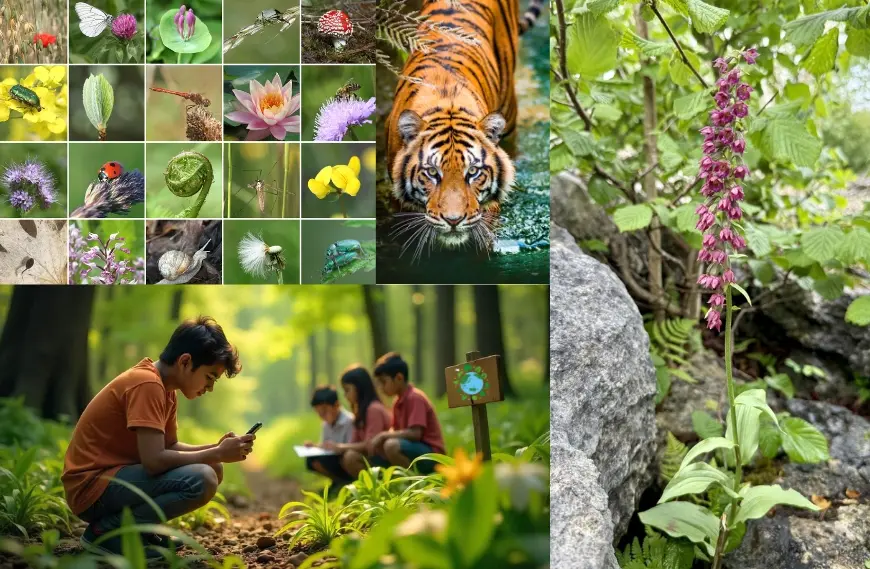
Ever found joy in spotting a wildflower by the roadside or deep in the hills? Imagine if that simple act could help save India’s rarest plants. As citizens of a land bursting with biodiversity, we often overlook the smallest wonders. But what if, like in the UK’s Helleborine Challenge, we could turn curiosity into conservation… with just a camera, a hashtag, and a little care for nature?
What is the Helleborine Challenge?
The Helleborine Challenge is a UK-based initiative where people hunt for rare Helleborine orchids and share photos online. It’s tied to #WildflowerHour, a weekly X event celebrating UK wildflowers. Participants use ID guides from groups like the Lancashire Wildlife Trust to spot species like Broad-leaved or Dune Helleborine. For example, @Lancswildlife posted a guide on July 8, 2025, to help beginners. They snap photos, post with hashtags like #HelleborineChallenge, and help map these plants. Consequently, this builds a community of citizen scientists. The challenge isn’t just about finding flowers; it tracks rare species facing habitat loss. Thus, every photo aids conservation, making it a fun way to protect nature.
Why is it trending in the UK?
The Helleborine Challenge is trending in the UK as of July 7, 2025, because it’s fun, accessible, and meaningful. Social media, especially X, fuels its popularity. Posts like @BSBIbotany’s on July 7, 2025, during #WildflowerHour, sparked massive engagement. People love the thrill of spotting rare orchids, like the Broad-leaved Helleborine in Cornwall, as @Botany2021 shared. Moreover, it’s inclusive… anyone with a phone can join. The challenge supports conservation, aligning with the UK’s biodiversity crisis, where it ranks 228th globally, per the 2023 State of Nature Report. Habitat loss threatens orchids, and this initiative provides data to save them. As a result, it’s gone viral, uniting families, students, and nature lovers in a shared mission.
Why it resonates with people
The challenge taps into the joy of discovery. Finding a rare orchid, like the Dune Helleborine in Fylde Sand Dunes, feels like uncovering treasure. Participants learn details, like how orchids attract pollinators with nectar. For instance, @StroudStory celebrated nine Broad-leaved Helleborines on July 7, 2025.
Furthermore, social media amplifies this excitement. X posts create a digital hub, spreading awareness globally. The challenge also empowers people. By sharing photos, they contribute to projects like the Wet Willow Wildlife Programme. Meanwhile, the UK’s biodiversity decline, noted in The Guardian on July 5, 2025, makes it urgent. Thus, it’s a perfect mix of fun, community, and purpose, driving its viral spread.
India’s biodiversity situation
India hosts 7-8% of global species, with four biodiversity hotspots… Himalayas, Western Ghats, Indo-Burma, and Sundaland. However, it faces challenges. Between 2001 and 2018, India lost 1.6 million hectares of forest cover. Human-wildlife conflict is rising… Maharashtra saw 253 tiger-related deaths from 2019 to 2024. Consequently, only 5% of India’s land is protected, per the 2023 State of Nature Report. Government efforts like Project Tiger have raised tiger numbers to 3,167 by 2022. Community-led projects, like Singchung Bugun Village Reserve in Arunachal Pradesh, protect orchids and earn 5 million rupees yearly via eco-tourism. Yet, grassroots initiatives for smaller species, like orchids, are limited. Social media-driven campaigns are also less common due to low rural internet access (40% in 2024, per TRAI).
Why India should adopt a Helleborine-style challenge
India has over 1,300 orchid species, many threatened by habitat loss. A Helleborine-style challenge could map these, like the Coelogyne cristata in Sikkim. It’s inclusive… anyone with a phone can participate. Moreover, social media could boost awareness. Platforms like Earth5R already collect biodiversity data. For example, Nagaland’s Amur falcon campaign used social media to turn poachers into protectors. Such a challenge aligns with India’s National Biodiversity Action Plan, which emphasizes community efforts. Additionally, it’s fun, engaging youth and urban audiences active on X. By documenting species, citizens could support policies like the Aravali Green Wall Project. Therefore, India should launch a similar initiative to protect its rich flora and inspire conservation.
How India can make it happen
India can start a challenge focused on local species, like orchids or butterflies. First, partner with NGOs like the Wildlife Trust of India to create ID guides. Second, use hashtags, similar to #HelleborineChallenge to build a digital community. For instance, Sikkim’s eco-clubs could involve schools, mirroring the UK’s 30 Days Wild project. Third, leverage apps like eBird for data collection. Rural areas, with limited internet, could use community radio, as seen in Nagaland’s falcon campaign. Moreover, local leaders can promote participation, like in the Yaongyimchen Reserve, which revived hornbills. By combining these tools, India can make conservation accessible and fun, encouraging millions to join the effort.
Future impact on India
A Helleborine-style challenge could transform India’s conservation scene. First, it would raise awareness. Urban youth on X could drive viral campaigns, like #SaveAravali in 2024. Second, it would empower communities. Locals documenting orchids could inform policies, supporting projects like the Aravali Green Wall. Third, it could create jobs. Eco-tourism, as in Singchung Bugun Reserve, generates millions annually. Furthermore, citizen science data could protect habitats, vital since 25% of India’s forests are degraded. The challenge could inspire Gen Z, fostering lifelong conservation habits. As a result, India’s 1,300 orchid species and other flora could thrive, ensuring a richer natural heritage for future generations.
Call to unite for nature
The Helleborine Challenge shows how fun and community can save nature. In the UK, it’s trending because it’s simple, joyful, and impactful. India, with its vast biodiversity, can follow suit. By launching a similar challenge, India could protect its orchids and more. Consequently, it would unite people, from Assam’s forests to Mumbai’s parks. Social media can spread the word, as seen with Nagaland’s falcons. So, India should act now. Grab a phone, snap a flower, and join the movement. Your photo could save a species and spark a conservation revolution.
Also Read: India’s Digital Advertising Boom: Transforming Brands & Consumer Connections in 2025


