










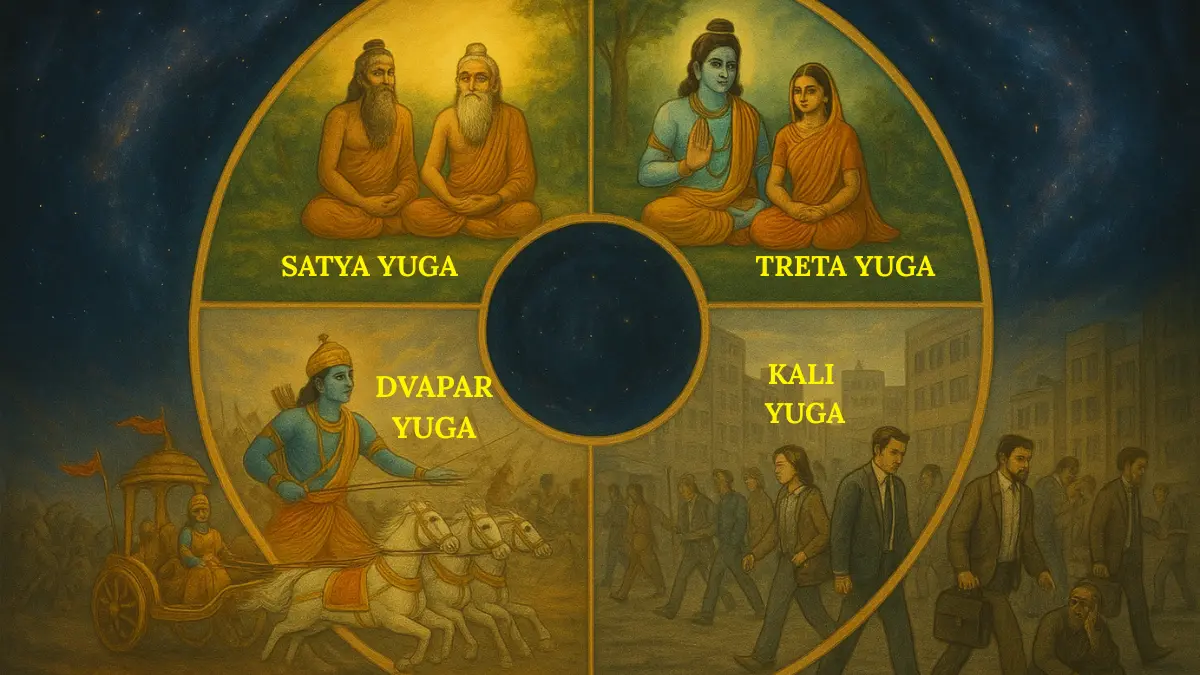
In Hindu thought, time does not move in a straight line. Instead, it flows in vast loops called yugas. Each yuga has a distinct moral and spiritual character. These cosmic ages rise and fall, repeating over and over. They are believed to shape the destiny of the world.
The Four Yugas
Hindu scriptures speak of four yugas. Satya Yuga, also called Krita Yuga, is the Age of Truth. In this era, Dharma stands on all four legs, virtue thrives, and people live long and righteous lives. Treta Yuga follows, with Dharma standing on three legs. Virtue declines slightly, lifespans shorten, and the events of the Ramayana unfold in this age.
The third is Dvapara Yuga, when Dharma stands on two legs. Moral decline speeds up, and the Mahabharata war marks the turning point. The final age is Kali Yuga, with Dharma reduced to one leg. Greed, conflict, and ignorance dominate. This is the age we live in today.
The Cosmic Clock
Each yuga lasts a set number of divine years. One divine year equals 360 human years.
| Yuga | Divine Years | Human Years | Dharma Standing |
|---|---|---|---|
| Satya Yuga | 4,800 | 1,728,000 | 100% |
| Treta Yuga | 3,600 | 1,296,000 | 75% |
| Dvapara Yuga | 2,400 | 864,000 | 50% |
| Kali Yuga | 1,200 | 432,000 | 25% |
A complete cycle, called a Mahayuga, spans 12,000 divine years or 4,320,000 human years. Twenty-eight Mahayugas make one day of Brahma, known as a kalpa. Three hundred and sixty kalpas form a year for Brahma, whose life lasts 100 such years — equal to 311 trillion human years. At the end of his life, creation dissolves and begins again.
Rising and Falling Morality
The yuga cycle reflects the changing moral state of the world. In Satya Yuga, wisdom and truth dominate. By Kali Yuga, ignorance and greed prevail. Yet Hindu belief holds that divine avatars appear to restore balance in each age. Rama came in Treta Yuga, Krishna in Dvapara Yuga, and Kalki is yet to appear in Kali Yuga.
Shared Myths Across Cultures
Many ancient cultures describe similar cycles of time. Greek mythology speaks of the Golden, Silver, Bronze, and Iron Ages. The Mayans told of different suns, each ending in destruction. Norse mythology speaks of Ragnarok, a great battle after which the world is renewed. These similarities suggest a shared human view of time as cyclical rather than linear.
Living in Kali Yuga
Tradition says Kali Yuga began in 3102 BCE, making us more than 5,000 years into it. This age is seen as the most challenging, marked by social, moral, and environmental decline. Spiritual practice in this period focuses on devotion and mantra chanting. The Mahamantra is believed to be a powerful way to progress spiritually. In earlier ages, knowledge and ritual alone were enough, but in Kali Yuga, faith and meditation are seen as most effective.
Science Meets Myth
Modern science usually measures time in a straight line, but some cosmological theories explore cyclic models of the universe. While the Hindu yuga system is rooted in mythology, it mirrors these ideas in symbolic form. It reflects a deep understanding that growth, decay, and renewal are part of existence.
Carrying the Spark Forward
Even in Kali Yuga, Dharma survives. We can live with the truth of Satya Yuga, embrace the selflessness of Treta Yuga, and uphold the courage of Dvapara Yuga. By acting with compassion, we help carry the spark of virtue into the next cycle.


