










By: Hiren Gandhi
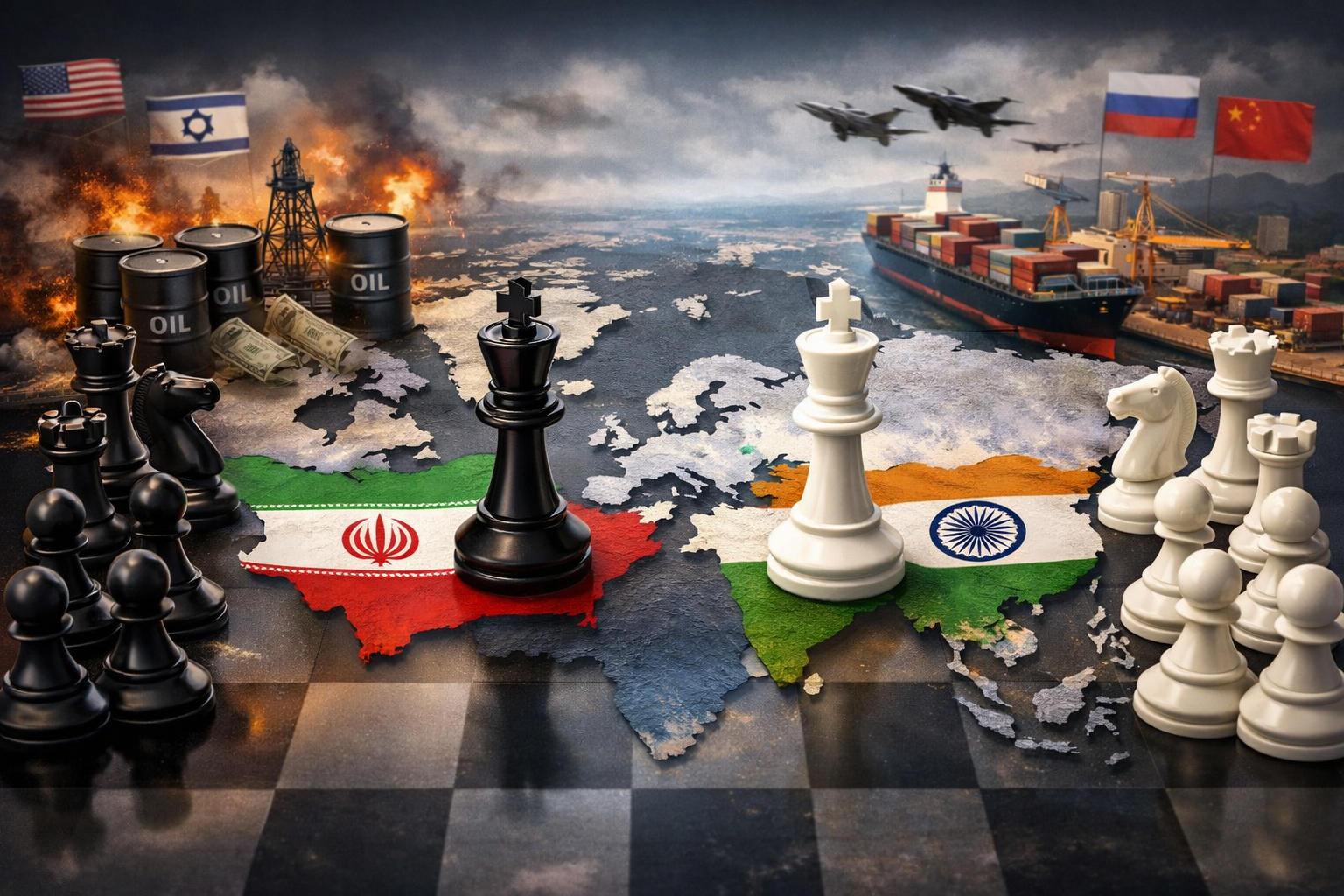
Global warfare has fundamentally changed its character. Wars of the 21st century are no longer fought primarily with tanks, missiles or soldiers, but through oil barrels, currency control, global banking systems, economic sanctions, proxy pressure and diplomatic containment. On this evolving global chessboard, Iran stands at the center, while India emerges as a critical balancing power.
Iran remains one of the few regional powers in the Middle East that refuses to recognize Israel, resists American strategic directives and maintains an independent foreign policy. Its influence across Iraq, Syria and Lebanon positions it as an “uncontrolled regional power” in the eyes of Washington. This is precisely why Iran has become the focus of sustained economic and diplomatic pressure rather than direct military confrontation.
Economic sanctions have become the primary weapon against Iran. Restrictions on oil exports drastically reduced national revenue, while exclusion from the SWIFT banking system and dollar-based transactions led to a collapse of the Iranian rial. These measures have triggered runaway inflation, skyrocketing prices of food and medicines, and rising youth unemployment. The objective is clear—create economic distress, generate internal political pressure and force systemic change.
The United States avoids direct war after costly experiences in Iraq and Afghanistan, where military intervention resulted in trillion-dollar expenditures and domestic political backlash. Instead, the new strategy is war without weapons, relying on economic strangulation, proxy conflicts and diplomatic isolation. Israel complements this approach by targeting Iranian influence in Syria and Lebanon, aiming to gradually shrink Tehran’s regional footprint.
China benefits quietly from discounted Iranian oil while avoiding open confrontation with the United States. Russia, constrained by its own sanctions and the Ukraine conflict, offers limited support but cannot act as a full strategic shield for Iran.
Amid these competing pressures, India plays a calculated and intelligent balancing role. It maintains strategic ties with the United States, long-standing defense relations with Russia, and critical economic and connectivity interests with Iran, particularly through the Chabahar Port and energy cooperation. India neither abandons Iran nor openly challenges American sanctions. This approach reflects India’s doctrine of strategic autonomy—protecting national interests through quiet diplomacy rather than public confrontation.
The reality of today’s geopolitics is unmistakable. Wars are no longer won by weapons alone, but by economic power and strategic balance. And in this global contest, India survives—and succeeds—by mastering balance.

Secretary – InGlobal Business Foundation (IBF)
Director – ReNis Agro International LLP, Ahmedabad, India
Subscribe Deshwale on YouTube


