







South Korea did not detain a travel influencer. It sent a message. Whether that message was deliberate or accidental is the most interesting question to emerge from the Sachin Awasthi affair, and the answer, whatever it turns out to be, matters well beyond the world of travel content.
Awasthi, an Indian travel influencer with a substantial online following, posted a raw account of being detained for 38 hours at Jeju Island’s airport in late February 2026. His Instagram post and YouTube video went viral within hours. By the following day, the Indian Embassy in Seoul had issued a formal travel advisory. The speed and precision of that response has since led more than a few observers to ask whether the episode was perhaps too convenient to be entirely spontaneous.
That is a question this article intends to take seriously.
Paradise With a Complicated Door
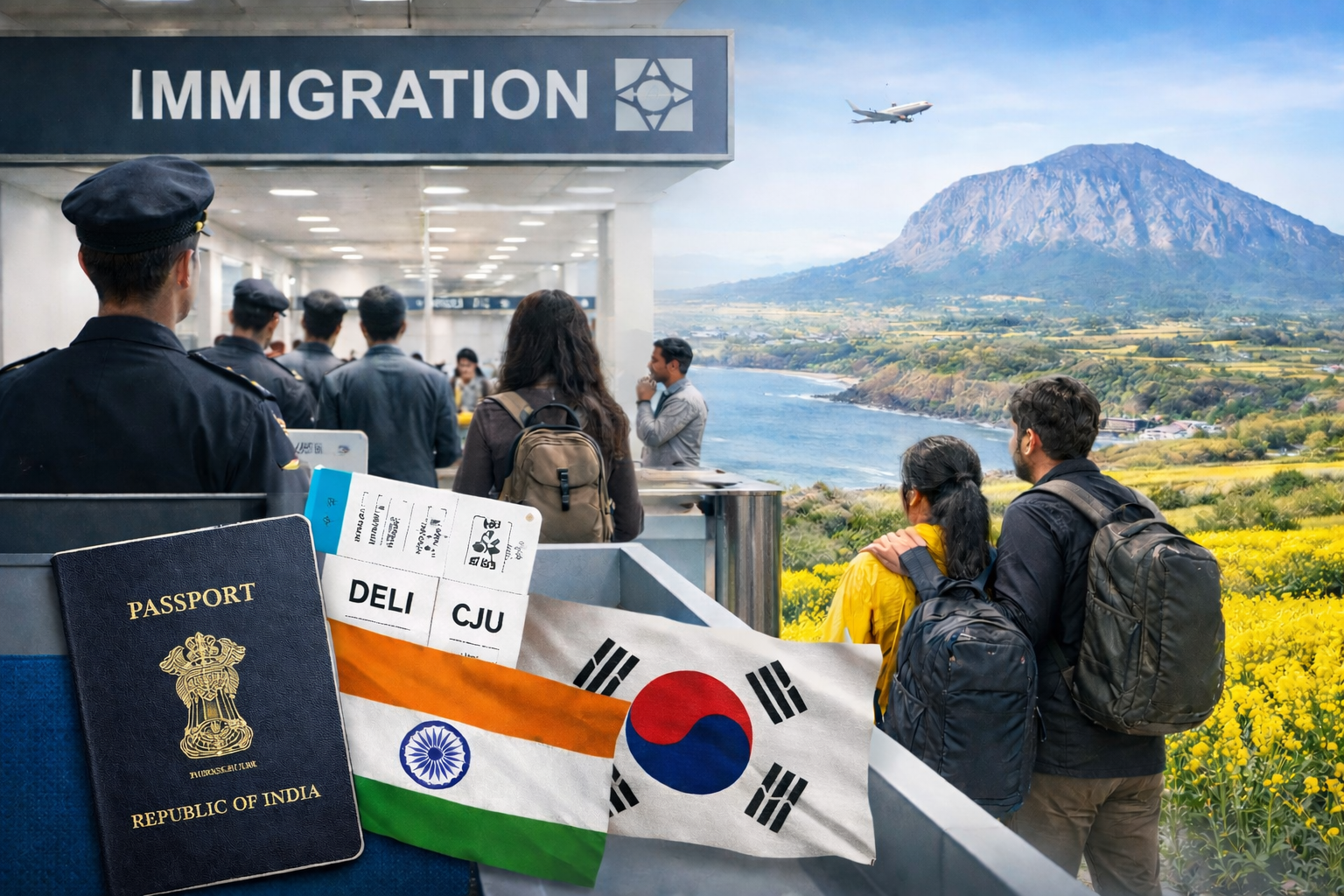
Jeju sits off the southern tip of the Korean peninsula, roughly 130 kilometres from the mainland. It is South Korea’s largest island and only self-governing province. Hallasan, a dormant shield volcano and the country’s highest peak, dominates the interior landscape. Around it spread lava tube caves, dramatic coastal cliffs, black-sand beaches and expansive canola fields that turn the island yellow in spring. UNESCO has recognised Jeju’s natural value through a rare Triple Crown designation, covering its biosphere reserve, World Heritage geological sites and Global Geopark status. Tens of thousands of honeymooners, hikers and leisure travellers pass through Jeju International Airport every month. The island is, on its own terms, one of Northeast Asia’s most spectacular destinations.
It also runs a special visa-free entry programme for foreign nationals, including Indian passport holders. Travellers may arrive without a pre-approved Korean visa provided they land on a direct international flight, stay only on Jeju, and do not attempt to travel onward to mainland South Korea. The scheme was designed to boost tourism revenue. In practice, it has increasingly attracted a very different kind of attention.
The Incident Itself
Awasthi’s ordeal did not begin at Jeju. It started earlier, in Bangkok, where he and his wife Deepshikha Mishra attempted to board their connecting flight to Jeju and faced the first round of questions about the purpose of their visit. They flew on regardless and arrived at Jeju International Airport with confirmed hotel bookings and return tickets. Immigration officers questioned their purpose of visit and refused them entry. Awasthi claims the entry-denied stamp had already been applied to their documents before any meaningful conversation took place. The couple was placed in a holding facility he described as resembling a jail, with no natural light, restricted movement and inadequate food. Attempts to contact the Indian Embassy in Seoul, he said, went unanswered through the night. They were eventually compelled to purchase a return ticket at roughly ten times the standard market fare.
What has received less attention is that the ordeal continued beyond Jeju. During their transit through China on the return journey, Awasthi alleges they faced further supervision, restricted communication, confiscation of phone access, inadequate food and the worst sleeping conditions of the entire trip. By the time they were finally told they would be sent back to India, he said, they were mentally drained. The Jeju detention was the headline. The China transit was the coda that made the full picture considerably darker.
Chinese authorities have not yet publicly responded to these allegations.
The Indian Embassy in Seoul issued a detailed advisory on 24 February 2026, clarifying that the Jeju visa waiver does not guarantee entry, that final admission rests solely with South Korean immigration officers, and that the Embassy is not in a position to overturn those decisions. Travellers were urged to carry printed copies of return tickets, hotel bookings, proof of sufficient funds and a clear day-by-day itinerary. The message was firm: do not arrive at Jeju assuming that the visa-free label means the door is open.
Was This a Coordinated Warning?
Here is where the story gets genuinely uncomfortable, and where most coverage has chosen to look away.
The advisory that followed Awasthi’s video was not merely fast. It was structured, specific and almost pedagogical in tone, reading less like a reactive diplomatic notice and more like a document that knew exactly what problem it was trying to solve. His YouTube video, for its part, was calm, instructional and composed in a way that sat oddly with the ordeal he was describing. A man who has just spent 38 hours in a detention room with no adequate food and no consular support might reasonably be expected to be angrier, or at least less organised. His channel name is, after all, “Sachin Awasthi Unscripted.”
Could the detention, the viral account and the government advisory have been, at some level, a coordinated effort by Indian and South Korean authorities to deliver a public deterrent to would-be illegal immigrants who use Jeju as a staging post into the Korean mainland? The honest answer is that nobody outside the relevant government offices knows. What is known is this: the Indian Embassy had, by its own admission in the advisory, been receiving reports of Indian nationals being denied entry at Jeju for some time before this incident. A high-profile content creator with a large, travel-oriented following documenting exactly what happens when things go wrong at Jeju immigration is, regardless of how it came about, the most effective public service announcement either government could have designed. The outcome has functioned as a deterrent. It reached millions of people who would never have read a government press release. And it cost, as far as anyone can tell, nothing.
That may all be coincidence. It may also not be.
A Crisis That Could Become a Career-Defining Moment
There is another dimension to this story that deserves honest examination, and it has nothing to do with immigration policy. In the competitive and often precarious world of travel content creation, a dramatic, real-world ordeal can do for a creator’s subscriber count what years of well-produced videos sometimes cannot. Adversity, when documented compellingly, drives algorithm-friendly engagement: watch time climbs, shares multiply, comment sections fill with a mixture of outrage, solidarity and debate, all of which signal relevance to platforms like YouTube.
Awasthi’s channel, which built its following through travel narratives and lifestyle content, has almost certainly seen a significant surge in viewership following this incident. Videos about visa denials, detention experiences and government advisories tend to attract audiences well beyond a creator’s existing subscriber base. News portals embed them. WhatsApp groups circulate them. People who had never heard of Sachin Awasthi before February 2026 will have watched his Jeju account simply because it appeared in their recommendations or was sent to them by a well-meaning relative planning a Korea trip.
None of this implies that Awasthi manufactured or exaggerated his experience for views. There is no reason to suggest that. His account has been taken seriously enough by the Indian Embassy to prompt an official response, which is a form of institutional validation that carries real weight. But it is also true that the travel influencer economy runs on moments of friction and resolution, on stories where something goes wrong and the creator navigates it for their audience. A 38-hour detention, a refusal at immigration, a forced return ticket at ten times the price: these are the raw materials of genuinely compelling content, and Awasthi has clearly used them well.
Whether this episode translates into sustained growth for his channel or remains a one-time viral spike will depend on what he does next. Creators who convert a crisis moment into a deeper editorial identity, perhaps as a reliable and informed voice on travel rights, visa rules and the real experiences of Indian passport holders abroad, tend to retain the new audiences that adversity brings. Those who simply move on to the next destination video often see that spike recede as quickly as it arrived. Either way, Jeju has given Sachin Awasthi something that money and careful planning rarely can: a story that people genuinely wanted to hear.
The Dunki Route and South Korea’s Real Worry
South Korea is well aware that its Jeju visa-waiver scheme has been exploited systematically. Indian and Chinese nationals have been among those most frequently identified as overstaying or attempting to slip through to the mainland without the required visa. This is the Dunki route, a term borrowed from Hindi slang that describes the practice of taking an indirect, often illegal, multi-hop path to reach a desired destination. Jeju, with its comparatively relaxed entry rules and its geographic position as an island with direct international flights, fits neatly into that logic. The mainland’s robust manufacturing sector, construction industry and persistent demand for low-cost labour make South Korea an attractive endpoint. Immigration officers at Jeju are therefore trained to be alert to travellers who cannot clearly articulate their tourism plans, who carry inconsistent documentation, or who show behavioural patterns more consistent with economic migration than leisure travel.
The numbers, though modest in absolute terms, tell a story of acceleration. According to the Jeju Coast Guard, there were seven documented cases of unauthorised attempts to reach the South Korean mainland in 2024 alone, involving individuals who had entered Jeju through its visa-free programme. In total, 18 people were caught, including foreign nationals and Korean brokers facilitating the illegal departures, while authorities have been candid that many more are believed to have evaded detection entirely. That figure represented a sharp and troubling rise from 2023, when only two such incidents were recorded. A near fourfold increase in a single year is not a statistical blip. It is a trend, and South Korean authorities are responding to it as one.
The political sensitivity around Jeju’s immigration status runs deep. In 2018, the arrival of several hundred Yemeni asylum seekers on Jeju prompted more than 700,000 South Koreans to sign a petition demanding their deportation. The island’s visa-free policy came under national scrutiny at that time, and the public debate about who should and should not be allowed in never fully settled. South Korea is a country with a historically homogeneous society, a strong sense of national identity, and a population that is particularly alert to what it perceives as demographic or economic pressure from unauthorised arrivals. The government has had to balance its tourism ambitions against those domestic anxieties ever since.
There is a grim and instructive irony in the contrast with North Korea. The authoritarian state to the north, sealed off from the world and offering its citizens no economic incentive to stay, does not face illegal immigration pressure. Nobody attempts to enter North Korea through a Dunki route. South Korea, by contrast, is an open and prosperous democracy, and it is precisely those qualities that make it a destination for people who have no intention of following the rules. The very freedoms that make South Korea admirable are the same ones that create the vulnerability. Every sovereign nation has the right to protect its borders from illegal entry, and South Korea’s tightening of Jeju’s immigration screening is a legitimate exercise of that right, even when it results in genuine tourists being caught uncomfortably in the net.
How Illegal Immigrants Bring a Bad Name to Every Honest Traveller
Every Indian national who enters Jeju illegally, overstays their permitted period or attempts to move to the mainland without a valid Korean visa makes the immigration experience measurably harder for every legitimate Indian tourist who follows. This is not a matter of fairness in any abstract sense. It is simply how border management operates in practice. When a recognisable pattern of abuse has been associated with a particular nationality, immigration officers adjust their screening intensity accordingly. That adjustment does not distinguish between the person who abused the system and the person who has done everything right.
Awasthi acknowledged this directly in his video. He noted that the increasing frequency of illegal entry attempts by Indian nationals had created what felt like a generalised suspicion of all Indian passport holders at Jeju. The immigration interpreter at the holding facility allegedly asked the couple, repeatedly and with some insistence, whether they were seeking refugee status. That question, posed to two Indian travel content creators who had confirmed accommodation and return flights, is a revealing indicator of how severely Jeju’s immigration officers have recalibrated their expectations of Indian arrivals.
The wider picture is not encouraging. In 2023, the United Kingdom introduced a mandatory electronic travel authorisation system that disproportionately affected nationals from South Asia, including India, following years of data showing elevated visa overstay rates among certain visitor categories. Canada has tightened student visa scrutiny after a surge in applications from India that officials publicly described as containing a significant proportion of fraudulent documentation. In the Schengen zone, Indian nationals face some of the highest visa rejection rates of any nationality applying for short-stay tourist visas, with Italy and Germany among the more restrictive processing centres. These are not expressions of hostility toward India as a nation. They are administrative responses to documented patterns of abuse, and the Indian nationals who exploit those systems are, in effect, writing the rules that every other Indian traveller must then live by.
South Korea and Jeju sit squarely within that broader global trend. The reputational damage caused by a comparatively small number of illegal immigrants carries consequences for tens of millions of honest, law-abiding Indian passport holders who simply want to see the world and come home.
What Genuine Tourists Must Now Do
The Indian Embassy’s advisory leaves little room for ambiguity. Travellers should carry printed copies of all documents and not rely on mobile screenshots alone, since there is no guarantee of network access or the ability to unlock a phone during immigration questioning. A clear, specific itinerary with named hotels, confirmed booking references and dates is essential. Proof of sufficient funds, whether bank statements or a travel card, must be on hand. Employer letters, university identity cards and evidence of family ties in India all help demonstrate that the traveller has strong reasons to return home and no incentive to overstay.
Routing matters considerably. If an itinerary requires clearing immigration at Incheon or Gimpo airports, a standard South Korean visa is almost certainly required. The Jeju-specific visa exemption applies only to travellers arriving on a direct international flight into Jeju International Airport. Travellers who are uncertain about their routing should verify with their airline before purchasing tickets.
For most well-prepared tourists, Jeju remains accessible, beautiful and genuinely worth the journey. The volcanic landscapes are extraordinary. The Manjanggul lava tube cave is one of the longest in the world. Seongsan Ilchulbong, the crater formed by an ancient volcanic eruption, rises dramatically from the sea and draws photographers from across Asia. The island’s haenyeo, women divers who harvest seafood from the ocean floor without breathing equipment, are a living cultural tradition recognised by UNESCO. The seafood itself, served fresh along the harbour fronts, is exceptional. Jeju’s culture is distinct from the mainland in ways that reward curious visitors who take the time to look beyond the tourist trail.
But the visa-free label has never been a guarantee of entry. It is a privilege, extended under specific conditions, to people who can demonstrate that they intend to honour those conditions. The Sachin Awasthi episode, whatever its precise origins, has served a clear public function. It has told millions of Indian travellers, loudly and with some urgency, that Jeju’s open door is not unconditional. Treat every sovereign border with the respect it deserves, prepare thoroughly, and the island remains one of Asia’s finest travel experiences. Treat it as a loophole or a stepping stone, and the consequences can be severe and expensive.
Subscribe Deshwale on YouTube


