





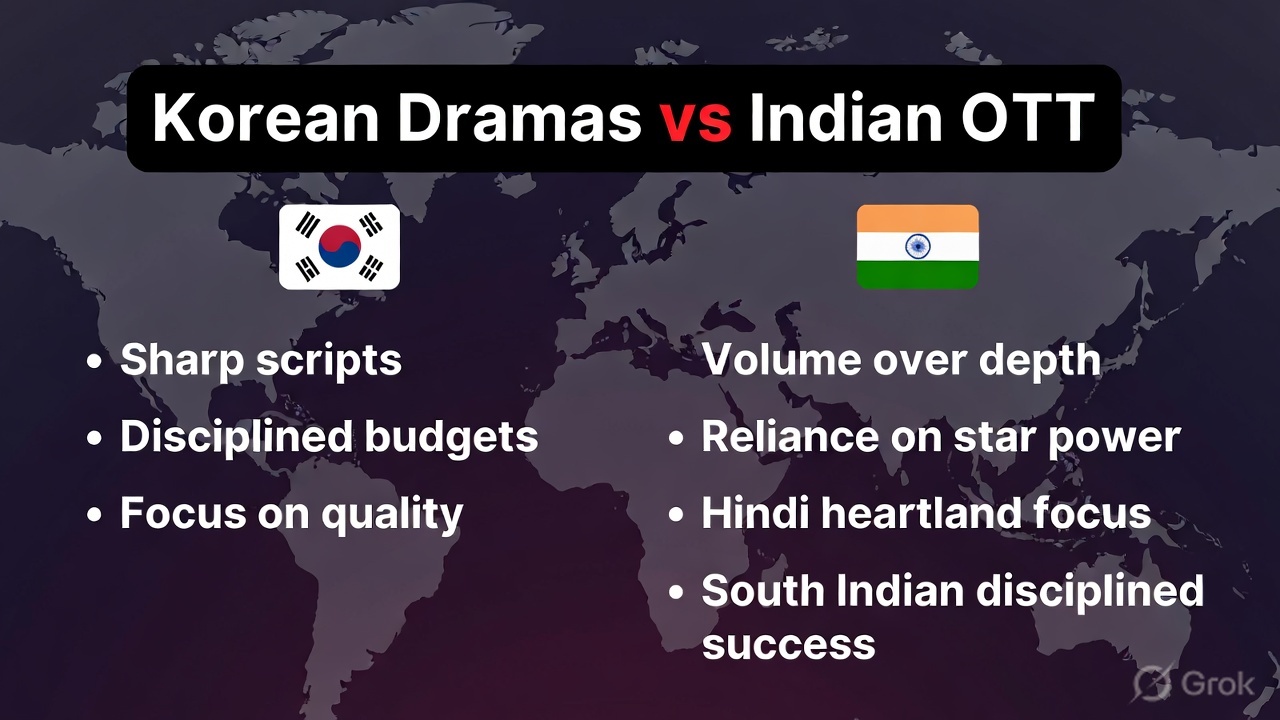
South Korean dramas dominate globally with razor-sharp stories, ironclad budgets, and universal appeal, while Hindi OTT often chases volume over depth – yet the fix is closer than Seoul, thriving right in our South Indian backyard.
South Korean dramas keep winning big with sharp stories, tight budgets, and real global love. Mainstream Hindi OTT? We often lag, not from lack of talent or cash flow, but because we prioritise quantity over quality. Platforms are flooding with content and revenue, yet many shows feel half-baked. A few Korean habits could fix that fast. And the best news? We don’t have to copy Seoul – our South is already doing it right here.
Look at any viral Korean set clip: stars and crew grinding efficiently, zero drama, no vanity vans as palaces, no perks even outdoors. Their secret sauce? Precise scripts from the start, strong production values, and post-production that’s obsessive: editing, colour grading, effects that actually elevate the narrative.
They guard money fiercely. Squid Game Season 1 cost ~US$21.4 million (roughly Rs. 180 crore then), delivered Netflix ~US$900 million in impact value, and hooked 142 million viewers. Stack against Heeramandi’s Rs. 200 crore. True, period pieces need grand sets and costumes, so this is not an exact comparison, but the ROI difference is stark.
Koreans lead with story, not star ego. Script dictates everything. Barely 15-20 years ago, Korean entertainment was off the map. Hallyu changed it: 1990s dramas stormed China (What is Love topped imports in 1997), journalists named it “Hallyu” in 1999 after Shiri’s smash. Economic woes pushed President Kim Dae-jung to export culture – dramas, films, beauty – and post-military censorship let creativity explode.
Hallyu grew steadily. Asia-focused in the 1990s, broader in 2000s-2010s, now worldwide via Parasite and Squid Game. Na Yeong-seok’s intimate hits like Two Days & One Night show script polish can take months or years, a standard there. Writers like Kim Eun-sook or Kim Eun-hee draw crowds by their name alone. TV’s 12-16 episode rule built restraint – no dragging for ratings – and OTT inherited it seamlessly.
They adapt without mess too. Crash Landing on You aired 16 episodes while shooting continued, tweaking via viewer feedback and guidelines, quality rock-solid. Contrast our reality. We have rushed scripts, skimped research (all ‘creative liberty’), constant on-set rewrites by directors, actors, technicians, dismissed as “kya farak padta hai?” Outcome: budgets balloon, schedules collapse, viewers get mediocre.
Korea has flops too. Ambitious ones like Moving paid off huge, but Arthdal Chronicles sequels overran and bombed, scandals hit hard, proving even discipline strains at scale.
And India has its own standouts as well. Sacred Games reshaped OTT with overseas buzz. Delhi Crime snagged an International Emmy for gritty realism – Season 3 (November 2025) tackled trafficking unflinchingly. Scam 1992 became a benchmark, launched Pratik Gandhi, showed smart true stories need only craft.
Netflix’s Korea bet? US$2.5 billion (2023-2026), biggest non-US single-country spend, because returns hold steady (Korean shows topped 90+ country charts by 2022). Their episodes average Rs. 6-18 crore, and over-deliver in many cases! Ours for mid-length often hit Rs. 25 crore+, bloated by star fees, long formats, loose prep.
So, what are Hindi OTT pain points? Star systems swallow 30-40% of budgets early, sidelining unknowns but powerful actors and technicians who could surprise and save money. Occasional platform-banner cosy deals, under-table ‘dakshina’ whispers (without which some insist no show happens), and refusal to learn from flops hold us back. As Anurag Kashyap has exposed, actors demand personal chefs at Rs. 2 lakh/day for ‘bird feed’ meals, or send drivers on 3-hour burger hunts from five star hotels. And yes, lakhs vanish on ‘meetings’: one minor star reportedly blew Rs. 35 lakh on coffee shop sessions for a Rs. 2 crore film, while producers foot boozing tabs too – all to keep peace, turning budgets into black holes before shooting starts.
Korean teams keep post-release buzz alive on socials. Here, promo dies after drop unless Season 2 is locked.
The real game-changer: India already nails this Korean-style approach in the South.
Mollywood (Malayalam) makes films on budgets that wouldn’t cover one Bollywood vanity van, yet delivers emotional knockout punches: Jallikattu, The Great Indian Kitchen, Manjummel Boys, Premam. Script is sacred, star serves story, opposite of Hindi excess. Big names skip the entourage drama; a Malayalam set feels more Korean than Film City.
And Tamil brings scale with control. Vetrimaaran’s Visaranai and Vada Chennai feel like serious literature on screen. Lokesh Kanagaraj plans universes (Vikram, Kaithi, Leo) with long term vision. Mani Ratnam proves over decades that beauty and budget intelligence coexist.
There were the pan-India breakthroughs too. RRR (Rs. 550 crore cost) earned Rs. 1,200+ crore worldwide, an Oscar for Naatu Naatu, and became our true cultural export, of Hallyu level in one go. Baahubali built worlds with rare discipline. KGF and Pushpa proved rooted regional stories, told with conviction and craft, and smashed every barrier.
Yes, South OTT also shines. Suzhal and Gargi won loyal fans with tight, character-driven depth. Farzi (Raj & DK, South-influenced) turned discipline into a bingeable global hit.
The bottom line? Hindi inefficiencies aren’t India’s destiny. They are a Bollywood habit. The cure thrives in Chennai, Kochi, Hyderabad.
And Korean success? It comes from their disciplined writing, controlled spends, writer respect, smart promo, nothing exotic. SS Rajamouli, Vetrimaaran, Dileesh Pothan, Lijo Jose Pellissery live it daily, in our languages, for our and world audiences.
For Hindi OTT platforms and creators, a simple question one can ask is: why chase Seoul when the lesson’s taught brilliantly at home?
We have talent, market, and hunger. Blend southern rigour with Korean polish – boundary-breaking stories will follow. Blueprint’s desi, multi-language. Will the right people finally pay attention?
Subscribe Deshwale on YouTube