











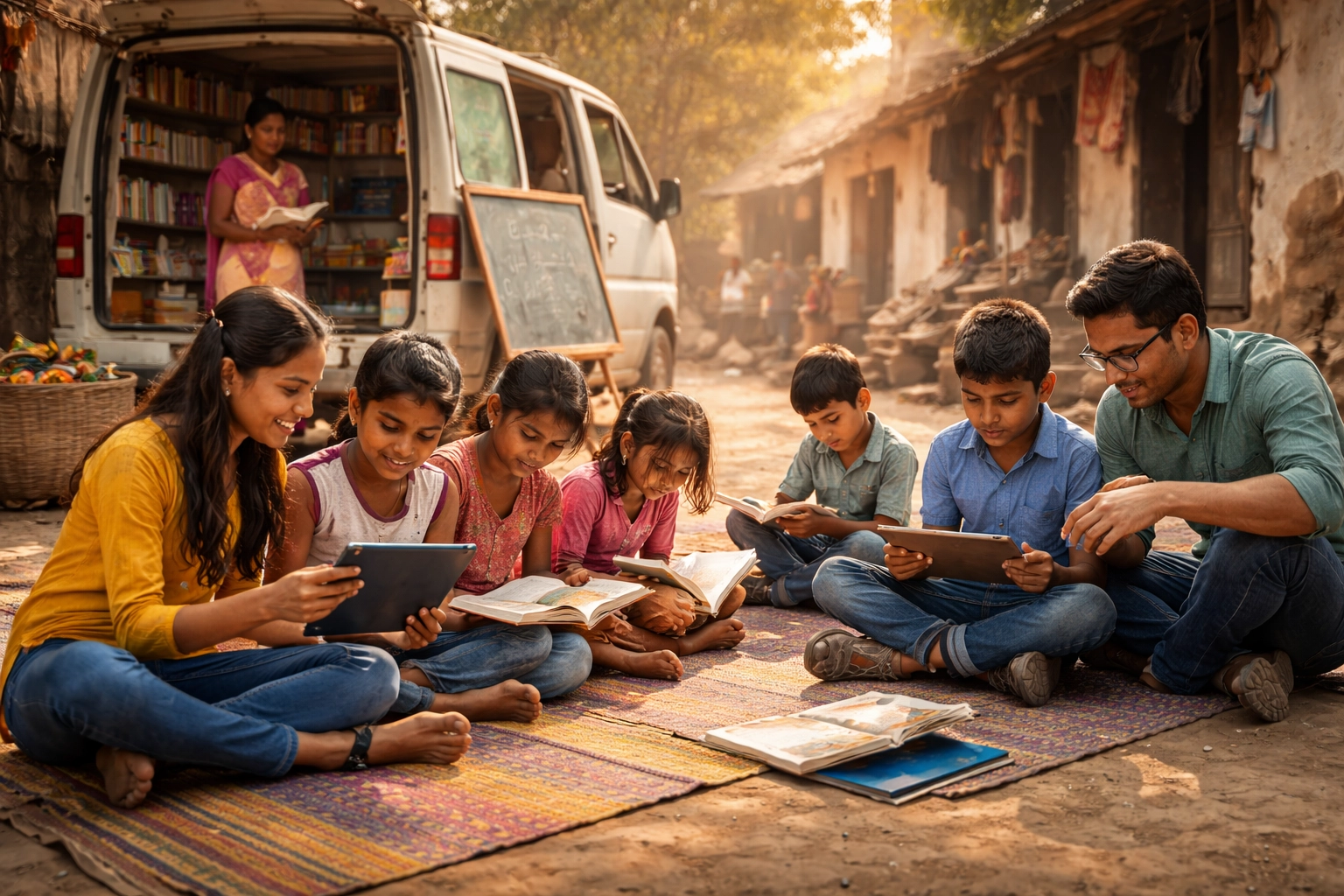
In a narrow lane of a dense settlement, as the afternoon sun softens, a group of children gathers on woven mats under a temporary shade. There are no formal classrooms here, no painted school buildings in sight. Yet the scene is unmistakably one of learning. A volunteer writes simple maths problems on a portable board while another reads aloud from a storybook in the local language. Laughter mixes with concentration as children take turns answering.
For many of them, formal schooling had been irregular. Migration, economic hardship, or lack of nearby facilities had interrupted their education. Community-led learning spaces like this are quietly filling the gaps.
Across India, citizens, teachers and local organisations are creating flexible learning environments where conventional systems struggle to reach consistently. In some places, unused community halls become evening study centres. In others, mobile libraries travel from village to village, bringing books and storytelling sessions to children who have never owned a book of their own.
Digital tools are also being adapted to local contexts. In villages with limited connectivity, recorded lessons are shared via offline devices. Volunteers help children navigate basic digital literacy, ensuring that technology becomes an aid rather than a barrier. The focus is not only on exam preparation but on building confidence, reading habits and curiosity.
Migrant communities, whose children often fall through administrative cracks, benefit significantly from such initiatives. Seasonal learning centres operate during periods when families are in one place, helping children maintain continuity in education. When they move again, basic learning foundations travel with them.
Teachers frequently extend their roles beyond school hours, mentoring first-generation learners and supporting parents who may be unfamiliar with formal education systems. Retired professionals, college students and homemakers join as volunteers, turning education into a shared social responsibility rather than a service delivered only by institutions.
These efforts do not replace formal schools. Instead, they act as bridges helping children return to classrooms better prepared, reducing dropout rates and strengthening foundational skills. They also demonstrate that learning does not depend solely on infrastructure. It thrives wherever there is patience, guidance and a belief that every child can progress.
In neighbourhoods and villages where resources are limited, such community learning spaces are doing something profound: They are restoring the idea that education belongs to everyone, not just to those with easy access.
Subscribe Deshwale on YouTube


