










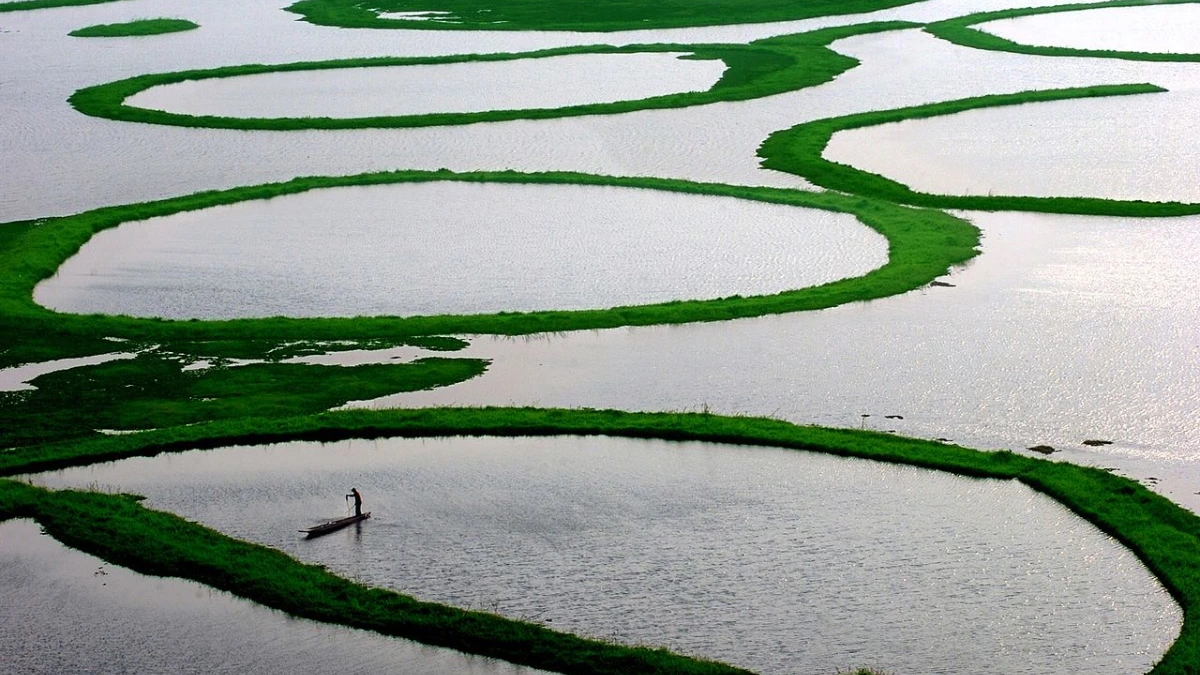
In the heart of Manipur’s hills lies a lake that defies everything we know about water bodies. Loktak Lake, often called the jewel of northeast India, is no ordinary lake. What sets it apart are its phumdis – floating islands made of vegetation, soil, and organic matter. These ever-moving masses glide across the lake’s surface, forming an ecosystem so unique that it has become one of India’s most remarkable natural wonders.
Loktak is not just a lake but a living entity. It changes with the seasons, sustains rare wildlife, and supports thousands of people who have built their lives around it. Nowhere else on Earth exists a freshwater body quite like this.
The Mystery of the Phumdis
Phumdis (sometimes called phumshongs) are dense mats of decomposed plant material that float naturally on Loktak’s waters. Some are no larger than a canoe, while others stretch across vast areas of the lake. In certain parts, they become so solid that people can walk on them or build huts known as phumshangs.
During the monsoon season, Loktak spans up to 287 square kilometres, making it the largest freshwater lake in northeast India. As the water level rises and falls, phumdis grow or shrink, shifting shape and location with the rhythm of nature.
Life on a Floating World
Among the most remarkable phumdis is Keibul Lamjao National Park, the only floating national park on the planet. It is also the last natural habitat of the endangered Sangai deer, a species so graceful it is nicknamed the “dancing deer.” This shy animal lives nowhere else, and its survival depends entirely on the delicate balance of Loktak’s floating islands.
Beyond wildlife, Loktak is home to over 100,000 people who rely on its waters and phumdis for their livelihoods. Fishermen anchor their homes on these floating platforms and move with the drifting islands, casting nets to catch fish like carp. Women harvest aquatic plants to use as vegetables and fodder, while floating gardens grow crops such as mustard and colocasia.
Cultural Connections
To the Meitei people of Manipur, Loktak is far more than a body of water. It is a sacred space woven into their identity, stories, and spiritual life. Local legends speak of gods creating the lake to sustain life in the valley. Traditional festivals, dances, and songs often honour the spirit of Loktak, reflecting the deep bond between the community and its environment.
Troubled Waters
Despite its magical charm, Loktak faces growing threats. The construction of the Ithai Barrage in the 1980s permanently raised water levels, disrupting the lake’s natural rhythm. In earlier times, phumdis would sink during dry months, replenishing nutrients and rebuilding themselves. Now, they remain afloat all year, weakening their structure and stability.
Additionally, pollution from untreated sewage, agricultural chemicals, and plastic waste has degraded water quality. Invasive plants like water hyacinth have spread rapidly, choking the lake and threatening native vegetation. While the Loktak Development Authority has launched clean-up drives and tried to regulate fishing practices, balancing conservation with the needs of local communities remains a difficult task.
A Landscape Worth Saving
Even as it faces ecological stress, Loktak continues to amaze all who visit. It is a place where the earth floats, where rare deer dance on water, and where ancient traditions live in harmony with nature. Preserving Loktak is not just about protecting a lake. It is about safeguarding a culture, a species, and one of the most extraordinary ecosystems on the planet.


