









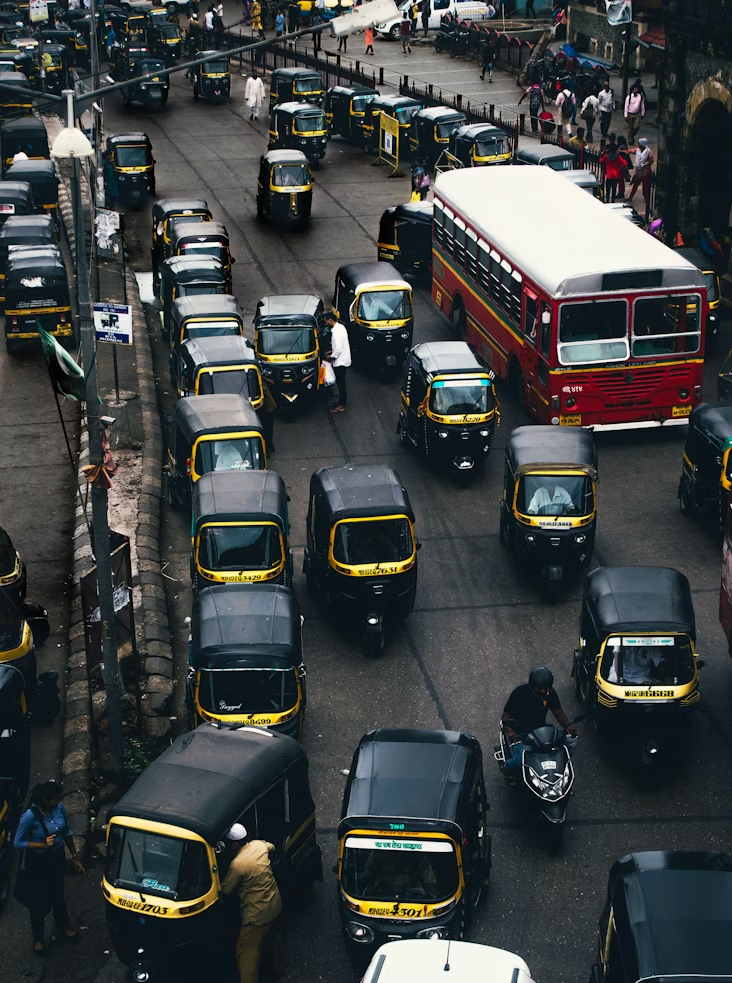
There is a sound that defines every Indian city. It is not the metro bell or the bus horn. It is the putt-putt of an autorickshaw negotiating a gap in traffic that no car would dare attempt. In Maharashtra, that sound now carries a new weight. The state government has announced a temporary freeze on new autorickshaw permits, citing traffic congestion and worsening air pollution across its major urban centres. Transport Minister Pratap Sarnaik confirmed the decision, noting that nearly 1.4 million autorickshaw permits have already been issued across the state. The halt, taken with central government approval, applies statewide and affects Mumbai, Pune, Nagpur and every other city in between.
On the face of it, this looks like routine transport regulation. But pull at the thread a little and what unravels is a much larger story about Indian cities, the informal economy, environmental governance, livelihood politics, and the messy business of deciding who gets to move through a city and how.
A City Choking on Its Own Growth
Maharashtra’s cities have been growing faster than their road infrastructure can keep pace with. Mumbai alone is among the most densely populated urban areas on the planet, with over 20,000 persons per square kilometre in its older zones. Roads that were designed for a fraction of the current vehicle load now carry a near-impossible burden.
The scale of the vehicle surge is not abstract. Official RTO data show that Maharashtra registered over 28 lakh new vehicles in 2024 alone, a 12.32 per cent jump from the previous year. That single-year addition included over 87,000 three-wheelers. Set that against a road network that has not grown proportionately in any of the state’s major cities, and the arithmetic of congestion becomes obvious. Autorickshaws account for roughly 7 per cent of Mumbai’s modal share, a number that seems modest until you factor in the sheer volume of vehicles. Nearly 1.4 million permits statewide means a very large number of three-wheelers competing for road space in cities where carriageways are already consumed by cars, buses, two-wheelers, trucks and delivery vehicles. Officials in the transport department have pointed out that the growing number of autorickshaws has slowed traffic movement across several arterial routes, increased idling time and, by extension, pushed up fuel consumption and tailpipe emissions in already polluted urban corridors.
The pollution numbers are equally sobering. According to air quality monitoring data, Mumbai’s ambient PM2.5 concentration currently runs at roughly 4.4 times the annual guideline value set by the World Health Organisation. Mumbai is not Delhi, and its coastal geography offers some relief from the worst particulate episodes, but the gap between acceptable and actual air quality in the city is real, persistent and widening. Vehicular emissions, alongside construction dust, remain among the primary contributors to this load.
But autorickshaws are only one part of the problem, and perhaps not even the worst of it. Anyone who has walked through Dadar, Andheri, Bandra or Kurla at peak hour knows the real visual assault on the streetscape: cars and SUVs parked in double and triple rows along roads that were never wide enough for even single-lane parking. The pavement disappears under bumpers. The carriageway narrows to a single thread. Pedestrians are pushed onto the road, into the path of moving traffic, because the footpath behind them has been swallowed by a vehicle that has no business being there.
This is not incidental disorder. It is a daily, normalised feature of Mumbai’s streets and those of every major city in Maharashtra. Markets like Linking Road, Colaba Causeway and the wholesale districts of Pune’s old city are ringed by vehicles parked three deep at busy hours. Commercial areas in Nagpur’s Sitabuldi suffer the same. Residents of quieter neighbourhoods are equally affected. Narayani Bharadwaj, a retired resident of Kandivali in her sixties who has lived in the suburb for decades, has cautiously welcomed the government’s move. The mushrooming autorickshaws in Mumbai, she reflects, have contributed to haphazard and disorderly parking in some areas of Kandivali, which is a real eyesore and worsens the residential experience in those areas. It is the kind of observation that does not make it into transport policy documents but that captures, with some precision, what unregulated vehicle growth does to the texture of a neighbourhood.
The ugliness is not just aesthetic, though that too is real. Streets that could function as public space, as walkable, breathable corridors through a dense city, are rendered almost unusable by the sheer volume of badly parked vehicles. The visual clutter of bumper-to-bumper parked cars stacked sideways across a road, with autorickshaws and motorcycles wedged in the remaining slivers, is one of the most persistent failures of urban management in Maharashtra. It speaks to an enforcement mechanism that simply does not work and, in many cases, is not intended to. Parking fines exist on paper. Towing operations are announced periodically. And then the cars come back and park in exactly the same spot the next morning.
The compounding effect of triple-parked cars on streets already dense with moving autorickshaws is significant. A road that should move two lanes of traffic in each direction is reduced, by illegal parking alone, to one crawling lane. The autorickshaw that is being blamed for congestion is often simply stuck in the same mess that a car created. The permit freeze addresses one variable. The parking chaos, which is arguably more corrosive to the street experience, remains untouched.
The Bombay High Court has, in recent years, been consistently vocal about Mumbai’s deteriorating air quality, pushing the state government to take concrete action on vehicular pollution. A seven-member committee was set up in mid-2025 to study the feasibility of banning petrol and diesel vehicles in the Mumbai Metropolitan Region. Maharashtra’s permit freeze sits within this broader regulatory momentum. It is not an isolated call but part of a series of moves that signal the state is slowly, sometimes haltingly, trying to rationalise the relationship between vehicles and city air.
The Livelihood Question Nobody Wants to Answer Directly
And then there is the other side of this. The drivers.
For the men who operate autorickshaws, most of them migrants from smaller towns and districts, the three-wheeler is not a vehicle. It is the whole economy. A vehicle, a livelihood and often a loan repayment scheme rolled into one noisy contraption. When the number of autorickshaws on the road rises faster than the number of passengers, it is the drivers who absorb the loss. More vehicles chasing the same pool of commuters means fewer trips per driver per day, which means lower daily earnings, which means real financial stress for households that are already running on narrow margins.
Existing permit holders had been raising these concerns with the state government for some time before the freeze was announced. Their argument was straightforward: too many rickshaws on the road, not enough fares to go around. Officials have confirmed that this concern was factored into the final decision, even if the public framing of the policy leaned more on traffic and pollution than on driver income.
This is worth pausing on. The permit freeze protects the economic interests of existing autorickshaw operators as much as it addresses environmental or mobility concerns. It is, in effect, a supply-side intervention in an informal labour market. Whether that is good urban policy or a form of regulatory capture by an organised voting bloc is, honestly, a question that deserves more debate than it usually gets.
A Permit System Under Scrutiny
The government’s announcement came bundled with a second disclosure that drew considerably more attention. An investigation into the permit distribution process had uncovered irregularities. Authorities revealed that some autorickshaw permits had allegedly been issued to individuals who were not eligible to hold them, and that illegal Bangladeshi nationals were among those who may have received permits. The matter is currently under investigation, with officials stating that further action will follow once findings are reviewed.
The allegation, if borne out, raises serious questions about the integrity of the permit issuance mechanism itself. Regional Transport Offices process thousands of applications every year. The verification chain, from documentation to background checks to actual permit issuance, is long and, in practice, imperfectly monitored. That irregularities could enter the system is, regrettably, not surprising to anyone who has spent time watching how RTOs function on the ground. What the investigation will need to establish is the scale of the problem and where exactly in the process the verification broke down.
The Regulatory Context is Messier Than It Looks
It is also worth noting that the permit freeze did not arrive in a vacuum. Maharashtra’s transport sector has been in a state of considerable agitation in early 2026. The Maharashtra Transporters Action Committee, representing truck operators, taxi unions and autorickshaw groups, launched an indefinite statewide strike in the first week of March over a separate but related issue: the e-challan system and what transporters describe as arbitrary, revenue-driven penalisation of vehicles.
Mumbai Rickshawmen’s Union and other autorickshaw bodies were also preparing to join the strike. Transport Minister Sarnaik, who is simultaneously managing the permit freeze and the e-challan dispute, has acknowledged in principle that many of the grievances about electronic traffic enforcement are legitimate, though the formal government resolution that transporters sought had not materialised at the time the strike was called. It is a lot to have on your plate.
The fact that all of this is happening together is not incidental. It reflects a transport ecosystem under simultaneous pressure from multiple directions: overcrowding, poor earnings, regulatory overreach in some areas and regulatory failure in others.
The Electoral Arithmetic Behind a Transport Decision
Policy decisions in Maharashtra rarely arrive without a political shadow, and this one is no different. The timing of the permit freeze matters as much as its content. The Brihanmumbai Municipal Corporation elections are expected in 2026, and the Mahayuti alliance, which brought the BJP, the Shiv Sena faction led by Chief Minister Devendra Fadnavis and the NCP faction led by Deputy Chief Minister Ajit Pawar together, is acutely aware that urban constituencies in Mumbai, Pune and Nagpur will be fiercely contested.
Autorickshaw drivers constitute a substantial and organised vote bank. Estimates vary, but across Maharashtra’s major cities, the community of permit holders, their families and the networks of spare-part dealers, mechanics, fuel vendors and union organisers tied to the autorickshaw ecosystem represent a significant bloc of votes in dozens of assembly and municipal constituencies. These are not peripheral numbers. In close urban contests, this is the margin. Politicians know it. Union leaders know it. And the drivers know that politicians know it.
The freeze, in that context, is a gift to existing permit holders. It protects their earnings by capping supply. It signals that the ruling dispensation is listening to their economic anxieties. It costs the government nothing in direct expenditure. And it can be framed simultaneously as an environmental measure for the urban middle class, which is increasingly agitated about traffic and pollution, and as a livelihood protection measure for working-class driver communities. That is, electorally speaking, a reasonably elegant piece of positioning.
This is not cynicism for its own sake. Indian urban policy has long operated at this intersection of governance and vote arithmetic, and it would be naive to pretend otherwise. The question worth asking is whether the policy, whatever its political motivations, produces good outcomes for the city. On that count, the answer is genuinely mixed, as it usually is when transport decisions are made with one eye on the ballot box.
There is also a subtler electoral calculation at play in the permit irregularities investigation. The allegation that autorickshaw permits were issued to illegal Bangladeshi nationals lands in a charged political environment. The ruling alliance has consistently foregrounded illegal immigration as a national security and cultural sovereignty issue. An investigation that surfaces this allegation in the context of a transport permit system sends a message that cuts across several constituencies at once. It signals tough governance to one audience and reinforces an existing political narrative to another. Whether or not the investigation produces prosecutions, the political utility of the disclosure is already embedded in the news cycle.
For the opposition, principally the Maha Vikas Aghadi combining the Congress, the Shiv Sena faction led by Uddhav Thackeray and the NCP faction led by Sharad Pawar, the challenge is to respond to a decision that is, on balance, popular with both urban commuters and autorickshaw operators. Opposing the freeze outright would alienate drivers. Endorsing it uncritically hands the government a clean win. The more likely response is to focus on what the freeze does not address: the e-challan grievances, the absence of a credible EV transition plan for the rickshaw sector, and the permit irregularities themselves, demanding accountability for how the RTO system was allowed to fail.
BMC elections are also a reminder that urban infrastructure and daily commute experience are top-of-mind issues for Mumbai voters in a way they perhaps were not a decade ago. Potholed roads, waterlogged streets, crowded buses and the sheer ordeal of moving through the city have become visceral political grievances. The permit freeze, framed correctly, allows the Mahayuti government to claim it is acting on congestion. Whether voters accept that framing or ask harder questions about parking enforcement, road quality and the long-delayed expansion of affordable public transport is what the coming months will determine.
The EV Question: Policy Ambition Meets Street-Level Reality
Maharashtra has been the most ambitious state in India on electric mobility, at least on paper. In FY2025, it led the nation in electric two-wheeler sales with over 2.1 lakh units, and topped the charts in electric commercial vehicle sales as well. The state’s EV Policy 2025, approved by the cabinet in April 2025 and backed by an allocation of Rs. 1,993 crore, sets a target of 40 per cent electrification of new two-wheelers and three-wheelers by 2030. It offers a purchase incentive of Rs. 30,000 for electric autorickshaws, and mandates that 50 per cent of aggregator and fleet vehicles be electric by the end of the policy period.
The ambition is real. The gap between ambition and ground-level reality is also real, and it is worth examining carefully.
Start with the numbers that do not appear in press releases. Despite Maharashtra’s overall EV leadership, the state ranked a modest tenth in electric three-wheeler retail sales in April 2025, recording just 1,020 units that month. States like Uttar Pradesh, Bihar, Assam and Delhi were running circles around Maharashtra in electric autorickshaw adoption. The Council on Energy, Environment and Water has noted in its research that Maharashtra has historically led in CNG and diesel three-wheeler registrations, precisely the fossil-fuel category that needs to transition. The state’s strength in ICE three-wheelers is, ironically, also the measure of how large the transition problem is.
Why is Maharashtra, the EV policy leader, lagging in electric three-wheeler adoption? Several reasons converge. CNG infrastructure in Maharashtra’s cities is well-established, and CNG autorickshaws are cheaper to buy upfront than their electric equivalents even after the Rs. 30,000 subsidy. Charging infrastructure for electric three-wheelers in dense urban localities is patchy. Battery range anxiety, particularly for drivers who clock 100 to 150 kilometres a day on city routes, remains a real concern. And the financing ecosystem for electric vehicles, while improving, is still not as seamless as the well-worn CNG loan model that drivers have navigated for years.
None of this is unsolvable. Electric autorickshaws, where they do operate, reduce running costs significantly compared to CNG. Research from the CEEW on IPT vehicles in comparable cities suggests that electric autorickshaws running 160 kilometres a day cost 38 to 46 per cent less to operate than their CNG counterparts. That is a compelling number for a driver trying to make thin margins work. The economics are not the problem. The problem is the transition itself: who bears the upfront cost, how quickly charging points proliferate, and whether the government’s stated incentives translate into accessible, on-the-ground support rather than just policy documents.
The e-bike taxi scheme approved in 2025 adds another layer. Targeting single-passenger trips of up to 15 kilometres, it comes with a Rs. 10,000 financial assistance for children of autorickshaw and taxi drivers affiliated with government-certified corporations. The intent is to begin seeding the next generation of mobility workers into clean vehicle categories. Whether it displaces autorickshaw dependency or simply adds another mode to the mix is an open question.
Then there is BEST, which is supposed to be the anchor of Mumbai’s public transport ecosystem. BEST carries roughly 30 lakh passengers a day across its network, a figure that was 45 lakh a decade ago before rising car ownership and app-based cabs bit into ridership. A contractor was mandated to deliver 2,100 electric buses to BEST by May 2023 and had supplied only 536 over three years. BEST has ordered 5,330 electric buses over the past five years and received fewer than 1,000. Its owned fleet has shrunk to just 437 buses, or 17 per cent of total operational capacity, with the remaining 83 per cent running on wet-lease agreements from private contractors. The aspiration is a fully electric fleet of 8,000 buses by 2027. At current delivery rates, that is an extraordinary stretch.
This matters directly to the autorickshaw story. Autorickshaws fill the last-mile gap that buses and the metro do not reach. If BEST’s fleet had not shrunk from 4,500 buses to under 2,800 over the last decade, if buses ran more frequently and on more routes, the demand pressure on autorickshaws would itself ease. The permit freeze deals with the symptom. The atrophying of public bus infrastructure is a large part of the disease.
What This Decision Actually Signals
The permit freeze, for all its practical implications, is ultimately a statement about how the Maharashtra government understands the urban mobility problem right now. It is saying: we have enough autorickshaws; adding more creates more problems than it solves.
That is a defensible position. But it is not a complete transport policy. A freeze on new permits does nothing to address the quality or condition of existing vehicles. It does not accelerate the shift to electric autorickshaws in a state that is, for all its EV ambitions, still ranked tenth in that specific segment. It does not improve the roads those vehicles run on, or expand the bus network that would reduce pressure on intermediate modes in the first place. And it does not resolve the permit verification mess that allowed irregularities to accumulate in the system for who knows how long. It certainly does not touch the double and triple parking that disfigures the same streets every single day, and that residents like Narayani Bharadwaj in Kandivali have been quietly absorbing as an unaddressed feature of their daily lives.
The autorickshaw is, in many ways, the perfect symbol of the Indian city’s transport contradiction. It is flexible, affordable and indispensable to millions of commuters, including the elderly and those who cannot access or afford other modes. It is also a source of pollution, congestion and precarious livelihoods. No single policy decision will resolve that tension. The permit freeze is a pause, not a plan. What follows it will matter far more than the freeze itself.
Indian cities have been promised coherent urban transport plans for decades. The documents exist. The master plans are there. The gap between what is written and what actually happens on the road, in the dust and the exhaust and the sound of a million three-wheelers, remains very wide. Maharashtra has made one move. The board is still cluttered with pieces that have not found their square.
Subscribe Deshwale on YouTube


