









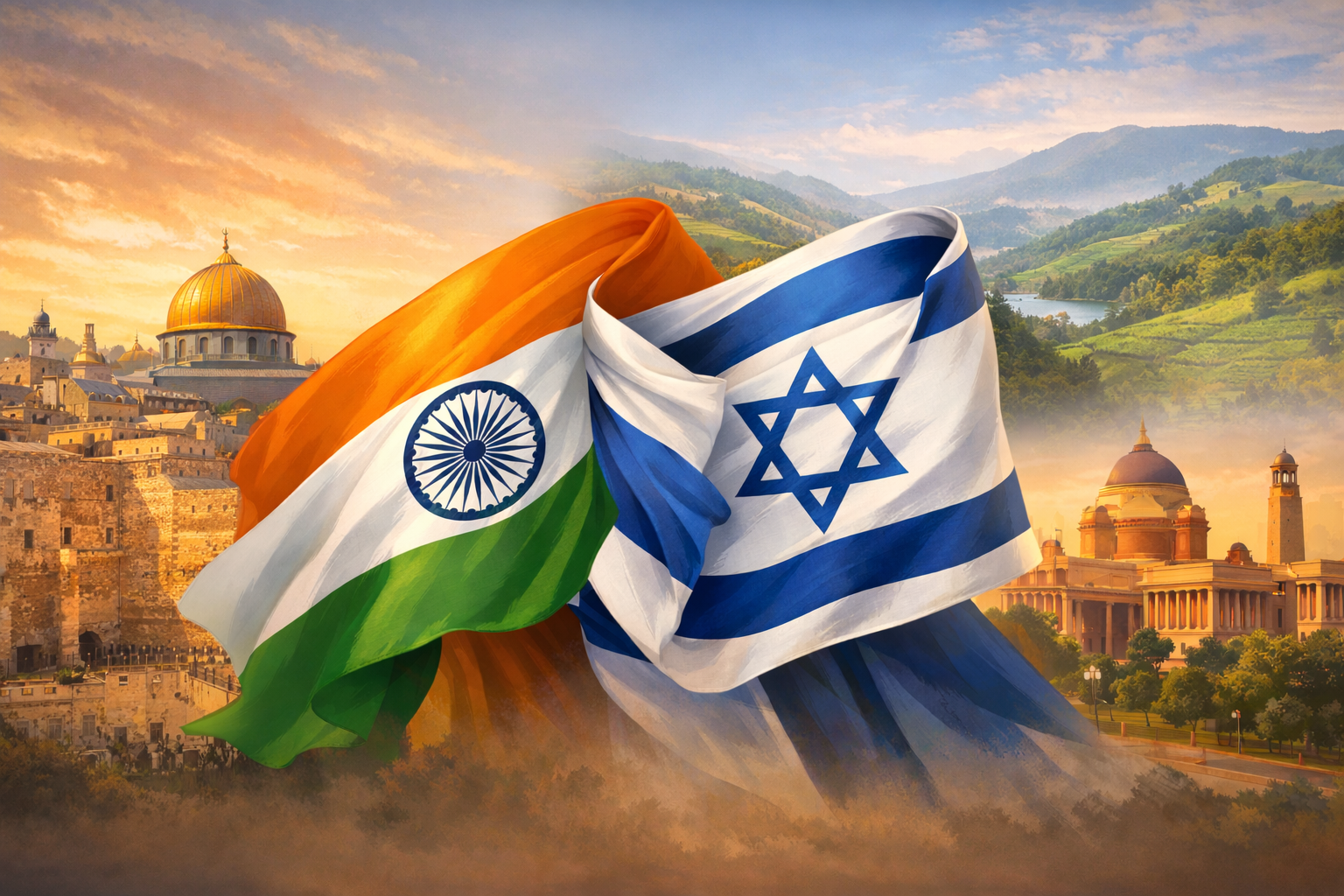
When Prime Minister Narendra Modi lands in Tel Aviv on 25 February 2026, he will be carrying more than a diplomatic brief. He will be carrying the weight of a relationship that has grown steadily, sometimes quietly, and often controversially, over the past three decades. The visit is being described by Indian officials as historic. The word is accurate. It is also, by now, somewhat overused.
This is only the second time an Indian prime minister has visited Israel. Modi himself made the first such trip in 2017, breaking decades of diplomatic caution. That visit was symbolic. This one is expected to be substantive. Several agreements are likely to be signed, spanning artificial intelligence, cybersecurity, quantum technology, and innovation. The Indian Ambassador to Israel has said that both countries are on the same page on terrorism and that the time has come to take the strategic partnership to a new phase.
That framing, however, has not gone uncontested. Not in India. Not in Israel. And not in the broader region watching this visit with considerable unease.
The Long Road to Full Recognition
To understand where this relationship stands, you have to understand how strange it once was that it barely existed at all.
India and Israel have had partial diplomatic contact since Israel’s founding in 1948, but India chose for decades not to extend full diplomatic recognition. The reasons were layered and, frankly, not always principled. India had a large Muslim population and successive governments were acutely conscious of how any warmth towards Israel would be received by Muslim voters, particularly in constituencies where the community was politically decisive. Electoral arithmetic played a considerable role. This was foreign policy shaped as much by vote-counting as by conviction.
There was also the Non-Aligned Movement context. India positioned itself alongside the Arab world and the Palestinian cause. Voting against Israel at the United Nations was, for India, as much about keeping Arab nations on side as it was about genuine ideological commitment.
And yet, beneath all of this, a quiet and entirely pragmatic intelligence relationship was being built in the shadows.
As far back as the 1960s, India’s external intelligence agency, the Research and Analysis Wing, and Israel’s Mossad were in contact and later in active cooperation. The channels deepened through the 1970s, when both countries shared concerns about cross-border terrorism and hostile neighbours. By the 1990s, after India faced a surge of militancy in Kashmir backed by groups such as Jaish-e-Mohammed and Lashkar-e-Toiba, the operational value of Israeli intelligence became impossible to ignore. R&AW and Mossad shared information, tradecraft, and, reportedly, technical surveillance capabilities. All of this happened while India’s official diplomatic position remained one of studied distance from Israel. It was, to put it plainly, a somewhat dishonest arrangement.
It was left to Prime Minister P.V. Narasimha Rao to cut through the contradiction. In January 1992, under his Congress-led government, India established full diplomatic relations with Israel. The timing mattered. The Soviet Union had just collapsed. The Cold War framework that had made it politically convenient to stand with Arab nations against Israel was dissolving. The Oslo peace process was underway, giving India diplomatic cover to normalise ties without appearing to abandon the Palestinian cause. Rao, a pragmatist by instinct and a considerably underrated foreign policy thinker, seized the moment. It remains one of the more consequential foreign policy decisions of the post-independence era.
Sharon in New Delhi: A Milestone in the Making
If Rao’s decision in 1992 was the foundation, then Israeli Prime Minister Ariel Sharon’s visit to India in September 2003 was the first significant superstructure built upon it. Sharon became the first Israeli prime minister to visit India, which was a bigger deal than it was reported as at the time.
Sharon arrived in New Delhi at the head of a large delegation that included senior defence and intelligence officials. The visit produced agreements on defence cooperation, agriculture, and water management. But its deeper significance lay in what it signalled: that the relationship was now mature enough to bear the weight of a high-profile bilateral engagement without either side feeling compelled to apologise for it.
Sharon was a deeply polarising figure internationally, associated with the controversial entry into the Al-Aqsa Mosque compound in 2000 that many analysts believe helped ignite the Second Intifada. Arab governments watched the New Delhi visit with open displeasure. India’s then government, led by Prime Minister Atal Bihari Vajpayee of the BJP, absorbed that criticism and pressed ahead. The calculation was that the material benefits of deeper defence and technology cooperation outweighed the diplomatic discomfort. Whether that calculation was right is a question that applies equally to the visit happening this week.
Sharon’s visit accelerated defence procurement discussions and helped lay the groundwork for what would become one of the most substantive arms supply relationships in Asia. It also established something important: that Indian governments across the political spectrum, Congress and BJP alike, were willing to deepen ties with Israel when strategic interests demanded it, even while maintaining a public commitment to the Palestinian cause. That gap between public position and private preference has only widened since.
The Bilateral Story
Today, Israel is among India’s most significant defence suppliers. The partnership covers unmanned aerial vehicles, missile systems, surveillance technology, and naval equipment. On the agricultural side, Israeli expertise has left a measurable imprint on Indian farming, particularly in states that struggle with water scarcity, and this is worth dwelling on for a moment because it tends to get lost in the defence and geopolitics conversation.
The Indo-Israel Agriculture Project, launched in the early 2000s and expanded significantly after 2012, is a genuinely impressive piece of bilateral work. Israel helped establish Centres of Excellence for agriculture across Rajasthan, Gujarat, Maharashtra, Haryana, and Karnataka. These centres introduced drip irrigation technology to farmers growing vegetables, fruits, and flowers in conditions where conventional flood irrigation was wasteful and, in many cases, simply unsustainable. In Rajasthan alone, thousands of farmers adopted micro-irrigation methods developed and refined in Israel’s Negev desert, improving yields while cutting water consumption. The technology came with training and soil management guidance tailored to Indian conditions. It was practical cooperation that made a tangible difference to people’s lives, which is rarer in bilateral relationships than the diplomatic language usually suggests.
On the technology side, India and Israel signed a cyber cooperation agreement in 2017, during Modi’s first Tel Aviv visit. Under this framework, the two countries established channels for sharing threat intelligence, coordinating responses to state-sponsored cyberattacks, and collaborating on the protection of critical infrastructure. Israeli cybersecurity firms, several with deep links to the country’s military intelligence establishment, have worked with Indian counterparts in both government and private sectors. Given the persistent cyber threats India faces across its borders, this cooperation has had real operational value.
Bilateral trade between India and Israel stood at approximately Rs. 47,000 crore, equivalent to roughly 21 billion Israeli shekels, in recent years. Israel’s exports to India cover diamonds, chemicals, and high-technology goods. Indian exports include pharmaceuticals, textiles, machinery, and food products. The figures are not enormous by the standards of India’s larger trading relationships, but the trajectory has been upward and the quality of what is being exchanged, particularly on the technology side, matters more than the headline numbers.
The Timing Problem
Here is where the visit gets genuinely complicated, and where the easy celebratory framing starts to fray.
The broader Middle East is in a state of significant flux. The conflict in Gaza has dragged on longer and with greater human cost than almost anyone predicted. Regional tensions remain elevated. India, which has traditionally supported a two-state solution and maintained close ties with Arab nations, now finds itself in a diplomatically delicate position that its foreign policy establishment is not entirely comfortable discussing in public.
A parliamentary panel in India has formally questioned the timing of the visit. The concern is not about the visit itself but about what it signals at this particular moment. When a country of India’s stature undertakes a high-profile state visit to Israel while the region remains volatile, the optics matter enormously. Arab nations are watching. So are Muslim-majority countries with which India maintains important diplomatic and economic ties.
The Palestinian Authority has also taken note. It has conveyed its displeasure through diplomatic channels, making clear that high-profile visits to Israel by major democracies at this juncture, without any corresponding pressure regarding Gaza or Palestinian statehood, are seen in Ramallah as a form of implicit endorsement. That is a reading India would dispute. But it is the reading being made, and New Delhi knows it.
India’s foreign policy establishment has long prided itself on strategic autonomy. The challenge now is whether that autonomy is being perceived as such, or whether the visit is being read, fairly or unfairly, as a tilt towards one side of a conflict that India has always insisted it views with even-handed concern.
The Arab World Is Not a Monolith
One assumption that keeps distorting this conversation is that the Arab and Muslim-majority world speaks with one voice on Israel. It does not, and has not for some time.
The United Arab Emirates normalised relations with Israel in 2020 as part of the Abraham Accords. Bahrain and Morocco followed. Sudan also signed on. Egypt and Jordan have maintained formal peace treaties with Israel since 1979 and 1994 respectively. Saudi Arabia, while yet to formally normalise, has been conducting back-channel diplomacy with Israel, and substantial indirect trade between the two countries is well-documented. Oman has periodically hosted Israeli officials. Qatar, despite its sharp public rhetoric over Gaza, has served as a critical back-channel for hostage negotiations between Israel and Hamas, a role requiring sustained and direct engagement with Israeli interlocutors.
The picture is considerably more complicated than the public positioning of these governments suggests. Many Muslim-majority nations have made their own cold calculations about Israel, driven by shared concerns over Iran, economic interests, and security cooperation. India is doing something broadly similar. The difference, and it is not a small one, is that India does it with more public scrutiny, a more vocal domestic constituency, and a longer tradition of officially supporting the Palestinian cause that makes the current direction harder to explain without contradiction.
The Israeli Opposition Speaks
In Israel itself, Modi’s visit has generated its own political undercurrents. The Israeli opposition, led by former prime minister Yair Lapid and figures within the National Unity bloc, has welcomed the visit as an important signal of bilateral friendship while carefully framing it in ways that implicitly criticise the Netanyahu government. Opposition voices have argued that visits of this kind should translate into concrete pressure on the government to pursue a more decisive path towards ending the Gaza conflict and securing the release of remaining hostages.
Some in the Israeli opposition have pointedly noted that world leaders visiting Tel Aviv lend Netanyahu political capital at a moment when his domestic standing is contested and when he faces ongoing legal proceedings. The argument is that high-profile visits risk being used for internal political purposes rather than genuine diplomatic progress. There is also a segment of Israeli civil society, particularly those aligned with the peace camp, that has expressed real ambivalence about the visit given the humanitarian situation in Gaza.
None of this has derailed the visit. But it adds a layer of complexity that the standard bilateral narrative tends to flatten entirely.
Domestic Calculations
At home in India, the visit sits at the intersection of foreign policy and political identity in ways that are worth examining honestly, even if that examination makes everyone slightly uncomfortable.
The Congress party, which established full diplomatic ties with Israel under Narasimha Rao in 1992 and did not reverse the direction set by the Sharon visit when it returned to power, has nevertheless questioned the timing and optics of this visit from the opposition benches. There is an element of political positioning in that criticism. But the underlying questions are not without merit. Has India quietly softened its commitment to Palestinian statehood? Is this visit being calibrated to serve domestic audiences as much as strategic ones? These are fair things to ask of any government, and the current one has not answered them with any great clarity.
There is also the broader question of democratic oversight. Parliamentary panels questioning executive decisions on foreign policy is not obstructionism. It is how accountable government works. That this needs to be stated at all reflects something about the current state of political discourse in India.
Huckabee, the Bible, and a Diplomatic Storm
Into this already charged environment came remarks that rattled several governments at once. Mike Huckabee, the United States Ambassador to Israel and a former governor of Arkansas with long-standing evangelical Christian convictions, told commentator Tucker Carlson in a widely circulated interview that Israel has a biblical right to expansive territory across the Middle East. The remarks went well beyond standard American diplomatic language and landed with considerable force across the Arab world and among Palestinian leaders.
The significance of Huckabee’s comments lies not merely in what he said but in who said it and from which position. An American ambassador speaking about biblical entitlement to territory is not an academic statement. It carries the implicit weight of the administration he represents. Arab governments navigating the Abraham Accords and the possibility of Saudi normalisation with Israel suddenly found themselves required to respond publicly to language that undermined their own domestic narratives. Palestinian leadership rejected the remarks firmly, arguing that framing territorial claims in religious scripture removes the conflict entirely from the realm of international law and negotiated settlement. They are not wrong about that.
European governments expressed discomfort through diplomatic channels. The United Nations reiterated that territorial questions must be resolved through internationally recognised frameworks. Several Muslim-majority nations issued formal statements of objection.
For India, the Huckabee episode presents a specific difficulty. India engages with the United States, with Israel, and with Arab nations simultaneously, and it needs all three relationships to function. Comments of this nature force every government in the region to take a position, and silence itself becomes a position. New Delhi has not responded publicly to Huckabee’s remarks. That silence will be noted, and not only in Ramallah.
Trump’s Gaza Plan and Where India Stands
The broader American approach to Gaza under President Donald Trump has taken a form that few anticipated. The Trump administration has put forward what it describes as a Board of Peace for Gaza, a framework that envisions a fundamental transformation of the territory rather than a conventional two-state resolution. The proposal reportedly involves the large-scale resettlement of Palestinians, the rebuilding of Gaza under a new administrative and economic model, and the involvement of regional and international partners in financing and governing the transition.
Arab governments have largely rejected the resettlement dimension as incompatible with Palestinian rights and their own domestic political constraints. Egypt and Jordan, reportedly approached about absorbing displaced Palestinians, refused publicly and firmly. The plan has also drawn criticism from European governments and UN bodies.
Where India fits into this picture is a question surfacing with increasing frequency in foreign policy circles in New Delhi. India has not formally endorsed the Trump Gaza plan. It has reiterated its support for a two-state solution through established multilateral channels. But India’s growing proximity to both the United States and Israel means the question of participation in any reconstruction or stabilisation framework will eventually arrive at India’s doorstep whether New Delhi invites it or not. Some analysts have suggested India could contribute meaningfully to Gaza’s reconstruction under a legitimate international framework, drawing on its experience in post-conflict development in Afghanistan and across Africa. Whether the government chooses to engage, and on what terms, will say a great deal about how seriously India takes its own aspirations for global leadership.
The Geopolitical Architecture
The visit does not exist in isolation, and it would be a mistake to read it as if it did.
It needs to be understood alongside India’s growing engagement with the Abraham Accords countries, its participation in the I2U2 grouping with Israel, the United States, and the United Arab Emirates, and its broader Indo-Pacific strategy. India is increasingly part of a loose network of partnerships that orbit American strategic interests, even as it insists it is not formally aligned with anyone.
Some analysts describe this as a hexagon of alliances linking India to Israel, the US, Gulf states, and other partners in ways that serve mutual interests on counterterrorism, trade routes, and technology. Whether that framing is accurate or somewhat overstated is a legitimate debate. What is not debatable is that this visit will be read by China, by Pakistan, and by several Arab governments through an explicitly geopolitical lens.
India visiting a diplomatically isolated Israel at this particular moment is not a neutral act. It never really could be.
What India Gets Out of This
Strip away the commentary and the positioning, and the case for the visit is actually fairly straightforward.
India needs technology. It needs defence partnerships that are not dependent on any single supplier. It needs to diversify its relationships in a region it cannot afford to ignore. Israel offers things that few other countries can: cutting-edge military technology, genuine agricultural innovation, and deep and battle-tested expertise in cybersecurity. These are not abstract benefits. They have translated into real capability improvements for India over the past two decades.
The agreements being signed during this visit are not decorative. They are meant to produce outcomes. Whether they do will depend on implementation, which has occasionally been the weak point in this relationship, on both sides.
A Relationship at an Inflection Point
Modi’s visit to Israel arrives at a moment when every diplomatic signal is being parsed with unusual care. India has spent decades building a foreign policy that keeps its options open, that allows it to buy weapons from Israel while voting for Palestinian rights at the UN, that permits it to deepen ties with Washington without formally joining any alliance. That carefully constructed ambiguity is under more pressure right now than it has been in a long time.
The visit can be defended on strategic and economic grounds, and those defences are not trivial. The questions around its timing are genuine, and they are not going away. Both things are true at once, and that tension is not a failure of Indian foreign policy so much as a reflection of how complicated the world has become. India will have to live with both the benefits of this visit and the questions it leaves unanswered, and it will have to do so in public, in front of an audience that is paying closer attention than usual.
That is, perhaps, the most honest thing that can be said about it.
Subscribe Deshwale on YouTube


