











In a country that has woven gold into silk for a thousand years, the real price of a saree has never appeared on any price tag.
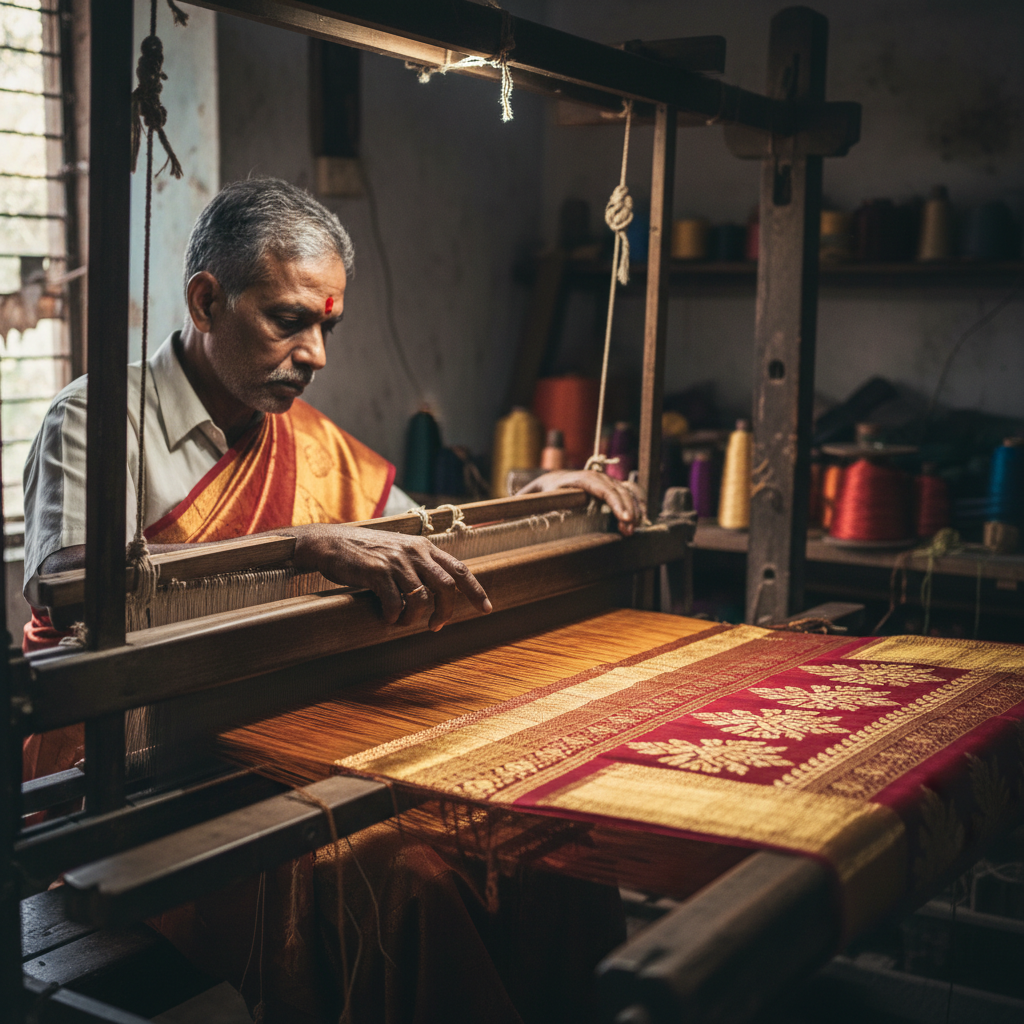
Rahul Salvi rises before the light reaches Patan. He is an architect by training, a weaver by calling, and, by the most unsentimental accounting, one of perhaps two or three people alive who possesses the complete knowledge of the double-ikat Patan Patola. On the loom in his family workshop, a half-finished saree stretches across silk threads pre-dyed in turmeric, indigo, and pomegranate skin. It has been there for four months. It will be there for four more. At the end of those eight months, it will weigh 450 grams, measure five metres, and cost between ₹1.5 lakh and ₹5 lakh, the floor price, not the ceiling. Salvi and his family sell five to seven of these a year. In a world where a streetside stall can print a facsimile in four hours for ₹500, Rahul Salvi is doing something that has no rational economic justification. He is keeping a civilisation alive at personal cost. And the civilisation, on the whole, is not paying attention.
This essay is not a buyer’s guide. It is not a listicle of luxury. It is an attempt to reckon honestly with what India’s most expensive sarees actually are, what they cost, what they carry, what they conceal, and to ask the question that the fashion pages never do: who pays, and who gets paid, and whether those two things are remotely the same.
Let us begin with the record. The most expensive saree ever documented in India is the Vivaah Pattu, created by Chennai Silks in Kanchipuram. It entered the Guinness World Records when it was sold on 5 January 2008 for ₹39,31,627. Thirty-six weavers laboured for 4,760 hours across eighteen months. The heart of this saree is not its navratna stones or its gold and platinum embroidery, it is Raja Ravi Varma’s paintings. Eleven of them, to be exact. The central pallu features the iconic Galaxy of Musicians, women in traditional attire, each playing a musical instrument. The women are woven, not printed, thread by microscopic thread, in sixteen colours and sixty-four shades. It weighs eight kilograms. It is, paradoxically, wearable.
What does it mean that the world’s most expensive saree is not a jewel or a relic but a painting, a painting of Indian women, rendered in the medium that Indian women have worn as their primary identity for three millennia? There is something in that fact that deserves more than a Guinness citation. It deserves awe. The Vivaah Pattu is India saying, through silk and gold, that it understands what it is. That its art and its fabric and its women are the same story.
The Kanjivaram, or Kanchipuram, sits at the pinnacle of everyday luxury, which is itself an oxymoron that only India has perfected. Woven from the highest quality mulberry silk with pure gold zari, a Kanjivaram wedding saree can take weeks to craft; the most exclusive pieces are priced in lakhs, particularly those with real gold threads and temple motifs. What distinguishes it technically from lesser silks is the construction: the border and the body are woven separately and then interlocked, a joint that will outlast the woman who wears it, and her daughter, and her daughter’s daughter. Medieval Indian literature described Kanjivaram fabrics as deva vastra, the clothing of gods. That claim is less poetic than it sounds. It is structural. A Kanjivaram does not drape around a body; it commands one. There is a reason Tamil brides have worn it for centuries without irony: the saree does not beautify. It consecrates.
Four hundred kilometres north, in Varanasi, the Banarasi silk carries a different inheritance. It is not the inheritance of temples but of courts, of the Mughal emperors who patronised brocade weaving using intricate gold and silver zari threads, making Banaras the specialty capital of this opulent craft. Persian weavers brought their motifs, fleur-de-lys, flowering vines, the jaal or net pattern, and the Banaras weavers absorbed them so completely that today a Banarasi saree is India’s most successful act of cultural synthesis: Hindu occasion, Mughal vocabulary, Ansari Muslim hands. The irony is not lost on anyone who has thought about it.
The saree that every Hindu bride considers essential for her wedding was refined by Mughal patronage and is still woven, predominantly, by Muslim craftsmen in the lanes of Varanasi. This is not a footnote. This is the argument. India’s most luminous object is a collaboration across every identity it has ever been told divides it.
A high-end Banarasi, a kadhua or jangla, hand-stitched with individual motifs, can take six months and cost several lakhs. Creating one requires approximately 5,600 threads, each 45 inches wide; three weavers must collaborate, one weaving the silk, one managing the threads for the bundling, and one handling the border design. The finished saree is an act of collective intelligence encoded in textile form. It is also the kind of object that the Varanasi weaver who made it cannot afford to buy for his own wife.
That sentence is not hyperbole. It is arithmetic. The average handloom weaver in Varanasi earns somewhere between ₹200 and ₹400 a day. A Banarasi saree that retails for ₹2 lakh represents, at that daily rate, two or three years of the weaver’s income. The middlemen who connect the weaver to the market take margins that the weaver has no power to negotiate. The Banarasi silk handloom industry has been incurring huge losses due to competition from mechanised units that produce sarees faster and cheaper. The power loom does not weave a Banarasi. It photocopies one. The customer often cannot tell the difference. The weaver knows, but the weaver has no lobby, no platform, no price-fixing power, only a GI tag obtained after two years of legal effort, which the market has already found seventeen ways to circumvent.
Now Gujarat. The Patan Patola is not merely the most expensive saree per metre, it is the most intellectually demanding textile object India has ever produced, and possibly one of the most demanding in the world. Patola is probably the only artwork done in reverse order: the threads are dyed first according to the pattern, and it is only during the weaving process that dye marks align to form a design. This is the double-ikat method, both the vertical warp threads and the horizontal weft threads are resist-dyed in precise alignment before a single pass of the loom. One misplaced knot and the geometry collapses. There is no correction. There is no erasing. The weaver holds the entire pattern in memory and executes it with their hands, millimetre by millimetre, for months on end.
A genuine Patan Patola commands between ₹1.5 lakh and ₹6 lakh, depending on the intricacy of the design; four weavers may labour for six months or more on a single saree. The Gujarati proverb says it best: Padi Patole bhaat, phate pan fitey nahin, the cloth of the Patola may tear, but the design and colour will never fade. A 200-year-old Salvi Patola, shown to visitors at the Patan Patola Heritage museum, still burns with the same jewel-tone intensity as the day it was completed. The natural dyes, indigo, turmeric, marigold, pomegranate skin, madder roots, are not fading. They are deepening.
King Kumarpal of the Solanki dynasty, in the 12th century, draped himself in a fresh Patola each dawn before his temple visit, reportedly going to war when he discovered that a supplier had used the fabrics as bedspreads before selling them. A man invaded a kingdom over the sanctity of a saree. That is not absurdity. That is a civilisation’s declaration that some objects are too sacred to be treated as merchandise. The Patan Patola is such an object. Which makes what is happening to it now, the proliferation of machine-printed imitations sold under its name in every bazaar, not a commercial problem but a cultural desecration.
Here is the word the conventional treatment of this subject never uses. Not heritage. Not luxury. Not even craft.
The word is survival.
Every conversation about India’s most expensive sarees, in magazines, on Instagram, in the glossy booths of designer exhibitions, is conducted in the language of celebration. These are masterpieces. These are heirlooms. These are investments. All of this is true, and all of it misses the point. The point is that every one of these sarees is a species facing extinction. Rahul Salvi pins all his hopes on his son, Vashisht, to pursue the craft, or it will be lost for ever. A 35-generation knowledge system, accumulated over 900 years, now depends on the choices of a single young man in Gujarat. That is not heritage. That is the last breath.
The Banarasi handloom faces cheaper power-loom copies that the untrained eye cannot identify. The Kanjivaram faces synthetic silk blends marketed as pure. The Patola faces single-ikat imitations sold at a fraction of the price to buyers who do not know the difference and, in a market economy, have no structural reason to learn. The machine does not merely compete with the handloom. It eats its customers.
And the state? The state has given GI tags and run awareness campaigns and placed these crafts on export promotional materials. The state has not, in any serious systemic way, addressed the daily wage of the weaver, the exploitation of the supply chain, or the collapse of the patronage system that once made this work economically viable. The Mughal emperors, whatever else may be said of them, kept the Banarasi weaver employed, fed, and valued. The republic has given him a GI tag and a power-loom competitor. This is called progress.
There is a thing that happens when a woman drapes a Kanjivaram for her wedding, or unwraps a Banarasi passed down from her mother, or holds a Patan Patola for the first time and feels how light it is, 450 grams, five metres, and how impossible. She is not just wearing cloth. She is wearing a negotiation between a weaver’s hands and time itself. She is wearing a year of a man’s life. She is wearing a century’s worth of accumulated knowledge of silk, of dye, of loom, of proportion and pattern and colour.
She probably does not know the weaver’s name. The saree does not come with one.
This is the gap at the centre of India’s relationship with its own most extraordinary objects. We celebrate the saree. We do not celebrate the man who made it. We call it heritage when it is convenient, and we call it expensive when we are shopping, and we call it precious when we are gifting. We do not call it what it is: the daily life of a craftsman who earns less than a delivery driver, who learned a skill that took decades to acquire, who will likely be the last in his line to know it, and who rises before dawn anyway, not out of resignation but out of something that has no adequate word in the language of markets.
Return to Rahul Salvi in Patan. The light has reached his workshop. His fingers move across the pre-dyed threads with the same unhurried certainty his father taught him, and his father’s father before that, across thirty-five generations of men who chose this over everything else the modern world offered. He is not a relic. He is not a symbol. He is a man who decided, at the cost of a comfortable career, that some knowledge is worth more than what it earns.
“Since it showcases the rich history and cultural significance, there is no room for mass production,” Rahul has said. “It is a guarded tradition.” What he means, what he cannot quite say without it sounding like an accusation, is that the tradition is being guarded by him alone, with very little help from a country that is proud of it in the abstract and indifferent to it in the particular.
The most expensive sarees in India are worth every rupee. Not because of the gold or the diamonds or the Guinness record, but because of what it costs a human being to make them, in years, in patience, in the radical choice to value a form of knowledge that the market has decided to abandon.
The question India has not yet answered is the simplest one: are we willing to pay that cost before it disappears?
The loom does not wait for an answer. It only knows how to keep moving.


