











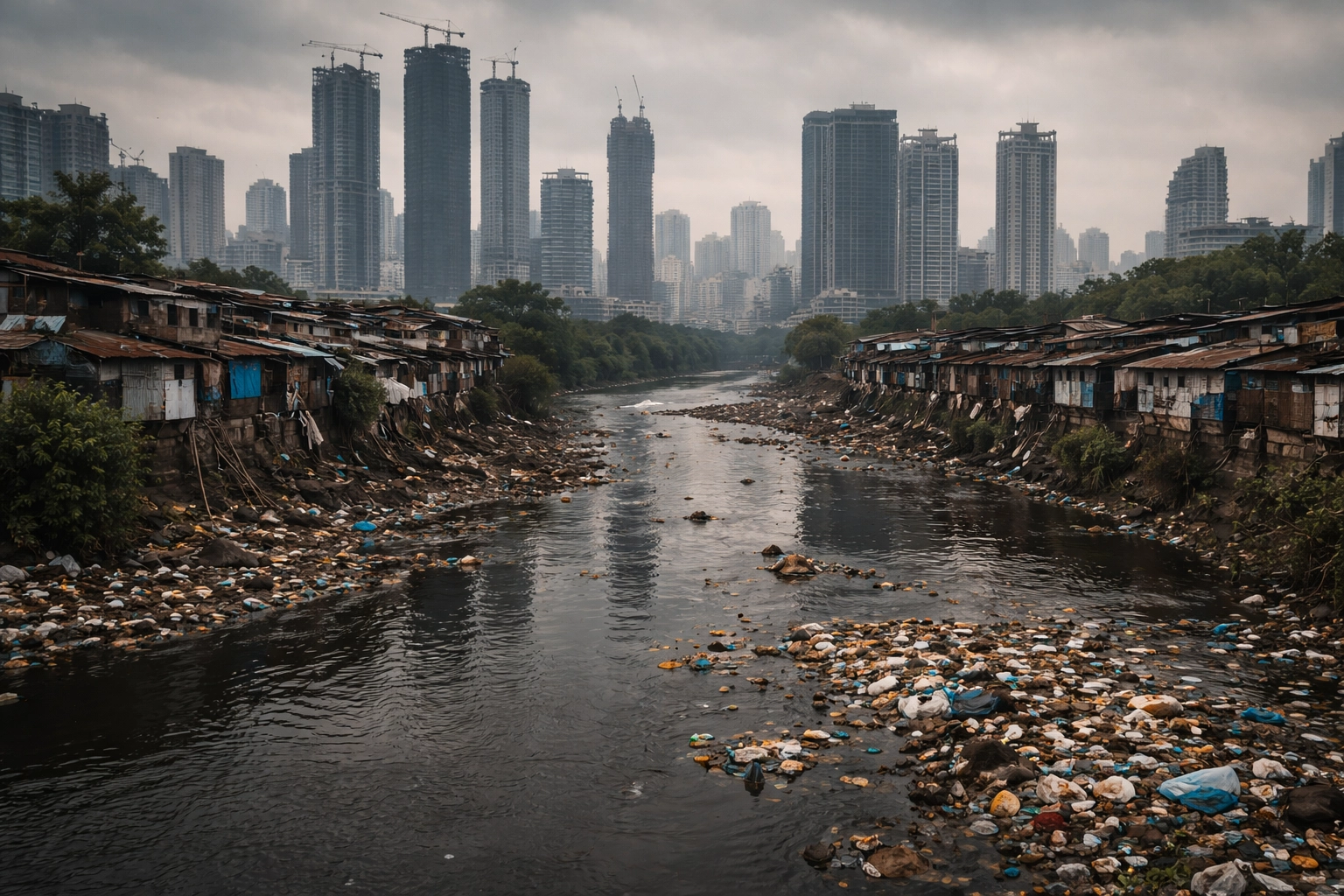
As Mumbai sweats through the above-normal heat of late March 2026 with the IMD warning of more heatwave days ahead the city celebrates the gleaming Coastal Road extensions and new skyscrapers. Yet beneath this global-city polish lies a stubborn truth: Mumbai has systematically betrayed the water bodies that once defined and protected it.
The Mithi: A River Demoted to a Gutter
Twenty-one years after the 2005 deluge that killed over 1,000, the Mithi River remains a damning symbol of urban failure. Despite thousands of crores spent and ambitious new projects including a 6.6-km diversion tunnel meant to intercept nearly 60% of sewage (targeted for completion around 2026-27) the river still carries a toxic mix of untreated sewage, industrial effluents, and garbage.
Its annual average Water Quality Index hovers around 35 (categorised as “heavily polluted”), with BOD levels often exceeding 30-80 mg/L. Encroachments and siltation have reduced its natural flood-carrying capacity; in August 2025, over 300 mm of rain in 24 hours caused the Mithi to swell dramatically, triggering evacuations and exposing how narrowed floodplains still fast-track water into dense neighbourhoods. What was once a natural artery is now a concrete-channeled wound that Mumbai refuses to heal fully.
The Illusion of “Beautification”
Powai Lake tells a similar story. As of late 2025, roughly 18 million litres of untreated sewage entered the lake daily through multiple inlets, fuelling explosive water hyacinth growth that has blanketed large portions of its surface. While the BMC has removed thousands of tonnes of hyacinth and promises to make the lake sewage-free by May 2026 via new diversion lines and treatment plants, the deeper issue persists: “beautification” (cycling tracks, lighting) takes precedence over genuine ecological restoration.
Bandra’s historic ponds, once vital community “sponges” for groundwater recharge, have been reduced to sterile cement basins or quietly lost to redevelopment. Across the city, wetlands, salt pans, and mangroves continue to shrink with recent approvals for Coastal Road extensions threatening tens of thousands of mangrove trees, further weakening natural coastal defences.
The Arrogance of Topographical Hubris
Mumbai’s planners treat the monsoon as a surprise visitor rather than an annual certainty. By paving over wetlands, choking mangroves, and building on reclaimed land, the city has created a vicious cycle of ecological debt:
Flood Risk: Reduced natural buffers turn heavy rains (like August 2025’s deluge) into urban disasters.
Urban Heat Island Effect: Loss of water bodies and blue-green cover intensifies the 2026 heatwaves already forecast to be above normal.
Water Insecurity: The city imports water from distant dams while local reservoirs like Powai turn eutrophic.
This is not mere neglect. It is contemptuous of the belief that concrete and engineering can indefinitely override nature in a coastal megacity.
The Verdict: A City Drowning in Denial
Mumbai’s tragedy is not lack of funds or knowledge. It is the repeated choice of short-term profit and cosmetic fixes over long-term resilience. A financial capital that cannot manage its own hydrology is not “world-class” ; it is vulnerable. Every flood, every heat spike, and every polluted water body is a bill coming due.
The Path to Redemption
Real change demands more than tunnels and track-laying. Mumbai must:
Declare remaining water bodies and riverbanks as strict No-Construction Zones, with transparent rehabilitation for genuine encroachments.
Achieve zero untreated sewage inflow not by 2026 targets that slip, but through enforced accountability and completed treatment infrastructure.
Shift from “beautification” to ecological restoration: Restore wetlands and mangroves as functional bioshields, not afterthoughts.
Empower citizen stewardship with real-time water quality monitoring and public dashboards.
Mumbai is a city built on dreams, but it is dreaming with its eyes wide shut to its own geography. The water that once sustained it will not wait forever. If we do not restore these lifelines with urgency and honesty, they will reclaim the city in floods, heat, and lost livability.
The choice is no longer between development and environment. It is between sustainable resilience and eventual reckoning.


