








The City That Forgot Its Waterways
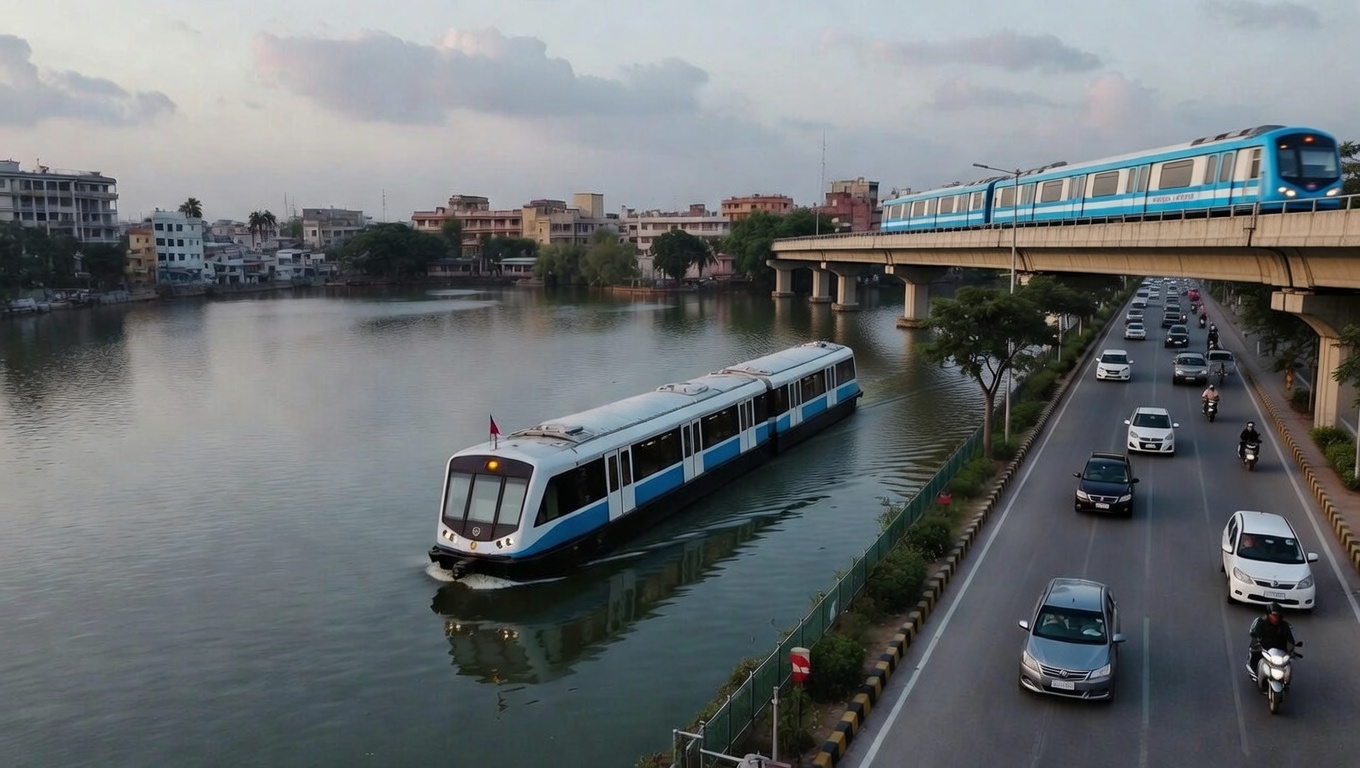
Mumbai is a peninsula. It is surrounded on three sides by water. It has a natural harbour that shaped its entire colonial and commercial history. And yet, for most of its 22 million residents, the sea is something you look at from a train window, not something you commute across. That is the central absurdity that a proposed Water Metro network could begin to address.
The idea is no longer speculative. In June 2025, Kochi Metro Rail Limited submitted a formal feasibility study to the Maharashtra government proposing a 250-kilometre waterway network across the Mumbai Metropolitan Region, covering 10 routes and 29 terminals. The study was submitted to Maharashtra Ports Minister Nitesh Rane, who directed relevant departments to begin steps towards implementation. A Detailed Project Report is now being prepared. Officials have indicated that the first two routes could launch as early as December 2026, subject to DPR finalisation. The estimated project cost stands at approximately Rs. 1,200 crore, as currently estimated.
Mumbai has been handed both a blueprint and a deadline. Whether it can meet either is the harder question.
What Kochi Proved
The Kochi Water Metro, inaugurated in April 2023 and now the most closely watched urban water transport project in Asia, provides the most relevant benchmark. The numbers are compelling. The service recorded over 2.33 million passenger trips in 2025 alone, a 15 per cent rise from the previous year. Single-day ridership peaked at over 17,000 passengers in December 2025. The integrated transit system of metro rail, water metro and electric feeder buses collectively carried over 161,000 passengers on New Year’s Day 2026. Kochi Metro Rail Limited posted an operating profit of Rs. 33.34 crore in the financial year 2024-25, its third consecutive year in surplus since a deficit of Rs. 24 crore at launch in 2017-18.
The factors behind that turnaround are instructive. Seamless integration with the Kochi Metro smartcard, reliable punctuality, clean terminals, and genuine last-mile connectivity through electric feeder buses built the kind of commuter trust that cannot be manufactured through advertising. Maharashtra has already approached KMRL to understand the model. KMRL is now conducting feasibility studies for water metro systems in 21 other cities across 11 states, a national replication exercise that Mumbai is positioned to lead.
Past Attempts, Present Plans
Mumbai’s relationship with water transport is not new. Passenger steamers once connected the city to its coastal hinterland. The city’s existing ferry services between Bhaucha Dhakka and Mandwa, and now the newer Ro-Ro service to Vijaydurg, demonstrate that the appetite for water-based commuting exists. What has been absent is integration, scale and political will sustained beyond a press conference.
The current push appears more serious. The proposed first-phase routes within Mumbai city will focus on the high-traffic western coastal corridor connecting Nariman Point, Worli, Bandra, Juhu and Versova. A particularly significant link has been proposed from the Radio Club jetty near the Gateway of India to the upcoming Navi Mumbai International Airport, a crossing expected to take roughly 40 minutes once the necessary jetty infrastructure is ready. Each electric ferry is expected to carry between 50 and 100 passengers per trip, with battery-powered vessels similar in design to the Kochi fleet built by Cochin Shipyard.
The Revenue Question
The financial logic of a Mumbai Water Metro is, on paper, more favourable than Kochi’s. Mumbai’s commuter base is larger, its tourism footfall heavier, and its premium-experience market far more developed. Non-ticket revenue potential through station naming rights, commercial development at terminals, advertising and tourism tie-ups could generate meaningful income from early in the service’s life, as the Kochi experience has demonstrated.
The airport link alone, if priced competitively with ride-hailing alternatives, could anchor the financial model of the entire network. A 40-minute water crossing to Navi Mumbai International Airport from the Gateway of India, in an air-conditioned electric vessel, past one of the world’s great harbour views, is a product that will sell.
What the Drains Say About the Dream
Here is the inconvenient part. Mumbai’s waterways are in a condition that no feasibility study can politely ignore. The Maharashtra Pollution Control Board has identified 70 drains that discharge untreated sewage directly into the city’s water bodies. The Mithi River, which meets the Arabian Sea at Mahim Creek, carries a Water Quality Index of 35, categorising it as heavily polluted. The BMC maintains over 260 kilometres of major nullahs and over 400 kilometres of minor nullahs across the city, most of which double as open sewers and solid waste dumping grounds. During the monsoon, these waterways carry not just stormwater but raw sewage, garbage, construction debris and industrial effluent to the sea.
The Water Metro’s proposed routes along the western coastline are largely on open sea and creek corridors rather than on the city’s internal river systems, which partially insulates the first phase from the worst of this pollution. But the creek routes that form a significant part of the 250-kilometre network, linking Thane, Panvel, Vasai, Vaitarna, Manori and Karanja, will require functional water quality before electric ferries can operate without posing health or operational hazards. Cleaning those waterways is not a pre-condition that can be finessed. It is a prerequisite. And it is work that Mumbai has been promising to complete since the catastrophic floods of 2005 killed over a thousand people, with Rs 39 billion already spent on Mithi River restoration alone, with the river still classified as heavily polluted.
Slums, Land and the Politics of Terminals
Building 29 terminals across the Mumbai Metropolitan Region will require land. In a city where nearly 60 per cent of the population lives in informal settlements and where every square metre of waterfront carries contested claims, terminal acquisition is not a planning exercise. It is a political one. Slum settlements line significant stretches of Mumbai’s creeks and riverfronts. Dharavi, Asia’s most densely populated informal settlement, sits adjacent to the Mahim Creek. Waterfront redevelopment in Mumbai has a long and troubled history of displacement without resettlement.
Whether the Water Metro’s terminal development triggers evictions, as previous infrastructure projects have, will determine whether the project is remembered as a public good or a displacement exercise dressed up as modernity.
What the World Has Learnt
Cities that have made water transport work share a consistent lesson: integration is everything. Istanbul’s ferry network, which carried 50 million passengers in a single year across the Bosphorus, works because every major terminal has bus stops, metro connections and BRT links directly alongside. Bangkok’s khlong boat services on the Saen Saep canal carry up to 100,000 passengers daily on polluted but functional waterways, demonstrating that imperfect conditions do not preclude operational viability. New York’s ferry system exceeded one million riders within its first 86 days by integrating mobile ticketing and connecting with existing transit. The Seattle King County Water Taxi recorded a 55 per cent ridership increase between 2023 and 2024 simply by adding midday sailings, a reminder that frequency drives demand as much as routes do.
The failure cases are equally instructive. Lagos launched water transport with considerable fanfare and watched it underperform due to poor terminal design, inadequate last-mile connectivity and lack of integration with the city’s bus network. Mumbai would do well to study both columns.
Will It Beautify Mumbai and Fix Its Traffic?
The aesthetic argument is easier to make than the traffic one. A fleet of clean, electric vessels moving along Mumbai’s western coastline past the Gateway of India, Marine Drive, Worli Sea Face and Bandra would visually transform the city’s waterfront identity. It would make Mumbai’s water, which is currently experienced primarily as a flood risk and a dumping ground, into a civic asset. That is not a small thing for a city that has spent decades arguing over what kind of place it wants to be.
The traffic relief argument requires more caution. Electric ferries carrying 50 to 100 passengers per trip will not move the needle on a city of 22 million that adds thousands of vehicles to its roads every month. They will, however, provide a meaningful alternative for specific high-density corridors, particularly the western coastal strip where road congestion is chronic and rail capacity is already exhausted. The airport link could divert a measurable volume of traffic from the Sion-Panvel and Eastern Express Highway approach routes. That is a contribution worth making, even if it falls well short of transformation.
India’s Broader Water Metro Ambition
Mumbai is not alone in this conversation. What is unfolding across India is something considerably more ambitious: a national replication of the Kochi model that, if it proceeds at scale, would make India the world’s most extensive water metro network outside of coastal Europe.
The Inland Waterways Authority of India, in consultation with the Ministry of Ports, Shipping and Waterways, has identified 17 cities across 12 states for water metro development. These include Ayodhya, Dhubri, Guwahati, Kollam, Kolkata, Prayagraj, Patna, Srinagar, Varanasi, Vasai, Mangaluru, Gandhinagar-Ahmedabad and Alleppey, alongside the island territories of Lakshadweep and the Andaman and Nicobar Islands. The Ministry of Ports, Shipping and Waterways formally approved technical feasibility studies for water-based transit in 24 cities in April 2025.
Each proposed city presents a distinct geography and a distinct challenge. Guwahati’s case is among the most compelling. The Brahmaputra, one of the world’s great rivers, flows through the city and is already used for limited passenger movement. A structured water metro on the Brahmaputra could serve Guwahati’s rapidly growing population while reducing pressure on road infrastructure that has not kept pace with the city’s expansion. Guwahati, Dibrugarh and Tezpur in Assam are all under consideration, reflecting the particular promise of Assam’s river-defined geography for water-based urban transit.
Varanasi and the Ganga corridor present a different kind of opportunity. Cities on National Waterway-1, including Varanasi, Ayodhya, Prayagraj, Patna and Kolkata, have already had traffic studies completed. Electric catamarans built by Cochin Shipyard are already deployed at Varanasi and Ayodhya under the Harit Nauka guidelines, providing a working proof of concept on the Ganga before a full water metro network is established. India’s first hydrogen fuel cell-powered vessel has also completed trials and is operating in Varanasi, a detail that places this river corridor at the forefront of green maritime technology in the country.
Srinagar’s Dal Lake proposal is the most evocative of the entire list. The Dal Lake shikara has been an icon of Kashmiri identity and tourism for generations. A modern water metro overlaid on that geography, connecting Dal Lake with the city’s expanding residential and commercial districts, would be unlike anything else in the national network. It would also require extraordinary sensitivity to the lake’s fragile ecology and to the livelihoods of the shikara operators whose income a modern ferry service could disrupt. Getting that balance right will be the defining challenge of the Srinagar proposal.
Mangaluru’s water metro, connecting areas along the Nethravathi and Gurupura rivers, received a significant push in April 2025 when Karnataka Chief Minister Siddaramaiah approved the project, making Karnataka the second state after Kerala to formally commit to water metro development. The Karnataka Maritime Board is preparing a Detailed Project Report for the Mangaluru project. Unlike Mumbai, where the network must navigate a dense, contested urban geography, Mangaluru’s river corridors offer a relatively cleaner canvas, with communities that are genuinely underserved by road transport on both river banks.
Kolkata, which has operated river ferries on the Hooghly for decades, is better placed than almost any other Indian city to absorb a structured water metro, given its existing jetty infrastructure, established commuter habits around river crossings, and a dense urban geography that makes alternatives to road and rail genuinely attractive.
What unites all of these proposals, from the Brahmaputra to the Dal Lake to the Hooghly to the Nethravathi, is the same insight that animated the Kochi Water Metro from its inception: India has been systematically underusing its waterways as public infrastructure for decades, and the cost of that underuse has been paid in congestion, pollution and disconnected communities. Kochi showed that the model works. The question that all 24 cities now face is whether the institutional capacity, the political will and the financial architecture can be assembled to make it work at national scale.
Mumbai, with its coastline, its commuter density and its revenue potential, has the strongest case of any city on the list. It also has the most complex obstacles. That combination makes it the most important test of whether India’s water metro ambition is a genuine national policy shift or a well-intentioned idea that travels better as an announcement than as infrastructure.
The Prerequisite Nobody Wants to Talk About
A Mumbai Water Metro is feasible. The Kochi proof of concept exists, the political momentum is real, the financial model has precedent, and the city’s waterfront geography is genuinely suited to a transit network built around the sea. But none of it functions without clean waterways, functioning terminals and last-mile connectivity that reaches beyond the commuter who can afford Rs 150 for an app-booked electric ferry.
Mumbai needs to clean its drains before it can sell tickets on them. That is not a romantic observation. It is an engineering and governance requirement. The Rs. 39 billion already spent on Mithi River restoration without restoring it to usability is a reminder that spending money and solving problems are not the same thing in this city.
The Water Metro is a worthy idea. It deserves to be built on better foundations than the city currently offers its own waterways.
Subscribe Deshwale on YouTube


