










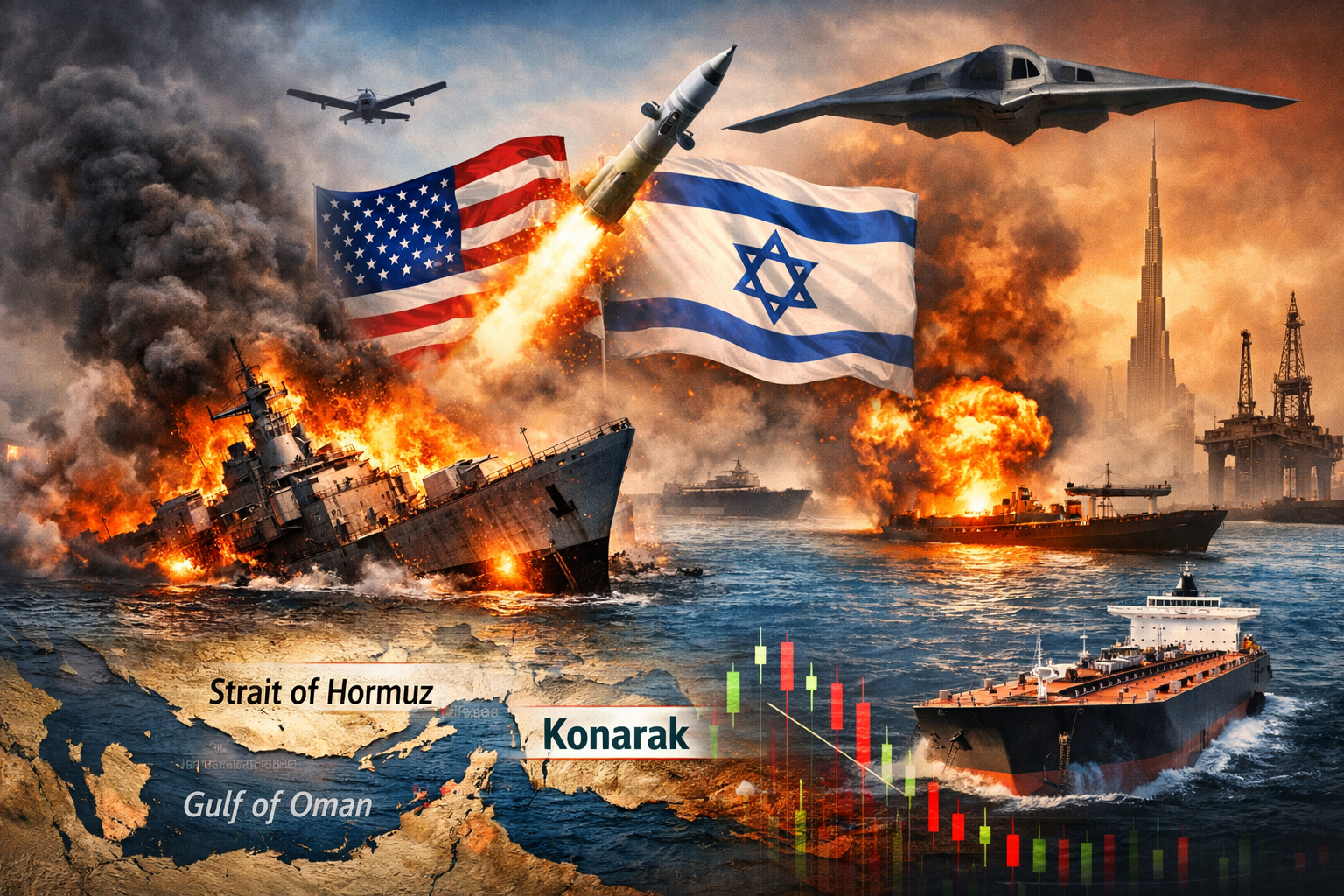
The Naval Strike That Opened a New Chapter
At roughly 2 a.m. Gulf Standard Time on 28 February 2026, the first explosions were reported near Chah Bahar. Within the hour, satellite feeds were showing fires burning at the waterline of Iran’s Konarak Naval Base. By dawn, the smoke was visible from commercial shipping lanes twelve nautical miles offshore. The Middle East had crossed a threshold it had been approaching for years. The United States and Israel had launched a coordinated assault on Iran under two codenames – Operation Epic Fury for Washington and Operation Raging Lion for Tel Aviv. Among the many targets struck across the country that night, Konarak stood out for its strategic weight.
What the satellite imagery subsequently confirmed went beyond the initial reports. The US spatial intelligence firm Vantor released imagery showing at least three Iranian naval vessels sunk or heavily damaged at the pier. US Central Command confirmed that among the destroyed vessels was a Jamaran-class corvette, which was, according to CENTCOM, sinking to the bottom of the Gulf of Oman. Scorch marks spread across hardened aircraft shelters nearby. A drone storage facility adjacent to the base was reduced to rubble. The imagery was detailed enough to show the waterline progressively rising against the hull of a second vessel still tethered to the dock.
President Donald Trump, in a video posted on social media in the early hours, said, as widely reported, that US forces would annihilate the Iranian navy. By the following day, he claimed nine Iranian naval vessels had been destroyed in total, though CENTCOM did not immediately confirm that broader number.
What Konarak Actually Means
To understand why Konarak matters, and it does matter quite a bit more than initial coverage suggested, you have to start with geography rather than hardware. Chah Bahar, of which Konarak is the naval hub, is Iran’s only port with direct access to the Indian Ocean, bypassing the Strait of Hormuz entirely. That geography matters enormously. It gives Iran the ability to project naval power eastward into the Gulf of Oman and well beyond, along trade routes connecting Asia, East Africa and the Persian Gulf. The base has also been, according to analysts, a significant staging point for Iran’s anti-shipping drone capabilities, including the Shahed-136 variant, which has featured in attacks across the Gulf region over the past two years.
The Jamaran-class corvette, though Iran designates the type as a frigate, displaces roughly 1,500 tonnes. These vessels are the largest surface combatants in Iran’s regular navy. The Moudge-class, a domestically produced derivative of the older Alvand design, now forms the backbone of Iranian surface capabilities. With six completed and one under construction, losing even one unit is a tangible blow to operational capacity. Replacing a vessel of this class takes Iran several years under ordinary conditions. Under sanctions and active military pressure, that timeline extends considerably further.
The Alvand class itself has a somewhat ironic history. The original ships were built in Britain in the 1970s for the Shah’s navy. Iran inherited them after the 1979 revolution, later replacing their Italian anti-ship missiles with Chinese C-802 variants. US forces actually sank one of these, the Sahand, back in 1988 during the Tanker War. What is happening now echoes that episode, but at a far larger scale and with the added dimension of coordinated air power, B-2 stealth bombers and two carrier strike groups positioned in the Mediterranean and the Arabian Sea.
What the Joint Operation Signals
The deployment of B-2s alongside Israeli strike packages, with carrier groups providing both air defence cover and strike reach, points to a level of operational integration between Washington and Tel Aviv that goes well beyond ad hoc coordination. Planning a mission of this complexity across two national command structures, synchronising stealth aircraft with conventional strike packages and ensuring deconflicted airspace over a sovereign third country, requires months of joint staff work, shared intelligence architecture and pre-agreed targeting protocols. This was not improvised.
Defence analysts will be studying this campaign for years as a template for how the two militaries might conduct future joint deep-strike operations against hardened or dispersed targets. The B-2 Spirit is capable of carrying the Massive Ordnance Penetrator, a 13,600-kilogram bunker-busting munition designed to destroy deeply buried fortified structures, and its deployment alongside Israeli F-35I Adir strike aircraft suggests that the target set likely included hardened underground facilities as well as surface assets. The operational picture that emerges is of a campaign designed not merely to degrade Iranian capabilities in the short term but to set back the country’s military regeneration capacity by a significant number of years. That is a strategic objective, not a punitive one. The distinction matters.
The Hormuz Question and Global Oil Markets
The disruption to global shipping was immediate. As a consequence of Iran closing or threatening to close the Strait of Hormuz, approximately 150 freight ships, including oil tankers, were reported stalled in waters behind the strait. This is the pressure point that energy markets have dreaded for decades. The strait handles roughly 20 per cent of the world’s seaborne oil trade. Even days of uncertainty around it push prices in ways that ripple through consumer economies from Europe to Asia.
Brent crude moved sharply upward in the first 48 hours after the strikes. Insurance premiums for vessels transiting the Northern Arabian Sea and Gulf of Oman rose steeply. Several major shipping companies suspended transit bookings pending clarity on the security situation. These are not abstract market movements. They translate, within weeks, into higher fuel costs, higher freight costs and eventually higher consumer prices across import-dependent economies. Countries in South and Southeast Asia, which depend heavily on Gulf energy imports, were watching the situation with particular anxiety.
The irony is that it was precisely Iran’s power to threaten Hormuz that made it strategically dangerous. Konarak, and its Indian Ocean access, represented a secondary projection capability, one that allowed Iran to operate beyond the strait and complicate any military attempt to neutralise its naval threat in a single theatre. Dismantling both is Washington’s apparent objective. Whether that calculation holds once Iranian retaliation fully plays out is another matter.
A Region Under Fire
Iran’s response was broad and, in places, devastating. Drones and ballistic missiles were fired at US military installations across the Gulf, including bases in Bahrain, Kuwait, Qatar, Jordan, Iraq, Saudi Arabia and the UAE. Three American service members were confirmed killed and five others seriously injured, according to CENTCOM. Iran made significantly higher claims about US casualties, which Washington disputed.
In the Gulf states, the civilian impact was visible and unsettling. Dubai’s iconic Burj Al Arab suffered damage from falling drone debris. An Iranian drone struck the Crowne Plaza Hotel in Manama, Bahrain. Debris from an intercepted drone damaged the Etihad Towers complex in Abu Dhabi, near the building housing the Israeli embassy. Three civilians were killed and 58 injured in the UAE. International airlines had already vacated Iranian airspace before the first strike landed, which, in hindsight, suggested the operation was not entirely a surprise to those paying attention.
Inside Iran, the picture was considerably worse. The Red Crescent reported 201 civilians killed and 747 injured within the first 17 hours of strikes. Israeli forces reported deploying over 1,200 bombs in the opening 24 hours of their campaign. That is, well, a remarkable number by any measure of modern air campaigns. Israeli strikes targeted Tehran directly, including what Israeli military officials described as command and communications infrastructure in the capital’s northern districts.
The Gulf Cooperation Council states, several of which host US bases that were themselves struck by Iranian missiles, found themselves in an acutely difficult position. Publicly, they condemned the escalation in careful diplomatic language. Privately, their security establishments had been anticipating some version of this scenario for years. Whether their populations interpret Iranian missile strikes on their soil as Iranian aggression or as blowback from hosting US forces is a question with significant long-term political implications for every government in the region, and one that is already surfacing in social media discourse across Gulf cities in ways that official statements from those same governments have not yet begun to acknowledge or address, and probably will not for some time.
The International Law Problem Nobody Is Resolving
Trump framed the strikes as defensive, citing imminent threats from the Iranian regime to American forces and shipping. The legal logic, on its face, draws on provisions allowing pre-emptive self-defence under Article 51 of the UN Charter. But the application has long been contested by international law scholars, and this case is no different. A joint US-Israeli strike targeting another sovereign state’s leadership, naval assets and military infrastructure, without Security Council authorisation and without a prior declaration of war through established channels, sits in deeply uncomfortable legal territory.
The Article 51 pre-emption argument requires demonstrating that a threat was not merely possible but imminent, specific and not addressable through non-military means. Washington has not yet publicly presented the intelligence basis for that determination. The absence of that disclosure does not mean the intelligence does not exist. But in the absence of a Security Council process, where such evidence would normally be tested, the legal justification remains entirely self-asserted. That is a significant gap, and other governments will not ignore it indefinitely.
The matter is complicated further by timing. A second round of US-Iran nuclear negotiations had been scheduled to take place in Geneva around the time the strikes commenced. Those talks, mediated by Oman, had raised expectations of a genuine diplomatic off-ramp, with both sides reported to have arrived at the table in a more constructive disposition than the first round. That two governments can apparently hold live diplomatic channels open in one room and plan a large-scale military assault in another is not entirely new in the history of statecraft. But the simultaneity here is striking enough to warrant serious scrutiny. The delegations in Geneva were, by all available accounts, still formally engaged when the first bombs fell. Whether either side was negotiating in good faith, or whether the talks were being used to manage the optics of an operation already in motion, is a question that will not be answered quickly or cleanly. The gap between what was said in Geneva and what was launched over Iranian airspace that morning is not a footnote. It is the central question that international lawyers, UN investigators and future historians will keep returning to.
Iran’s foreign ministry stated that the country would continue to resist foreign aggression. A White House official, citing reporters who were briefed on the matter, indicated that Trump planned to engage with Iran’s interim leadership eventually, but that operations in the region would continue unabated until then.
With the strait under pressure, warships on the seabed, and a region-wide escalation already underway, the narrow window for diplomacy appears to have been missed. What comes next is being written in real time, and it is not reading well for anyone.
Subscribe Deshwale on YouTube


