



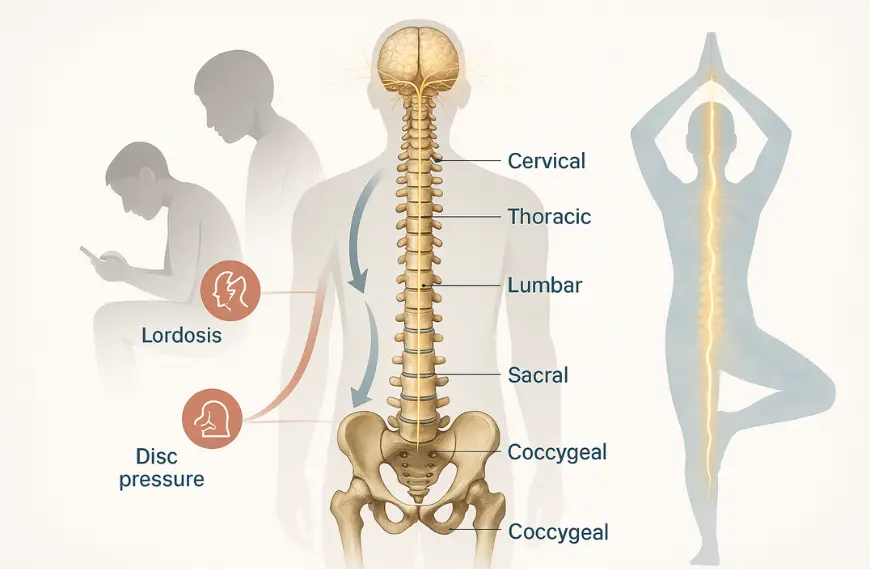
Your spine is both your backbone and your lifeline. It allows you to stand tall, bend low, and twist with agility – but it’s also vulnerable to the modern world’s stresses.
Anatomy of the Spine
The adult human spine has 33 vertebrae:
- 7 cervical (neck)
- 12 thoracic (mid-back)
- 5 lumbar (lower back)
- 5 fused sacral and 4 fused coccygeal forming the tailbone.
Between vertebrae, intervertebral discs act as shock absorbers. Ligaments and muscles stabilize the spine, while the spinal cord runs through the central canal, connecting brain and body.
Curves That Balance
The spine’s S-shaped curves distribute weight efficiently:
- Cervical and lumbar curves bend inward (lordosis)
- Thoracic and sacral curves bend outward (kyphosis)
These curves let us walk upright without tipping forward or backward.
Evolution of Upright Posture
Our spine evolved from a horizontal quadruped design to a vertical column. Bipedalism freed hands for tools but made the lumbar region prone to stress, explaining why lower back pain is humanity’s most common musculoskeletal complaint.
Posture: The Foundation of Health
Poor posture from slouching, hunching over devices, or sitting too long strains discs and ligaments. “Tech neck,” where the head juts forward, can add 20-30 kg of force to the cervical spine.
Simple habits – ergonomic chairs, standing breaks, core strengthening – can prevent pain and improve posture.
Movement and Flexibility
The spine provides remarkable flexibility, with joints allowing bending, twisting, and arching. Yoga, tai chi, and Pilates emphasize spinal mobility, which can relieve stiffness and maintain disc hydration.
Spinal Injuries and Advances
Spinal cord injuries can cause paralysis below the damage point. Yet breakthroughs like exoskeletons, stem cell therapies, and electrical stimulation offer new hope for restoring movement.
Herniated discs, scoliosis, and spinal stenosis are common spine issues. Early intervention with physiotherapy or minimally invasive surgery often preserves function.
Cultural Symbolism
The spine symbolizes courage (“having backbone”) and moral strength. In yoga, the spine is the central channel for energy (sushumna nadi), through which kundalini energy rises.
The Spine as Life’s Axis
From posture to mobility to nerve function, your spine is your pillar. Caring for it is essential to standing tall – in body and spirit.
